Mission: Impossible — Rogue Nation is the fifth film in the nearly 20-year-old franchise, once again starring Tom Cruise as Ethan Hunt, as well as a host of old and new characters.
One of the interesting qualities of this franchise is the frequent remix of creativity. Each Mission: Impossible has had a different director. Many of them, like Brad Bird and J.J. Abrams, have managed to breathe life in the aging franchise, while others…John Woo…have made it gasp for air.
So I was pleasantly excited to hear that Christopher McQuarrie — known for Usual Suspects, Valkyrie, and last year’s Edge of Tomorrow — would be bringing his signature style to “Rogue Nation” as both writer and director. And as you can imagine, the results are excellent.
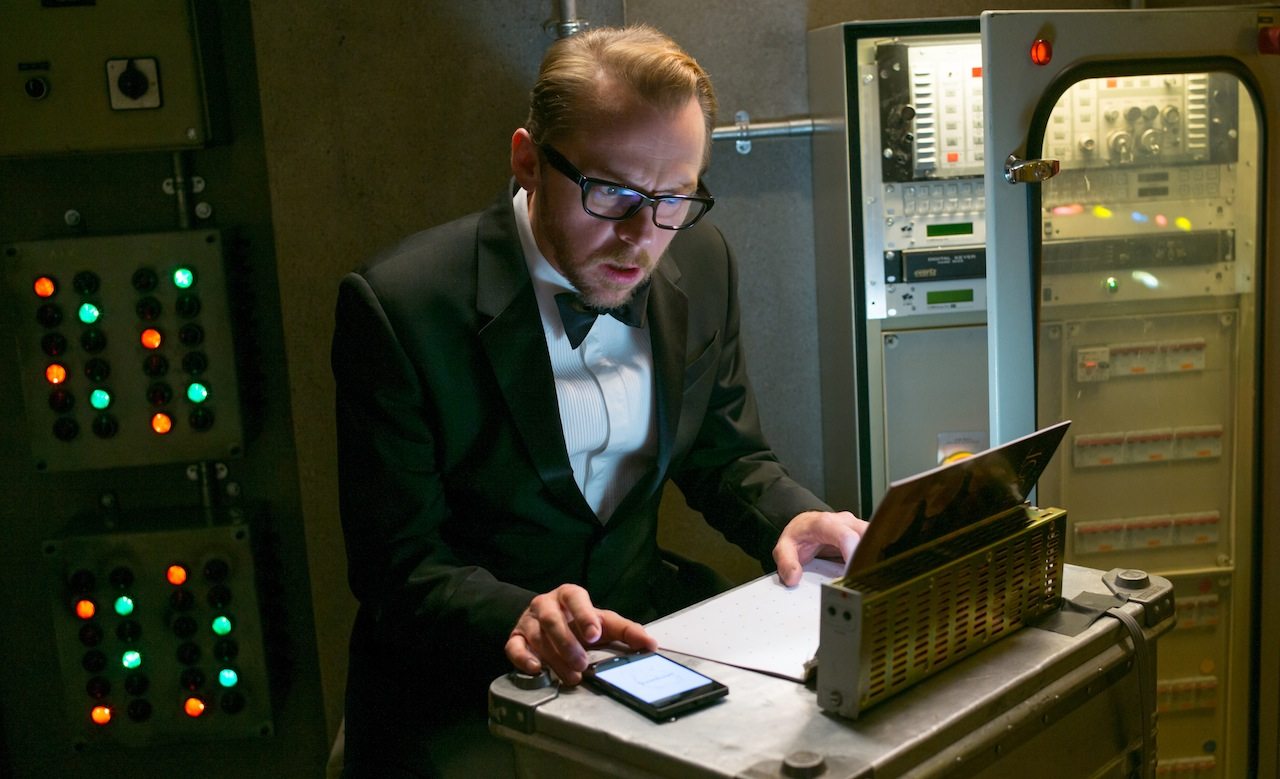
The basic set up of the film is pretty basic. The IMF (Impossible Mission Force) has been disbanded, and Ethan is now a fugitive hunted by the CIA. He has to gather old allies to combat a shadow organization that the CIA doesn’t believe exists called “The Syndicate,” aptly nicknamed the “Anti-IMF” by Simon Pegg’s character, Benji.
The Syndicate is composed of former government agents from around the world, sort of like a “dark” G.I. Joe, making them a pretty formidable foe for Ethan and his team. They’re not as chilling as Phillip Seymour Hoffman (the franchise’s best villain so far), but the plot is certainly fresher than Ghost Protocol and the second Mission: Impossible.
As always, Tom Cruise does many of the death-defying stunts we’ve come to expect in these films, adding to the tension of actually seeing him hang off of an airplane lifting off a runway. Every set piece in this movie graciously feels like a thrill ride that’s hard to get out of your head. You can tell that McQuarrie wanted to recapture some of the thriller aspects of the first Mission: Impossible, while making sure the action was nonstop as it’s been since M:I3. And it works to great effect.
You’ll probably love the characters, especially newcomer Rebecca Ferguson, who plays a femme fatale who seems to be having the most fun with her role. She’s electric on the screen and a welcome addition to the franchise. Alec Baldwin plays a CIA…manager or something…and has a forgettable role in my opinion, though the few scenes he’s in are pretty fun and break up the action.
Overall, this is an entertaining movie with great action and likable characters. I enjoyed it far more than this year’s Fast and Furious installment, a similar franchise that’s not ready to quit. Unlike that movie, “Rogue Nation” had me on the edge of the seat and smiling like a teenager all throughout.
Grade: B+
The villains aren’t particularly interesting and the smart plot is undercut by predictability, but the superb action scenes and great performances make this a standout in this year’s best action films.
Extra Credits
Simon Pegg and Ving Rhames are back and better than ever. I highly doubt the franchise would still be this good without them. I was less impressed with Renner, but he did have a running joke that had the whole theater laughing at one point.
I can neither confirm or deny that this movie is good. OK, I can.
They actually make fun of Tom Cruise’s height in this movie. Seriously.
The plane is hyped up in the trailers, but it’s not even the best scene. This was a great choice.
Hunt is the living manifestation of destiny!
Rogue Nationwas directed and written by Christopher McQuarrie. It stars Tom Cruise as Ethan Hunt, Jeremy Renner as William Brandt, Simon Pegg as Benji Dunn, Rebecca Ferguson as Ilsa Faust, Ving Rhames as Luther Stickell, Sean Harris as Solomon Lane, and Alec Baldwin as Alan Huntley.
I’m Jon and thanks for reading this. You can subscribe to my posts by clicking “Follow” in the right sidebar. Or just say hey on Twitter! @JonNegroni
[UPDATE: Well, it’s happened people. A Hey Arnold movie has officially been greenlit.]
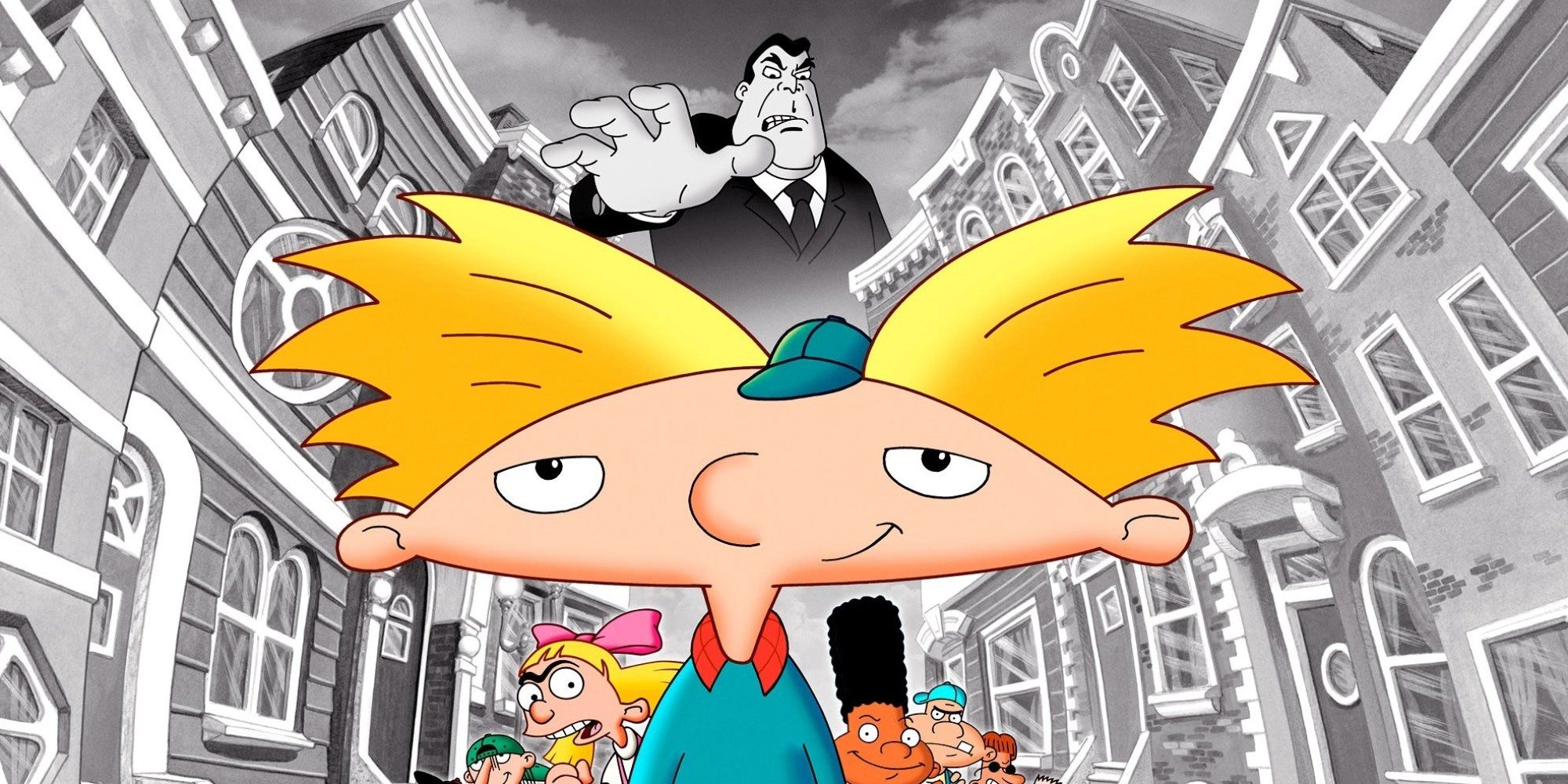
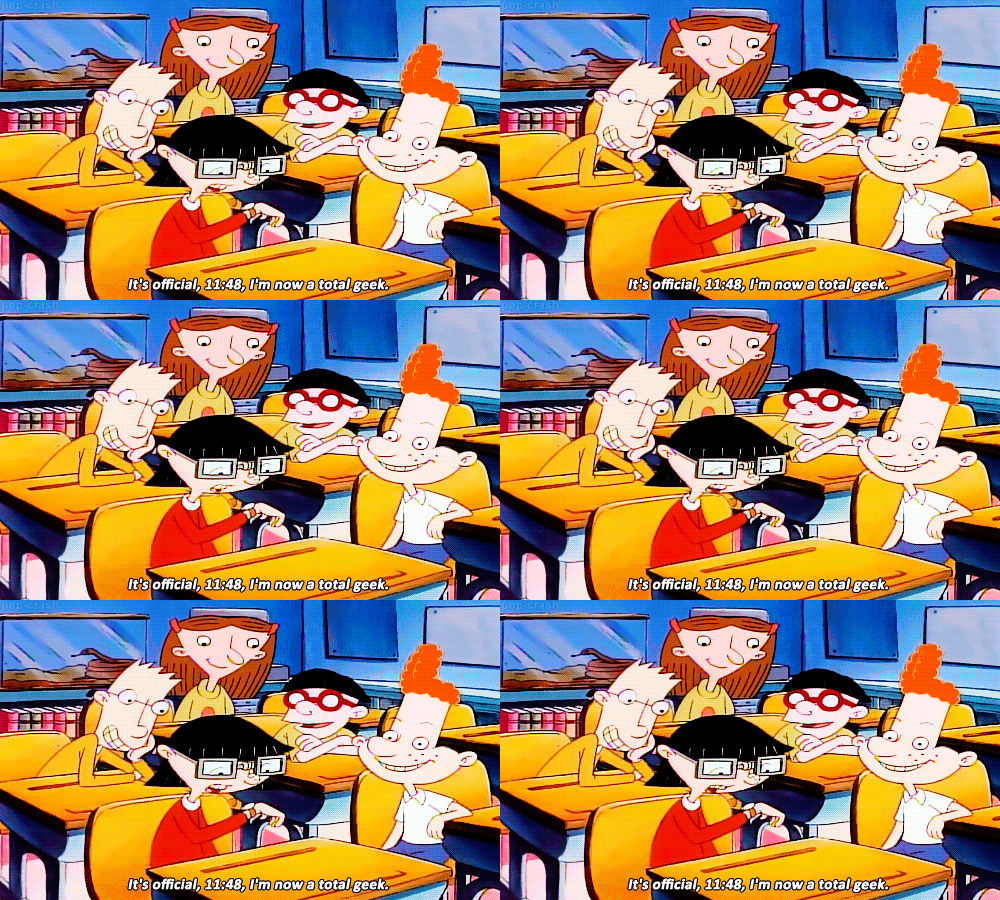
It’s been almost 19 years since the first episode of Hey Arnold premiered on Nickelodeon, and it’s been 11 since the series ended. That’s a lot of time, and yet many people still remember and love this show. There are a lot of reasons for that.
Hey Arnold was created by Craig Bartlett, who wrote Rugrats and married the sister of the guy who created The Simpsons. He even voiced some of the characters. And in many ways, Hey Arnold was and remains unlike any other cartoon on television.
Itwas about a fourth-grader named Arnold growing up in a fictional (and unnamed within the show, though it’s later called Hillwood) with his friends. The city was a mashup of familiar locations like Seattle, Chicago and New York, but it built its own identity as a believable location without ever needing a label (much like how Arnold himself never needed a last name).
Arnold lived with his grandparents in a grungy boarding house with a couple that fought all the time, an international spy, a hotheaded construction worker, a Vietnam refugee (that Christmas episode, though), and many others. The show put effort into exploring all of these relationships, as well as the lives of Arnold’s close friends at school.
These school kids were such well-developed and interesting characters that the show routinely featured them in their own episodes, some without any hint of Arnold himself. Characters like Harold, Eugene, Sid, Gerald, and even Stinky all had well-written episodes devoted to them. It’s hard to think of any other show on any network that his such a big catalogue of characters with rich backstories.
But much of the show’s success and impact is due to how comfortable the show was with exploring the lives of the girls at this school, not just the boys. Rhonda, Phoebe, and of course, Helga, all had many episodes of their own, despite Hey Arnold being originally conceived as a show for young boys.
For this reason, everyone had a reason to like Hey Arnold. If you didn’t really care for Eugene’s accident prone problems, you could always wait for the next episode about Rhonda learning humility and having to wear glasses. Or watch Arnold befriend a man who can fly with pigeons in one of the most surreal, yet metaphysically enthralling, episodes it ever made.
Hey Arnold is, without a doubt, a unique show that deserves all of the nostalgic praise it gets. But how did it end?
The show was famous for raising lots of questions without ever paying off the answers. While some mysteries, like Arnold’s last name, were never revealed, other curious story arcs developed slowly over time, like the origin of Arnold’s parents and whether or not Helga would ever tell Arnold how she feels.
Or if Brainy ever got his head checked out for internal bleeding.
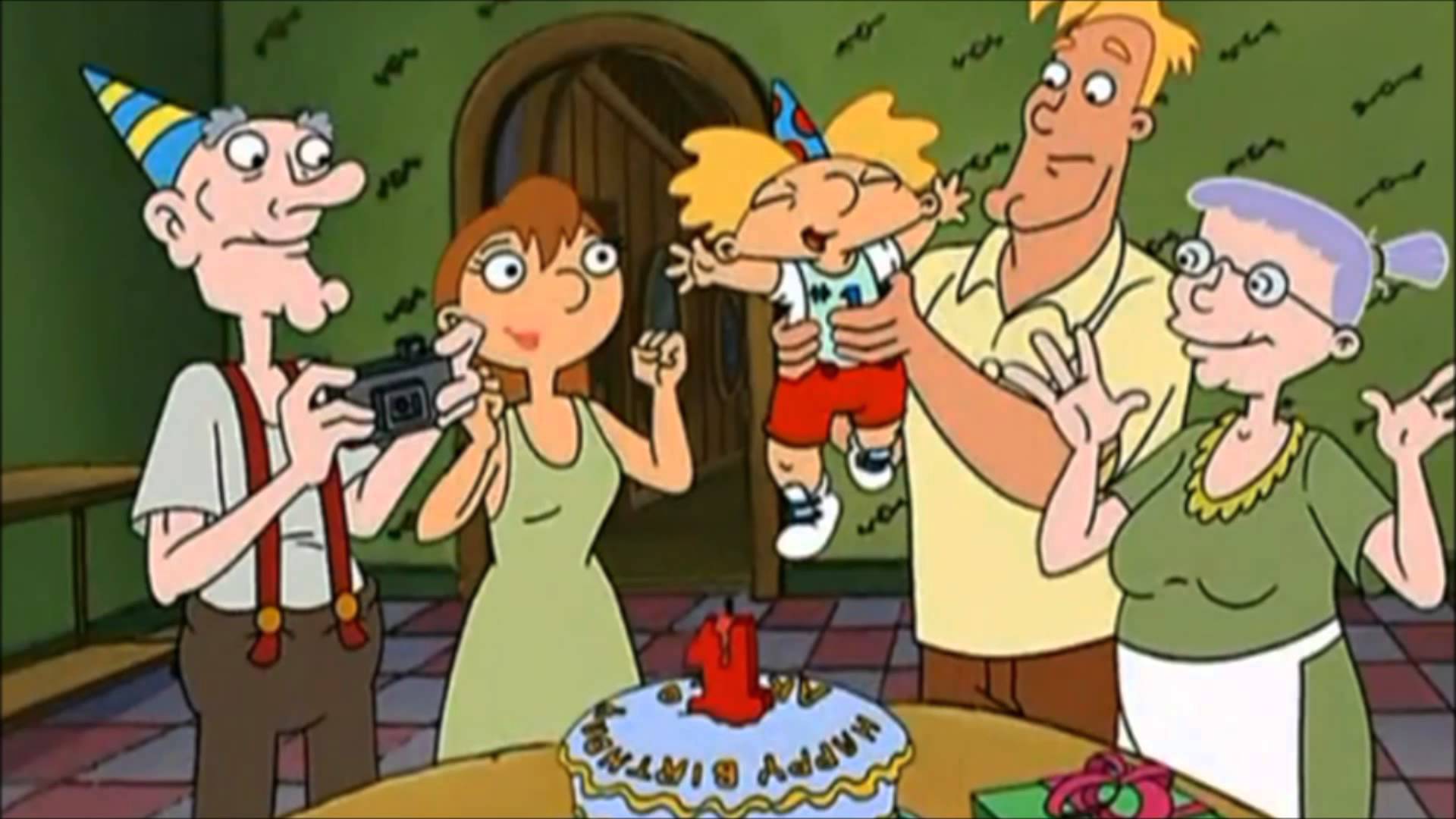
It wasn’t until years into the series that the episode, “Parents Day” finally gave viewers an answer to where Arnold came from and what happened to his parents, Miles and Stella. We found out that they were wilderness explorers who traveled the world like Indiana Jones and Lara Croft (Stella even wore a shirt right out of Tomb Raider).
But some time after Arnold was born, they vanished during an expedition to San Lorenzo, leaving their baby in the hands of his grandparents.
Years later, the series offered even more insight into what specifically happened to Arnold’s parents in the last episode that was ever produced (though more episodes were later released that happen before “The Journal”).
Arnold found his father’s journal, which revealed a lot about his parents’ adventures. He learned that they journeyed back to San Lorenzo (where Arnold was born to help a mysterious tribe known as the “Green Eyed People,” whom they had befriended years earlier. Stella was a doctor, and the Green Eyed People had been stricken by a disease. Since Stella and Miles were the only people they trusted, the parents had to leave Arnold and go save them.
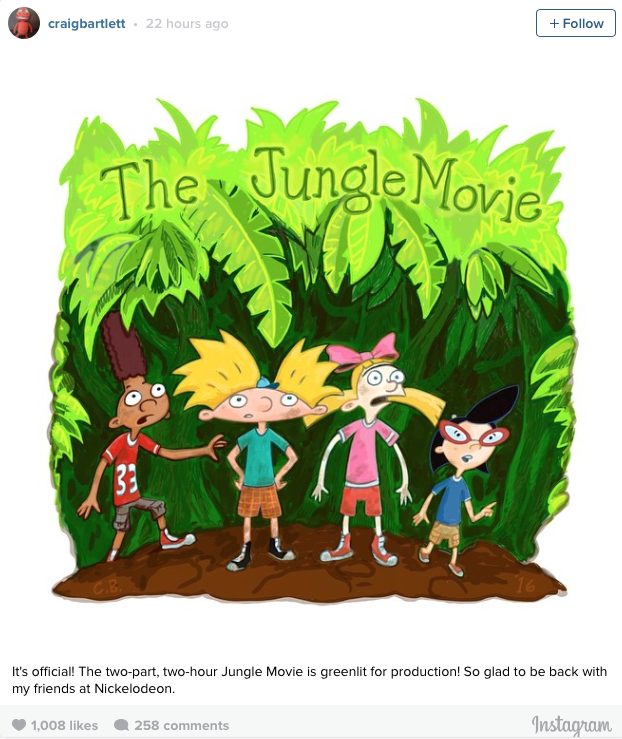
They never returned, of course, but Arnold found a map in the back of the journal. The series actually ended with Arnold telling this to his grandparents, implying that the story was not over. Nickelodeon was going to produce amovie called Hey Arnold!: The Jungle Movie to finish the series, but they ended up making Hey Arnold!: The Movie instead, which was based on the planned TV special, Arnold Saves the Neighborhood.
The movie made a lot of money, but fans weren’t very pleased.
Concept art for “Hey Arnold!: Jungle Movie”
Nickelodeon was planning on making another theatrical release for “Jungle Movie” despite the unsuccessful first attempt, which is why they produced “The Journal” to set it up. But disagreements between Bartlett and Nickelodeon caused the complete end of the series, including the movie.
Basically, Nickelodeon demanded that Bartlett only create shows for their network, but he refused because he was working on a series for Cartoon Network.
As a result, Hey Arnold and its finale movie were cancelled.
OK, fine, here it is.
For the longest time, I thought this was a sign of a theory I had about Arnold and his grandparents. Basically, I just assumed that none of these things about Arnold’s parents were true because they were so fantastical. They reminded me of the dream sequences Arnold would have in the first season, which positioned him as a more imaginative kid.
So when “The Journal” came out, I started to think that Arnold’s grandparents had planted that journal and even the photos. And I believed that they invented the story to make Arnold feel better about his parents abandoning him or passing away tragically.
But this theory is false. Bartlett was clearly working on a movie that debunks that, as we have ample concept art and plot lines that have been leaked over the years. There was no “hidden story” here for us to bother discussing.
Over the years, fans have clamored for Bartlett and Nickelodeon to revive the movie and finish the series strong. Despite rumors since 2012 that this could happen, no one has said anything official, which means it will likely never happen, and that’s not surprising.
In Nickelodeon’s defense, they’d be spending a lot of money to do a movie that most of its current audience wouldn’t have any previous knowledge of. At this point, only millennials like me remember this show, and many of us are too old to spend money on a Hey Arnold movie (besides me and probably anyone reading this).
We’ll probably never know what happened to Arnold’s parents, but there is one other massive plot thread that did get confirmed, and it’s sort of depressing. Unfortunately, Helga and Arnold never end up together.
Remember All Grown Up? The Rugrats spinoff that aged the characters and followed their lives as preteens and basically ruined Nickelodeon’s flagship series after two surprisingly decent seasons?
Well, the same thing was planned for Hey Arnold, but without Arnold. It was centered around Helga as a teenager at age 15, and it was simply called The Patakis. A fun surprise is that the show was deemed too dark for Nickelodeon, so it was planned to debut on MTV. Sadly, it never got off the ground.
Fans aren’t ready to give up quite yet.
The kicker is that in this spinoff, Helga has somewhat moved on from Arnold. For unexplained reasons, Arnold moves away from the city (maybe to live with his parents in San Lorenzo), so The Patakis would have focused only on Helga and some of the other characters from P.S. 118.
We don’t know much about the show, but Bartlett and other sources have given us small peeks at what could have been. Helga and Arnold apparently dated for a while, but they broke up. She’s still crazy about him when the show starts, and she writes him letters every night that she’s too scared to actually send. Her new “Arnold shrine” is now a binder with all of these letters.
Seriously, imagine how seriously interesting it would have been to watch an older Helga move on from Arnold and find something else in her life to hold onto, besides the unrequited love of a kid who showed her love at the lowest point in her life. It would have done wonders for this character.
This “updated” Helga wants to write books and still has that grumpy edge to her. She still has the unibrow (thankfully) and even the classic pink bow under her cap. The pilot is about how Olga has become the black sheep of the family in pursuit of an acting career. Her father, Big Bob, is selling cell phones now instead of beepers, and Miriam is in AA (apparently our suspicions were correct in assuming there was another ingredient in those “smoothies”).
Other Hey Arnold characters were planned to be in the show, including Gerald and Phoebe as a stable couple, Sid, Stinky, and even Brainy.
Assuming he survived this long.
Like Legend of Korra, this series could have been a fresh start built from the legacy of a previous series. In fact, I could still see the series happening since it wouldn’t necessarily have to rely on fans of the original show to fuel it. Just look at how other nostalgic favorites like Boy Meets World and Full House are being revived on Disney and Netflix.
So perhaps one day we will get the answers Bartlett has been keeping from us likely for the sake of his own sanity. In a world where Kickstarter and social media campaigns dictate the next craze derived from our unwillingness to let go of our respective childhoods, The Patakis is more than a safe bet.
After all, if Generation X gets to see Transformers turn into four incredibly mediocre movies, then why can’t we get just a season of our favorite football head? Or at least his girlfriend.
I’m Jon and thanks for reading this. You can subscribe to my posts by clicking “Follow” in the right sidebar. Or just say hey on Twitter! @JonNegroni
Paper Towns is the latest book-to-movie adaptation from author John Green, who also wrote last summer’s book movie, The Fault In Our Stars. I’ve read Paper Towns and have now seen the movie.
It’s strange. I’ll say that in most ways, the movie does the book justice. It captures the coming-of-age tale that made the 2008 book so relevant and relatable for the YA audience that read it. My favorite moments from the book make it to the screen, thankfully, and you can tell that Green had some input in the bigger story changes.
For the most part, however, Paper Towns is a mixed bag.
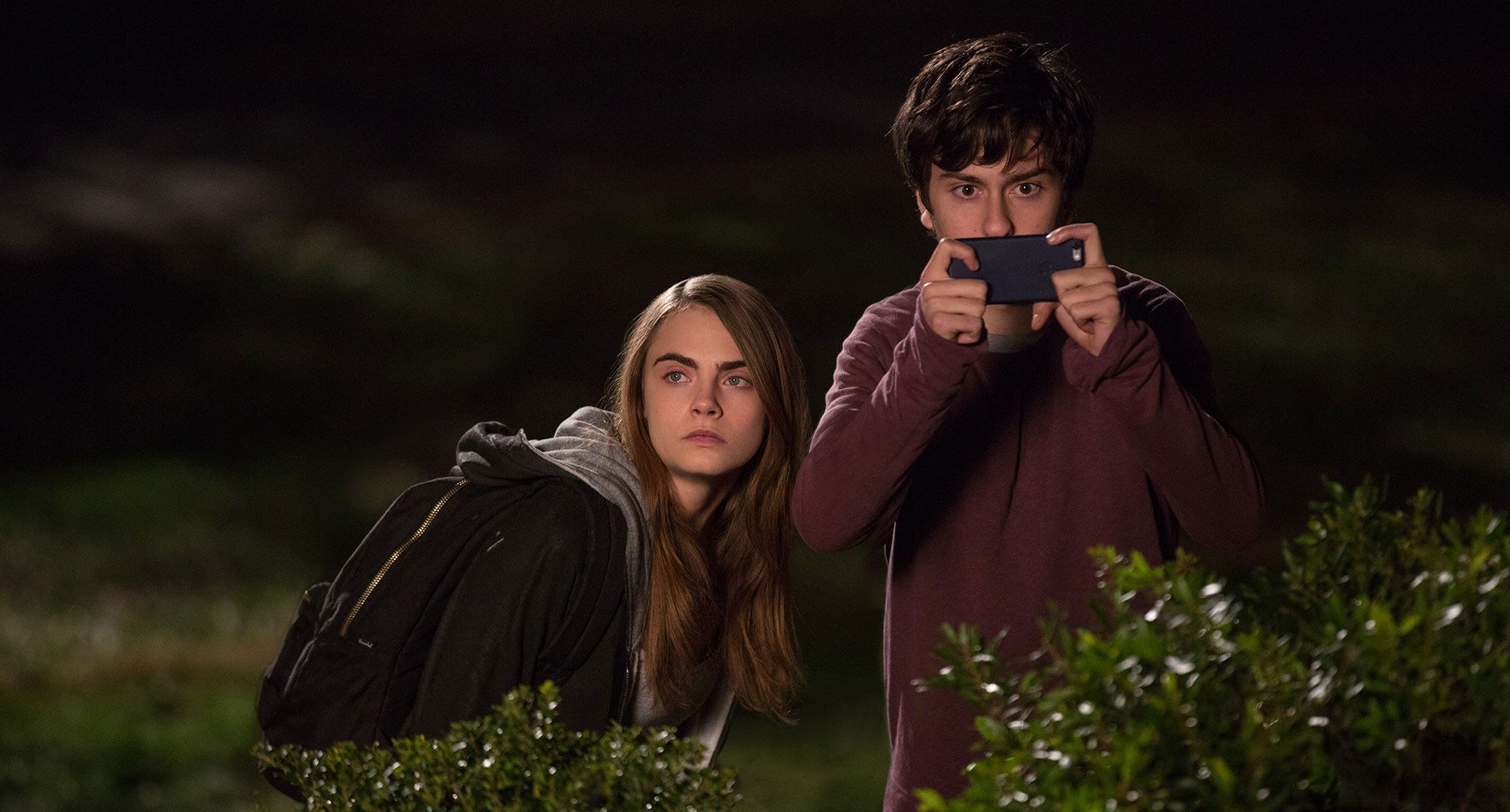
The story is about a high school senior, Quentin, who is hopelessly in love with Margo Roth Spiegelman, the girl next door he’s drifted apart from since they were kids. After years of ignoring him, she arrives at his window one night out of nowhere and takes him on a fun, unforgettable adventure. Only to disappear the next day. The rest of the movie focuses on Quentin’s burning desire to find her based on the clues she left behind.
If this was the only thrust of the movie, I’d give it a low grade. As a character, Quentin isn’t really that interesting, despite the efforts of Nat Wolff, an actor I certainly like. And Margo, played by Cara Delevingne, is mostly absent during the movie for obvious reasons. I hate to say it, but even when she was onscreen, I didn’t fall for her the way I did for the Margo in the books.
This is mostly because the Margo in the books is a flawed, depressed character who doesn’t have to say she is “mysterious.” The Margo of this film is a little too “manic pixie dream girl,” despite the novel actually being about the deconstruction of that trope. It’s too early to tell if Cara Delevingne is as good an actress as Hollywood wants us to think (especially with Suicide Squad releasing next year), but I wasn’t impressed with her performance here, honestly, as she was just a little — again, I hate to say this — boring.
That said, the film is saved by Quentin’s group of friends, who are also the best aspects of the book. You’ll probably enjoy watching their stories and seeing how things turn out for them independent of the film’s main plot. In fact, my favorite parts of this movie were when the script veered away from the Margo mystery.
The ending isn’t as good or original, but I think fresh eyes would disagree. Even with its flaws, Paper Towns is a fun teen flick that might actually make you think. Just be sure to pick up the book if you want a story that’s a little more energetic and compelling.
Grade: C+
I liked most of the performances in this movie, and John Green’s original material is salvaged enough for you to enjoy its quirky characters and memorable moments.
Paper Towns was directed by Jake Schreier and written by Scott Neustadter and Michael H. Weber. It stars Nat Wolff as Quentin, Cara Delevingne as Margo, Austin Abrams as Ben, Justice Smith as Radar, Halston Sage as Lacey, and Jaz Sinclair as Angela.
Trainwreck could just as easily be titled, “The Amy Schumer Movie.” It encompasses the comedy, writing, and tone of her projects in a way that not even Judd Apatow (Knocked Up, Funny People) could overshadow. I doubt I would have guessed Apatow was even a part of this film if I had not known that going in.
For these reasons and many others, I found it impossible to like Trainwreck. This is because I found it impossible to like Amy Schumer in this. Her character, aptly named Amy, is one of the most unlikable characters I’ve seen on a screen all year. Right up there with Jupiter Jones and “Oh” the alien.
Before we dive in and discuss the movie, keep in mind that I also didn’t like Spy, the other summer comedy that everyone else seems to believe is a laugh riot. I don’t look down on anyone who likes a comedy that I didn’t enjoy, but I also don’t hold back from announcing the huge problems I have with these movies, so you’ve been warned.
Trainwreck stars Amy Schumer as Amy, a free-spirited magazine writer who finds romantic commitment boring to the point of mocking it. She sleeps around without remorse until falling for the subject of an article she’s writing. Aaron Conners (played by Bill Hader) is a sports doctor that tries to woo Amy and hopefully help change her life for the better.
It was directed by Judd Apatow and written by Amy Schumer. As Apatow puts it, Trainwreck is based on a smattering of personal stories she shared with him, and the director liked them enough to turn Amy’s story into a movie.
That’s sort of the problem with Trainwreck. The film is essentially a series of raunchy comedy sketches that mostly feature Amy Schumer reacting negatively to things that we find normal, expect inserting gross-out gags to make them seem out-of-place.
Again, comedy sketches.
To make them all connect, the film has to drag its plot points in admittedly familiar Apatow style to keep things coherent. And even then, multitudes of dialogue and character choices end up making zero sense within the context of the story Amy is trying to tell with this script.
A prime example is Amy’s reaction to Aaron’s advances early in the film. She and her coworker best friend panic at the idea of a guy asking to hang out after having sex. This flies in the face of the first 15 minutes of the movie, which show Amy with a consistent boyfriend she cheats on (John Cena in a role that is just as confusing as the rest of the movie. The script can’t decide if he’s a softy who truly loves Amy or a closeted gay man).
The killing blow to a comedy is when its protagonist is unlikable. If you can’t get onboard with Amy Schumer’s character, then you’re going to feel the length of this movie.
The only funny moments I could salvage were from scenes featuring Bill Hader and Lebron James alone together (the gag involving “Gold Digger” is the only funny moment I can recall from this movie). But even these scenes ended up dragging because they revolved around a central plot I wasn’t invested in.
Now, many people seem to like Trainwreck, which leads me to believe that many people like Amy Schumer’s character in this movie. I find that pretty alarming considering everything about her that’s revealed over the course of two hours. In the first act alone, we see Amy as this condescending, self-centered drag who thinks everyone around her is less intelligent. Or cool, I suppose.
A movie can present its main character as a “train wreck.” It’s not Amy’s self-destructive behavior and constant partying that keeps me from sympathizing with her.
It’s actually how she claims to have a black best friend who is really a waiter in the background of a photo…
how she endlessly picks on her sister’s stepson for not being “cool…”
how she makes her sister feel guilty for settling down in every scene they’re in…
how she goes on a rant about how people who like sports are stupid (which repeats throughout the movie only for Aaron to finally call her out on this)…
how she writes these scenes to make her one-night stands exaggerated versions of morons in order to make us think that she’s this special flower but also a train wreck at the same time…
and how she essentially makes zero decisions for herself despite presenting herself as this woman who is happy with her choices…until she’s not.
Amy just goes along with dating Aaron, despite protesting it relentlessly. She keeps dating him, even though her inner monologue tells us she doesn’t really want to. She falls in love with him, even though her inner monologue says she expects the relationship to fail anyway.
Why in the world should I care about a character who doesn’t even seem to want to be in the story that’s being told? That’s not comedy. That’s drama.
I blame poor writing for these problems, because even though I wanted to laugh and have a good time, I found myself feeling depressed just by watching this. Amy Schumer has good comedic timing, and the supporting cast is great. But when your central premise is a tribute to nihilism disguised as a generic romantic comedy, then people who don’t want either of these things (namely, me) won’t enjoy it.
But Trainwreck has been a critical success and a hit among audiences, probably because the generic romantic comedy elements are enough for casual moviegoers to have a good time with this film. Even if the movie isn’t especially profitable, it will and probably already has cemented Amy Schumer as the next comedic powerhouse. Maybe even in the same way people saw Sarah Silverman during the 2000s.
And while I don’t want to write off Schumer as a talent after just one movie, I can’t help but predict that I’ll be skipping the next comedy grab she’s part of. Especially if she wrote it.
Grade: D+
While I somewhat enjoyed the performances from Bill Hader, Lebron James, and Brie Larson, I honestly couldn’t forgive this movie for its consistent narrative flaws and hackneyed premise fueled by its absurd lead actor.
For those of you who’ve seen the movie and agree/disagree, let me know your thoughts about Trainwreck in the comments. Did you like it or did you dislike it? Why?
If you want a different take on the film, check out our most recent podcast, where Maria Garcia gives a more favorable review that you might find interesting.
Part of the Marvel storytelling rulebook is to take a certain character and spin their weaknesses into massive strengths. Their powers are always paradoxes of who they are, from Iron Man’s sarcasm/mad genius angle to Thor’s power/humility character arc.
So if you like how Marvel has crafted these iconic characters so far, then you’ll probably enjoy Ant-Man, which does more or less the same thing with new faces and situations.
Paul Rudd plays Scott Lang, a master thief who wants to do right by his daughter (oh, but who doesn’t want that?) He teams up with brilliant scientist Hank Pym (ideally cast as Michael Douglas) and his estranged daughter, Hope (also a well-cast Evangeline Lilly) in order to stop a powerful technology from being sold as a weapon. He’s armed with a suit that lets him shrink in scale, but increase in strength, and he must rely on training from Hank and Hope in order to hone his new skills.
Like Guardians of the Galaxy, this film relies a lot on its self-awareness and wit to balance its silly premise. Edgar Wright (who once helmed the project before getting replaced by Peyton Reed) has his fingerprints all over this film, and thankfully so. Ant-Man’s quick edits and impatience with slow moments makes it a fun, breezy film with a lot of great action.
But the true star of the film is Michael Peña, whose hysterical performance makes you yearn for him in every scene he misses.
Grade: B+
While it’s not the best superhero film (or Marvel film) you’ll ever see, it’s definitely a sign of good things to come.
Extra credits:
Yes, there’s an after-credits scene, as well as something during the credits. Thanks to Age of Ultron, we actually have to point that out now.
Other critics are liking this movie. It currently has a 76% on Rottentomatoes and “Generally Favorable” reviews from Metacritic.
No spoilers if you know all of the hidden easter eggs teasing the Marvel Cinematic Universe. We’ll hit some of that on this week’s podcast, Now Conspiring.
I’m already a Paul Rudd fan, and this will go down as one of my favorite performances from him. It’s not his best, but it’s absolutely a good time.
Ant-Man stars Paul Rudd as Scott Lang, Michael Douglas as Hank Pym, Evangeline Lilly as Hope van Dyne, and Corey Stoll as Darren Cross. It was directed by Peyton Reed and co-written by Edgar Wright, Joe Cornish, Adam McKay, and Paul Rudd.
A lot of people like to “debunk” The Pixar Theory, which is cool. I consider it flattering that people give it that much thought, and I always enjoy hearing differing opinions.
This latest “debunk” however is just too nonsense for me not to address. Let’s hit it.
So the idea is that all of the Pixar movies are connected. Here’s what Stephen Marshal Bove has to say about all of that in his interestingly named article, “The Pixar Theory is Dead.”
Wait, what? Did you at least give it mouth to…
I just broke the Pixar Theory 🙂
First words of the article, and he’s already done it. This man can do anything! Free emoticons for everyone!
With two scenes from one movie, with characters from two films. Toy Story 2 and Bugs Life.
I almost ignored these sentences because they didn’t do normal sentence things. But OK, he’s apparently saying, “I just broke the Pixar Theory SMILING with two scenes from one movie, characters from two films. Oh, and those movies — in case you weren’t planning on bothering to read this — are Toy Story 2 and (A) Bug(‘)s Life.
Not to sound petty, but if you’re going to write about Pixar movies, can you at least get the titles right?
Just like the theory uses throwaway gags to defend the theory I allowed myself to do the same.
You know what you shouldn’t throw away? Commas. But OK, I’m done being petty.
Alright, even though I don’t remember any gags in particular, or what he even means by this at all, I’ll certainly give him the benefit of the doubtful.
In Toy Story 2’s opening Buzz Lightyear falls from space to an alien world to face off against Lord Zed.
Zurg. Get Buzz’s father’s name right (oh, spoilers!)
But when you look at the canyon Buzz flies in it’s actually the same canyon from a Bugs Life.
Two scenes involving rocks and a hill look the same in a theory about a universe that’s connected? No wonder he named the article what he did! Might as well pack it in and shut down the site for good.
Then Bove decides to attach a vimeo that talks about this, completely explaining that this wasn’t actually his discovery.
At the end of Toy Story 2 in the bloopers part of the film, (I wish Pixar still did them) Flick and Heimlich are both seen and talk about how they are excited for ‘a Bugs Life 2’ but Buzz brushes them aside before Heimlich can give Flick the bad news.
Oh no. Don’t tell me he’s about to argue that the bloopers for Pixar movies are now canon—
There is much more evidence to kill the theory, but these are the two that kill it outright, with no if ands or buts.
Wait, what? That’s it? You didn’t even explain how the two things you just presented kill the entire Pixar Theory (not even just an aspect of it). How in any way is this a FINISH HIM moment for you?
But I do have more,
Thank goodness.
if the Monsters from Monster’s Inc / University are from some future Earth, then what happened to them after the Cars destroyed the world after Human’s left it?
The monsters didn’t exist yet. Did you read the theory?
When Wall-e and Eve-A fly / crawl along the world, there is no sign of life except the one plant Wall-E found.
Except the massive field of grass revealed at the very end beyond Axiom. And all of the resolution paintings showcasing the recovery of the environment and some human civilization. And that tree.
Also the human’s have said to have left Earth in Wall-E because they destroyed the planet, making it so no living thing could breathe the air. That may work for the Cars, but what about the Monsters?
Did…did you watch the end of WALL-E?
In Finding Nemo, Mike is seen swimming under the water with a snorkel. So he obviously has to be able to breath unlike the Cars.
…did…did you just use something from the credits of Finding Nemo to make a point about monster anatomy? That’s almost impressive (if this wasn’t preceded by a complete misunderstanding of the Pixar Theory and several Pixar movies in general).
So there is another throw away gag that kills the theory instead of working for it.
Don’t you mean drowns?
Unlike the Witch from Brave having a Pizza Planet truck and a drawling of Sully which sadly does work for it, but again these are all throw away gags to the audience and animators having fun.
Because we all know making movies that are connected to each other “isn’t” fun. It’s the worst! Those poor animators just wanted to have a good time and we ruined it!
But lets look at that Sully drawling and see if it really does work for the theory?
Is he asking our permission? Yes…OK, let’s do that. You brought it up, after all.
The theory states that the witch from Brave is actually Boo from Monster’s Inc, and she discovered how to travel through time with doors like Mike and Sully.
Right, right, this proves you at least read a paragraph of the Pixar Theory.
(Instead of the Monster’s having their own world and jumping from their world to ours like the films says)
Blast.
But why would Boo need to go looking for Sully when Sully went back at the end of Monster’s Inc and was reunited with Boo. She was not much older than she was when she last saw Sully because her voice did not change very much.
It’s implied that this had to be a one time thing. No one expected Sulley to just keep visiting Boo all the way through college. That would be like taking your cowboy doll to…oh, so that’s foreshadowing.
In fact, Inside Out helps to explain the role of monsters post-Monsters Inc. Bing Bong is clearly an imaginary friend that Riley dreamed up after being visited by a monster, but she eventually forgot about him. In the same way, Sulley would stop visiting her and she’d just have those memories. Only Boo actually went to the monster world, and yes, Sulley came back at least one extra time.
So it makes sense to assume that this would traumatize the poor kid enough to wonder where her friend is. It would be like if Bing Bong made it to the Headquarters of Riley’s mind. With Boo, that’s probably the case.
So there you have it, the mighty Pixar Theory is dead and gone.
Oh, just like that, huh? I wish I could will things to just happen without any effort or humility.
But it will still linger like other theory proven wrong, *cough* never landing on Moon *cough* they’ve proven metal and man mad objects are there *cough*
I’m just going to ignore the second part of that because…obviously.
Also, you haven’t proven my theory “wrong.” You’ve barely even written anything.
But I digress, this is just the evidence, if you still believe the theory there is nothing that can be done for you.
At least you digressed.
If it makes the films more enjoyable for you then believe it.
The Merciful Stephen Marshal Bove has spoken. Obey him!
But if you think Pixar is connected then I got some zinger DC/Marvel and Disney theories for yeah.
Bove then goes on to “prove” a bunch of shared universe theories based on easter eggs and throaway gags. Can you believe that? Someone should write an article saying his theories are dead, so then they just will be without question. People will totally read that.
Thanks for reading this. To get updates on my theories, books, and giveaways, join my mailing list.
Scrubs is one of my favorite shows of all time. During college, I watched every season on repeat until I saw every episode at least 100 times. And that was before the days of Netflix.
Even though my Scrubs bingeing is extremely economical now thanks to the advent of streaming, I still revisit those old DVDs on occasion and jump back into the lives of John “J.D.” Dorian and his lifetime friends at Sacred Heart Hospital. I even watch Season 9 when I’m in the right mood.
So you’d think that after all this time, I’d have some sort of mind-blowing fan theory or revelation naturally generated from my obsession, but it’s quite the opposite. The show manages to be pretty airtight on its themes and messages, mostly because we spend most of our time inside J.D.’s head. There’s little left to the imagination.
But there do happen to be longstanding questions that Scrubs has never truly resolved, except they have, actually. There’s the matter of the Janitor, who you may recognize as Mike from ABC’s “The Middle.” He’s an enigma throughout the series, to the point where the writers initially intended for him to be a figment of J.D.’s imagination (they changed their mind by Season 2).
Yeah, he gets married and finds meaning in his life or something. But we never really find out his name. Throughout the series, he’s only referred to as “The Janitor,” and the mystery behind his name becomes a running gag all the way through the Season 8 finale. He finally reveals his name to J.D. as “Glen Matthews” in the finale.
Case closed, right?
WRONG.
Right after he reveals his name, Janitor is referred to as “Tommy” by an orderly. This implies that he was lying to J.D., which isn’t a stretch at all because that’s what the Janitor does. He consistently fabricates stories and facts about his life that are blatantly false and reveal his pathological lying.
So what is the Janitor’s name? Does he have one?
The answer is yes, and it’s depressingly simple, really. In “My Friend the Doctor” (S3E8), J.D. finds out that the Janitor played a character in the real-life movie, The Fugitive (you know, the Harrison Ford movie from the 90s).
This information alone lets us know that the Janitor’s real name must correspond with the actor who played his character in The Fugitive. So his name is Neil Flynn, the actual name of the actor who portrays him.
Case closed, right?
WRONG.
Look, I’m certainly not the first person to pick up on all this. Scrubs fans have been assuming the Janitor is Neil Flynn for over a decade. That’s why Bill Lawrence, the creator of Scrubs, took to Facebook and Twitter to decry those theories and say the following:
What does this mean? How is his name Glen, if his name is Neil in The Fugitive?
One argument is that he lied about his name to the casting director in the movie, so his real name ISN’T Neil Flynn after all. It really is Glen.
Case closed, right?
You serious?
Bill Lawrence want us to believe that the Janitor told J.D. the truth (for once). This is because the episode “My Finale” was meant to be the series finale, so it would make sense for the Janitor to close this chapter with one final moment of honesty.
There’s just one problem. The Janitor reveals one episode later that he never really thought J.D. was leaving. Scrubs was revamped into a semi-spinoff for Season 9 that focused mainly on a med school built for Sacred Heart, and J.D. only showed up for a few episodes.
In the first episode, Turk reveals to J.D. that the Janitor didn’t really think J.D. had left. Of course, Turk has to insist that J.D. is really gone, which causes the Janitor to hand him his mop and leave Sacred Heart…forever. No one there saw or heard from the Janitor again.
If the Janitor thought J.D. was really coming back, then why would he tell the doctor his name? Because of Season 9, I have to conclude that Lawrence lied to us, Janitor-style.
So is his name Neil Flynn? Let’s revisit 2009 for a second. Season 9 of Scrubs got started in December. And another show got started that fall. The pilot episode of The Middle premiered on ABC, starring…Neil Flynn.
What if the whole point of that first scene in Season 9 was to point us to the potential fact that The Middle stars the Janitor, who happens to be Neil Flynn. And that’s why he disappeared from the show altogether, instead of following J.D. to his new job. He revisited his acting career to portray a guy who has everything the Janitor wanted throughout the series: a family in the Midwest.
In the episode, “My Own Worst Enemy,” the Janitor reveals that his obsession with J.D. has prevented him from doing what he really wants to do: start a family. The day after J.D. leaves, the Janitor does too and finally pursues that dream. A year later, he’s on ABC starring as the loving father of a humble family. After all, the Janitor loves to lie. Becoming an actor is the perfect job for someone who likes to make up stories.
Don’t bother trying to tell me that’s not the case, Bill Lawrence.
And hey, if you don’t believe me and think this article is a waste of time, then don’t worry. Here’s a chart showing every girl name Dr. Cox called J.D. categorized by season:
Thanks for reading this. To get updates on my theories, books, and giveaways, join my mailing list.