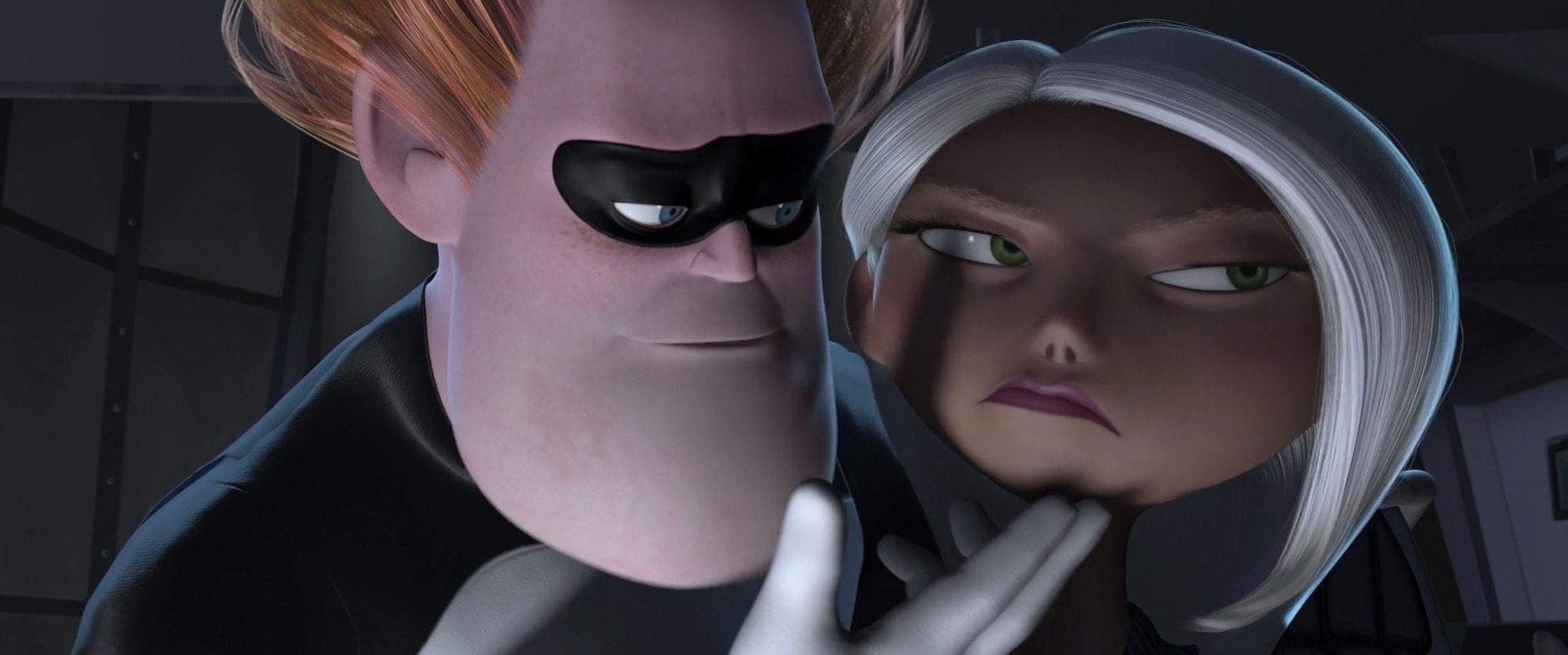
Snarcasm: Syndrome is Mr. Incredible’s Secret Lovechild

incredibles theory

For every Snarcasm piece, I usually feature what I brazenly call “the worst articles on the Internet.”

But this week, I’m doing something a little different.

Samuel James of ScreenPrism wrote his own “Pixar Theory,”  and asked (sort of) to get my opinion on it. I asked him if he wouldn’t mind letting me give his hard work the Snarcasm treatment, and his answer was ambiguous enough for me to just do it anyway.

Sorry, Sam. You let me ask for it.

Writing for the “Insights” column, Samuel asks the question,

Is Syndrome the Illegitimate Son of Mr. Incredible? 

Now, I know what you’re thinking. If a headline on the modern Internet poses a question, then we automatically know the answer is “NO.”

But let’s give Sam a chance to explain what he means by the words, illegitimateson, and Mr.

Since their beginning with Toy Story (1995), Pixar Animation Studios have opened an entire universe of magical films for both adults and children to enjoy.

I’m seriously nitpicking here, but Toy Story does not mark the beginning of Pixar. They started working on animated shorts and commercials nearly a decade before finishing their first feature film.

Jon Negroni has argued convincingly [link] that all 15 Pixar films, from Toy Story in 1995 to the latest Inside Out in 2015, are all connected in the same world, based on interactions on Earth between humans, animals and machines.

Aw, shucks.

The idea changed my perception of the Pixar universe, and I would love to believe Negroni is right.

Sam gets the spirit of The Pixar Theory, which I love. It’s not about this theory being right or wrong. It’s about wanting to believe it’s possible. I’m still going to be mean, though, because this. Is. Snarcasm.

 Now, I have a Pixar theory of my own to share on The Incredibles (2004): what if Syndrome, the film’s eventual antagonist, is actually Bob Parr (Mr. Incredible)’s illegitimate son from a relationship that preceded his marriage to Helen Parr (Elastigirl)?

I guess stranger theories have been made? But I can’t help but notice already that The Incredibles gives us zero insight into what Bob Parr was up to before he fell in love with Helen, so this claim is already making me think this is a stretch…

incredibles theory

Too easy?

I have considered this possibility over ten years and multiple viewings of the film, and, regardless of whether it matches Brad Bird’s intentions, this reading makes sense and the whole film more interesting.

In other words, I’m right, even if it’s obvious I’m wrong.

He has followed my work!

Obviously, Buddy is older than Mr. Incredible’s other children, as the prologue is set 15 years prior to their birth and just before Mr. Incredible’s marrying Elastigirl.

Um…the prologue isn’t set 15 years prior to their birth. That would mean they’re zero years old after the time skip. I mean, I know Dash is short, but…

One more nitpick and I’m done-ish: the prologue isn’t “just before” their wedding, it’s during their wedding. OK, I’m done…ish.

When Mr. Incredible and Buddy (Syndrome’s name as a child)

You mean, his real name?

first meet inside the former’s superhero car, there seems to be a striking resemblance.

Wait, you’re saying they look the same? How?

incredibles theory

Buddy’s ears, nose, mouth, jaw, and eyes don’t resemble Bob’s at all. Their hair isn’t even that similar, just blonde. And they’re white. Is this racist? Er-superist?

Also, Bob is probably between the ages of 25 and 30, since he goes through his mid-life crisis 15 years later. If Buddy was his son, then that means he had the kid between the ages of 10 and 15.

This is all happening too fast.

Buddy naming his unofficial alterego “IncrediBoy” already suggests a role-model connection between the two,

Suggests? Buddy straight up tells Mr. Incredible that he’s his biggest fan. It’s obvious he calls himself “Incrediboy” because he’s longing to be Mr. Incredible’s sidekick. It’s about as subtle as a Donald Trump supporter’s Facebook profile.

but the fact that they look like each other may argue there is a hidden father-son relationship that the narrative has kept as subtext.

The fact?!

It’s not a fact that they look like each other. They barely even look similar. Please don’t tell me this is the crux of your argument, because I need these Snarcasms to be more than 800 words…

As a child, Buddy seems to look up to Mr. Incredible with more intensity than he would if merely a fan.

Well, yeah, this is no secret. Again, he tells Bob that he’s his biggest fan. The intensity is even explained more later on, when Buddy feels left out and wants to rid the world of all supers, not just his alleged “father.”

incredibles theory

Wearing similar attire is just fandom, but Buddy’s angry and devastated reaction to being rejected by Mr. Incredible implies he has higher expectations of the man, and the pair could be father and son.

Sam is essentially saying that you can only have high expectations when it comes to your father.

Forget about teachers, college professors, your personal trainer, and Drake’s future choreographer. If you’re obsessed with being someone else, then that obviously means you’re related to them. That explains why Brad Pitt has so many children…

Wait. Brad Pitt…Brad Bird…It’s all connected.

Brad Bird already wrote and directed a Pixar film in which a young man finds out his true paternity –the Linguini and Gusteau relationship in Ratatouille (2007)—but in The Incredibles, this could be a hidden narrative implication.

Oh! I can do this, too! “WALL-E falls in love with a machine in his movie, so that means the hidden meaning behind Toy Story is that Andy secretly wants Woody to be his boyfriend.”

I feel gross all of a sudden.
incredibles theory

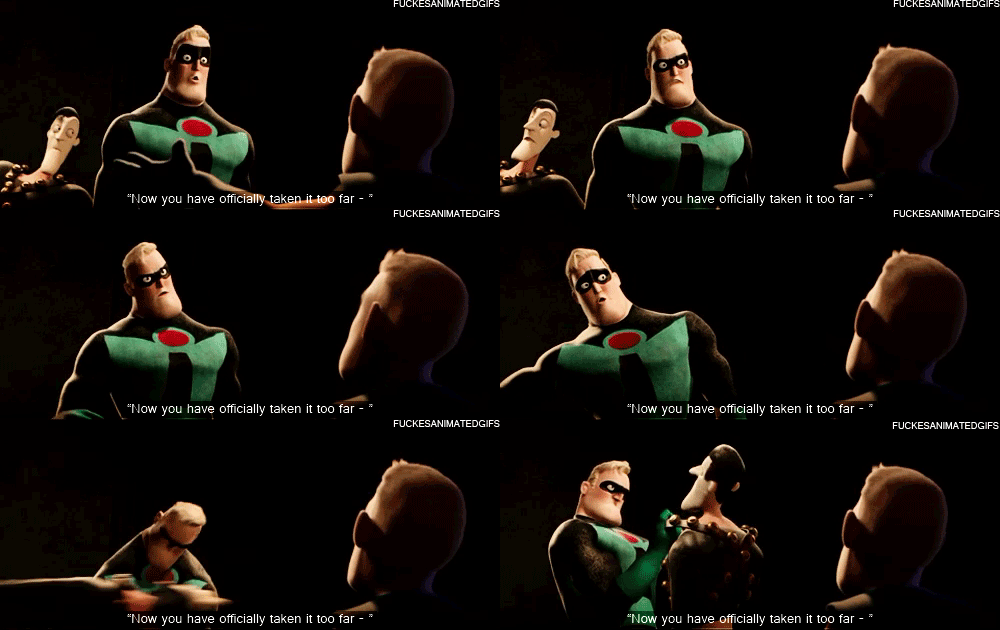
After trying to help him, Mr. Incredible rejects Buddy completely and tells the police officers, “Take this one home and make sure his mom knows what he’s been doing.” It may just be vague language assuming that kids are monitored primarily by their mothers,

Let’s just say you got it right the first time—

 but the fact he just says “mom” instead of “parents” or simply “mom and dad” could imply that Mr. Incredible either knows Buddy is from a single-parent family or knows his mother.

Or it could mean that he wants Buddy’s mom to know what he’s been doing.

This awareness could raise the idea that he once had a relationship with Buddy’s mother

I love it when just knowing who someone is means you had a complicated romance with them that resulted in a lovechild. I get that all the time.

“Hey, I know that girl!”

“Yeah? Well, how many kids do you two have, Brad?”

and perhaps even left her and Buddy behind to be with Elastigirl (which could also be Syndrome’s motive to want to kill her too).

Clearly, because it had nothing to do with Buddy’s determination to kill all supers, which is what he was already doing long before he knew Mr. Incredible and Elastigirl were married (he admits he didn’t know they were together, remember?)

In case you’re wondering what I look like right now:

incredibles theory

Buddy becomes Syndrome and extracts a plot, through Mirage, to gain revenge on Bob. Upon meeting again, Syndrome explains his traumatic childhood (after the rejection) through a brief flashback and attempts to kill him. When the attempt fails, the only adequate way to make Bob suffer, in Syndrome’s mind, is to kill his new family.

Buddy didn’t even know that his family was on that plane, Samuel. He just says, “So you do know these people?” And then he sends the missiles.

He doesn’t find out they’re Bob’s family until way later, and even then, he doesn’t kill them immediately. He just holds them in captivity like any other super villain. How many times did you watch this over the course of ten years?

This could be because Syndrome never got the childhood attention from Bob, as a father and hero, which Dash, Violent and Jack-Jack were getting.

This isn’t apparent at all. There’s no moment when Syndrome looked at the kids and seemed jealous, or wished for what they had. He just wants to see Mr. Incredible lose everything that’s dear to him.

In the climax scene at the Parr home, Syndrome doesn’t really attack or attempt to kill the family. Instead, his intention is to kidnap Jack-Jack, the youngest child. Syndrome’s motive is to rid Bob of his infant child and recreate the paternal loss that he himself experienced from childhood, even at one year old.

You just said that he apparently wants to kill Bob’s family. Which is it, then?

And Bob wouldn’t suffer “paternal loss.” He’d suffer infant loss. That’s not the same thing at all.

And Buddy says he wants to kidnap Jack-Jack to “steal” their future, just like they stole his. They didn’t steal Buddy’s “past,” which is what your theory implies.

Buddy even says mentor when he’s talking about taking Jack-Jack under his wing in a way that Bob never did. If Bob was his father, and Buddy knew this, then wouldn’t he have said father?

And, and, and, ANDDDDDD…
incredibles theory

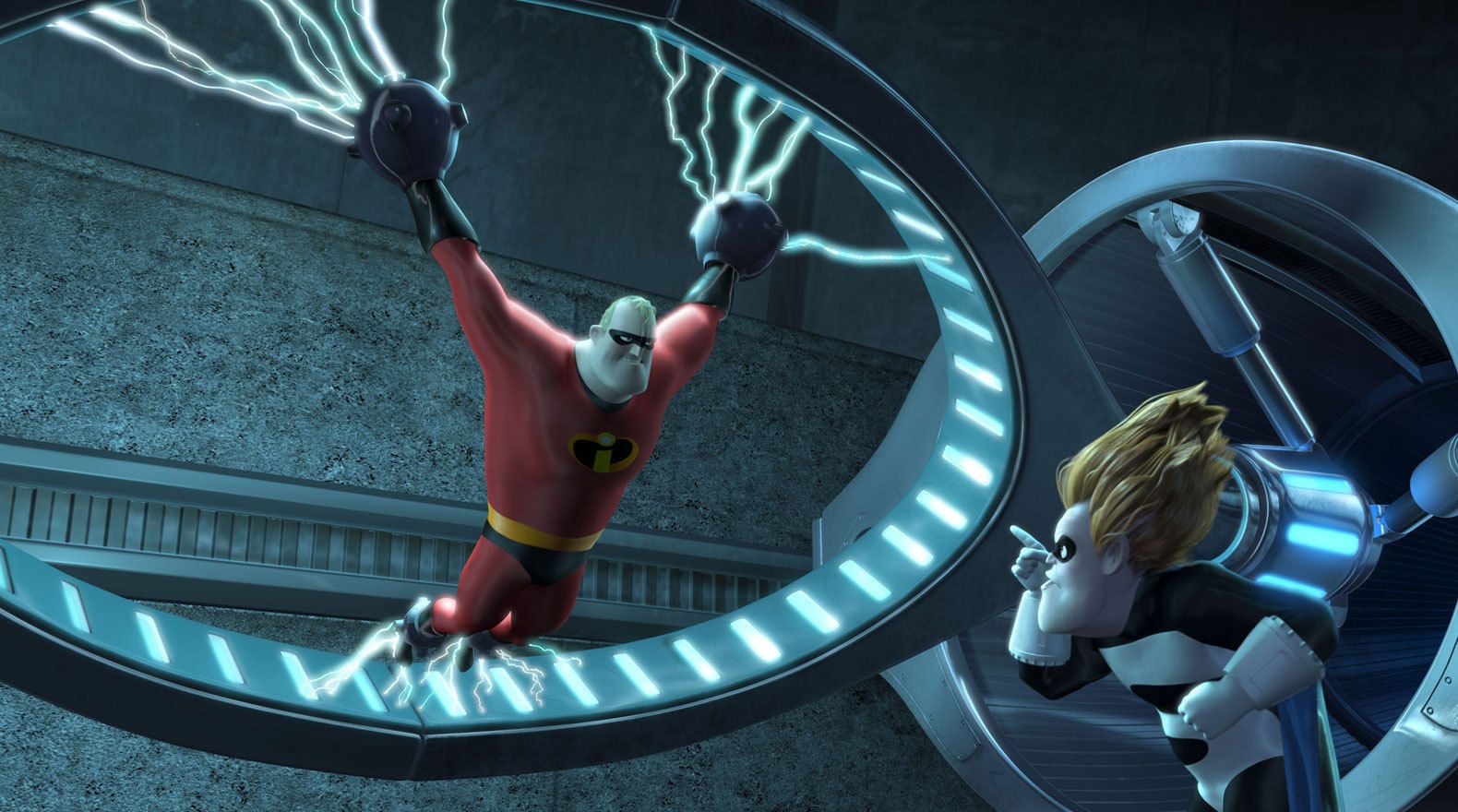
Bob shows no remorse or sadness when Syndrome dies. This could indicate Syndrome in fact wasn’t his son, but the narrative doesn’t address Bob’s response to Syndrome’s death in depth in a particular shot or any dialogue. 

Of course it doesn’t. The guy tried to kill him and steal his kid. Would you show remorse if the guy got what he clearly deserved?

Bob shows relief. The nightmare’s over. His family is finally safe, and the villain has been defeated. No depth necessary.

This whole theory may sound crazy, but it potentially adds more depth to Syndrome/Buddy’s character,

Does it? Being related to someone adds about as much depth as you would see in a soap opera.

When Luke finds out that Darth Vader is his father, the impact is huge for more reasons than a blood test. This is the guy Luke believed killed his father. This is the guy who killed his mentor and blew up the planet of one of his friends. This is the biggest, baddest, guy in the galaxy, and Luke now has to deal with the fact that he’s the son of this man, which means he’s capable of darkness, too.

But in The Incredibles, the friction between Buddy and Bob is readily explained. It already has depth and doesn’t need an arbitrary link to explain itself or become “more sophisticated” as Sam later says. It’s not like anyone left the theater wondering why Buddy was a villain. His backstory, in this case, is quite sufficient.
incredibles theory

Maybe I’m being harsh (OK, I’m being incredibly harsh and terrible), but my point is that if you’re going to suggest that two characters in a movie (or movie universe) are related without much evidence, then at least explain why it would make the movie better. 

In this case, I can see that Sam is really trying to do that, though he definitely comes up short with the argument that true drama is just a matter of who people are sleeping with (what has The CW done to us?)

Now, if Sam can elaborate on that Brad Pitt=Brad Bird theory we stumbled onto earlier, then he certainly has my attention yet again…

Hey! If you’ve come across a silly article that deserves the Snarcasm treatment, send it my way via Twitter or the comments below!

I’m Jon and thanks for reading this. You can subscribe to my posts by clicking “Follow” in the right sidebar. Or just say hey on Twitter! @JonNegroni

Which is Better? The Witcher 3 vs. Fallout 4

fallout 4 witcher 3

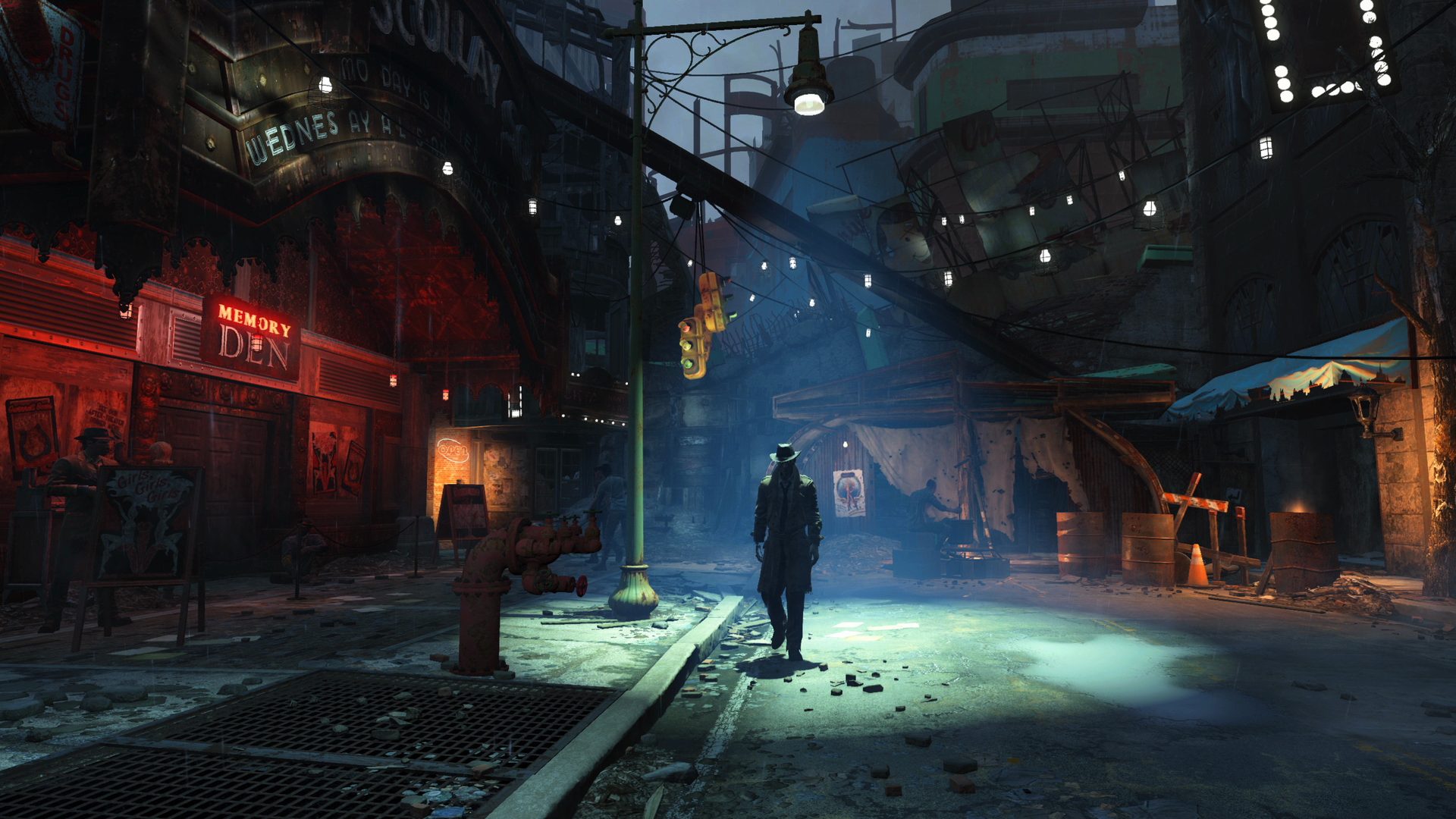
“Which is Better?” is a new editorial series that dares to compare the best of pretty much everything. This week is a battle of the wastelands, as we compare two of the biggest games of 2015.

There were a lot of games I considered for this week’s entry. At one point, I thought it would be fun to do Fallout 3 vs. Fallout 4 or even Skyrim vs. either of those games.

Eventually, I decided it would be more useful to compare two games that have come out recently. And not just any games. Though they may not be the highest-rated video games of the year, there’s little doubt that The Witcher 3 (TW3) and Fallout 4 (F4) are among the most popular and well-received installments of 2015.

F4 in particular has reached a near-Skyrim level of social consciousness outside of niche gaming circles, moreso than TW3. The difference is that TW3 has skyrocketed in both quality and audience this year, thanks to the game being that good. I think you can safely argue that F4 has been more underwhelming in comparison, if only because the games before it have already set mighty expectations that few games in history could probably meet.

These are two very different games, but they’re certainly in the conversation for being the best of 2015. To find out which is better, we’ll have to go beneath the surface and uncover what sets each game apart in terms of story, characters, the overall gaming experience, and more.

Let’s begin with…

BEST ART DESIGN

fallout 4 witcher 3

How a game looks will always be a selling point for gamers. But outside of frame rates and the amount of pixels depicted onscreen, which of these games has the more inspired look?

This includes landscapes, character models, and even costume design. As you read this, you’re probably thinking about every subtle visual you remember from both of these games, and I think I can guess which one you’re thinking of the most.

For me, it’s TW3. Even though I played it months ago (and F4 is more fresh in my mind), I can readily picture the rocky hillsides of Skellige and what the shady individuals are wearing in Novigrad. I remember the sense of awe I got from discovering these locations and exploring every inch of them (and I mean every inch).

When I think of F4, I really just go back to what my character looks like with a Vault 111 suit  underneath a set of combat armor. This isn’t a bad thing, but it certainly sheds light on how different the focus of these two games are.

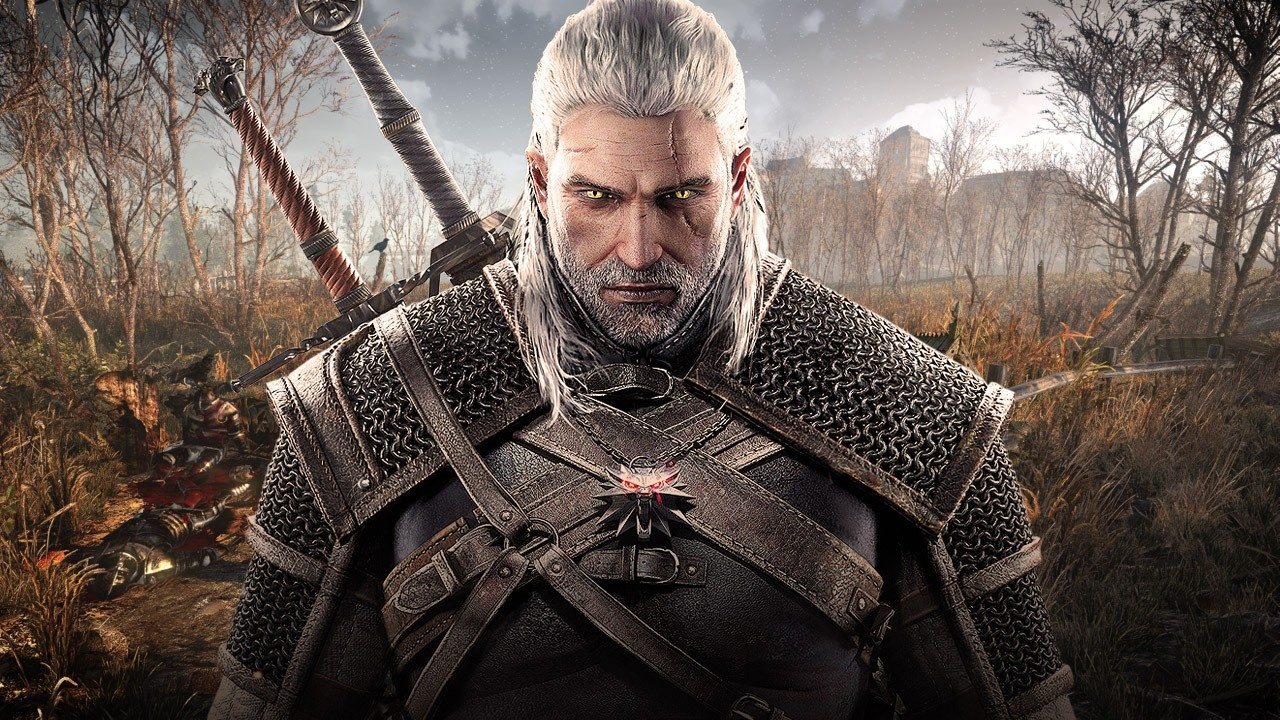
It’s interesting because these two games are somewhat inverse. I can only play as Geralt in TW3, and how I customize his look is pretty limited compared to everything I can do with the Sole Survivor of F4 (down to picking a name). But on the other hand, I influence the plot of TW3 in a huge variety of ways, while F4 really only has a cluster of similar endings that range from me being pure evil to complete righteousness.

I love the Commonwealth of F4, but it’s honestly just a refined version of a wasteland we’ve seen several times already. Though TW3 is also a sequel, it brings The Northern Kingdoms to life in a way that’s a huge step forward for the franchise.

Both games have inspiring art design, but if we’re talking about which one is more novel and memorable, then TW3 is the clear winner.

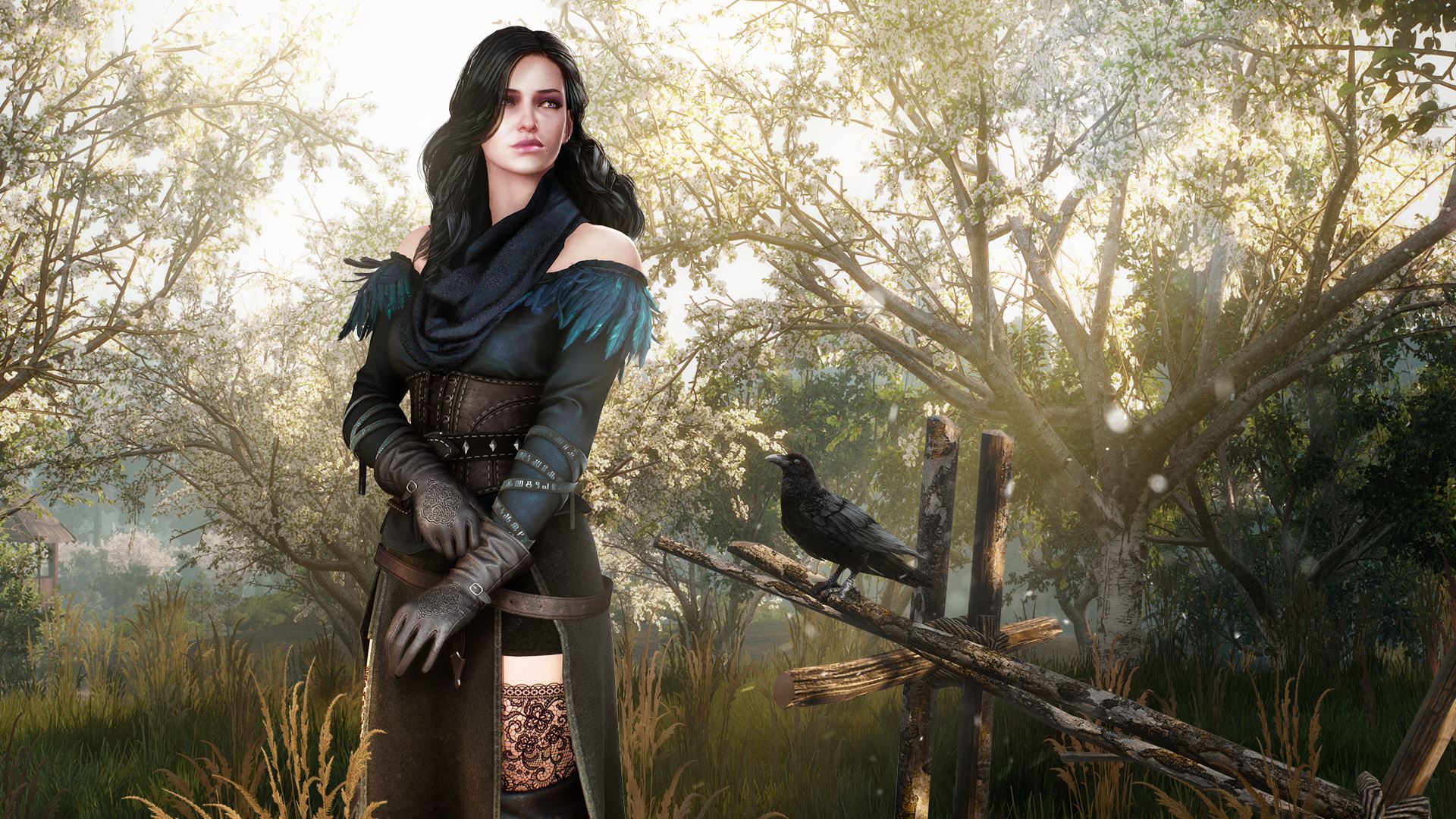
BEST CHARACTERS

fallout 4 witcher 3

At first, you might think TW3 wins this pretty easily, if only because it’s a game that focuses more on a central narrative with pretty rich characters. But F4, while different, also has an eclectic roundup of unique personalities, some far more interesting than what we have in TW3.

This is probably because F4 has more side characters. And every single one has a decent backstory you can uncover the more you get to know them. TW3 really only has a small cast of characters you care about, but they’re absolutely more interesting as a whole. So it’s a bit of a tossup.

Now, when it comes to voice acting and the lead character, TW3 wins by a landslide with Geralt. Even for a character who can’t display emotion, there’s a universe of depth to him that the Sole Survivor’s voice can’t even come close to. In fact, I sometimes wish you could opt out of hearing what your character in F4 has to say.

Yennifer, Triss, Ciri, and the other main characters of TW3 are also out of F4’s league in terms of likability and substance. I do think Valentine, MacCready, and even Piper are fun characters to hang out with in the Commonwealth, but at no point did I really care about what would happen to them next, which is a far cry from how much emotion I invested in my friends and allies from TW3.

It’s not a landslide victory, but TW3 wins this round.

BEST ACTION

fallout 4 witcher 3

Both of these games have a huge focus on defeating multitudes of faceless enemies. But which one does it better?

This is an interesting comparison, as well, because both games are action RPGs (well, F4 is technically an RPS). They both feature a ton of other side activities you can do with your character in-between the action, and they both let you fight in real-time.

With Geralt, you can fight with your handy swords (one for monsters and one for humans/animals) or use a small set of spells with varying effects. You can even make your own bombs. With the Sole Survivor, you can use many different types of guns and melee weapons, or you can fight unarmed . And you also have V.A.T.S., which lets you slow down time in order to focus your shots on the weak points of your enemy.

So, both games have great, thrilling action. TW3, in particular, features a major upgrade from its predecessor in this respect thanks to its fluid sword fighting and monster-hunting strategies that make you feel like a true witcher.

fallout 4 witcher 3

F4 is more of an action game than any other entry in the series, which is good news if that’s your favorite element of F3 or New Vegas. The gunplay is incredibly smooth and responsive. And the introduction of artillery strikes and other ways to call in aid from friendly factions is a fun strategy.

There are many different types of enemies you can face in TW3 and F4, so they tie when it comes to variety. And both games are pretty challenging depending on how you want to play.

But when I consider how often I can switch up my tactics, I have to credit F4 for having great experiences for each of its many weapons. I can pick up new weapons on the fly and feel good using them, while doing the same in TW3 will usually lead to a quick death. The problem with TW3 in this regard is that it’s easier to get stuck in your ways, so there’s not as much room for exploration in how you want to take down your enemies.

F4 is also more fun when it comes to crafting your armor and mixing/matching. Most of what I used in TW3 was pretty ugly and ineffective unless I went to the trouble of doing armor quests. Overall, the armor sets are cooler, as I mentioned above, but it’s harder to get the right look or change things up if you get sick of what you’re wearing. With F4, it’s a blast to mod your weapons and armor, instead of a drag.

This was a close one, but F4 gets the point.

BEST STORY

fallout 4 witcher 3

Look, I love the main quest in F4. It’s much more engaging and unique than any other I’ve played in a Bethesda game, let alone the Fallout series. But that might be more indicative of how low the standard is, as well as how underwhelming much of the side quests are in F4.

100 hours in, I’ve gotten to the point where almost all of my missions in F4 are recycled retreads. Characters I’ve stuck with in order to see where their stories go have all but stalled. And I’m rapidly losing interest in coming across any more of these side quests that will put me on yet another fetch/kill errand that will somehow boost me through the ranks of an established faction.

Throughout F4, there are moments that take you out of the game completely, because they’re designed for an open world, not an open world story. TW3, by comparison, blows F4 out of the irradiated water with its spiderweb plot and remarkably complex side missions that can be just as interesting as the main story.

It’s strange because usually Bethesda does a great job with smaller story moments found in their open world, like with surprise characters and random events that happen by accident. Just stumbling across an encounter in their games is pretty thrilling. This is certainly present in F4, but not to the same extent. You mostly just come across endless battles going on in the distance, which are fun to track down, but pretty one-note.

In TW3, I had a grand time starting seemingly mundane side quests that spiraled into massive conflicts I couldn’t have predicted, and almost all of them had satisfactory endings I didn’t see coming.

TW3 wins this round and then some.

BEST GAMING EXPERIENCE

fallout 4 witcher 3

This category is about how a game looks and feels overall. And it’s also about how it makes you feel.

In terms of graphics, TW3 is simply a more beautiful game. But F4 excels at having a more dense location that feels more alive. As we’ve discussed already, both games have great gameplay with myriad options for how you play it. And both games are wildly addicting.

That said, if you ask me which game I’m glad I played, then I immediately think about TW3.

I’ve enjoyed F4 thoroughly, and it’s been fun spending hours of my time creating massive, sustainable settlements. But after building all of the walls, setting up the turrets, hunting for elements in the wasteland, and coming back every once in a while to fix the problems of the settlers, I don’t feel fulfilled.

Overall, F4 really isn’t a rewarding experience. Not much of what you do amounts to anything within the confines of the game.

But TW3 left me with a smile, despite my ending not being “the best one.” The work and effort I put into that game directly affected the outcome of the characters, and after I finished, I didn’t feel like it was time wasted.

This is obviously subjective, but everyone I’ve talked to about this game has more-or-less said the same. F4 is a blast for a while, but it does little to impact the gamer. Maybe it didn’t need to do that in order to be successful, but I already know which sequel of which series I’m more excited about, assuming either of these franchises continue.

TW3 made me fall in love with a series I’ve only sort of liked for years. The graphics blew me away. The stories and characters were unlike anything I’ve come across in an open world game. And it’s a game I want to play again.

I want to keep playing F4, but only because the game taps into a side of me that’s compulsive. TW3 exploits what makes me love the art of gaming, and that’s no small feat.

THE VERDICT

fallout 4 witcher 3

This was tough, but I feel pretty good when I say that The Witcher 3 is better than Fallout 4. As I’ve said, both games are marvelous and deserve praise. But the former is certainly superior in a variety of ways, notably in how the gamer feels when it’s completed. And it’s even got better characters, an amazing story, and some decent action that make it the convincing choice.

Agree? Disagree? Sound off in the comments.

Thanks for reading this! You can subscribe to my posts by clicking “Follow” in the right sidebar. Or just say hey on Twitter: @JonNegroni

Review: ‘Krampus’

krampus review

The most interesting thing about Krampus is probably how refreshing it is to see a horror Christmas movie that sidesteps the usual suspects (such as a directly murderous Santa Claus). But while Krampus isn’t actually very scary or even funny, it captures something just as welcome as horror comedies go: it’s fun mayhem.

In European folklore, Krampus is the evil shadow of Santa Claus. Rather than fulfill the happy wishes of children, he comes to satisfy their darkest desires with his band of merry murderers. A child who has become disenfranchised with how Christmas shapes his dysfunctional family tragically discards his Christmas list, which earnestly asks Santa to make everyone in his life happier. As a result, Krampus (and a magically frenetic blizzard) is called upon instead.

That said, little of Krampus is seen until the end of the movie, as we spend more time focusing on his “little helpers.” Thankfully, they almost steal the show with their remarkable practical effects and a willingness for the movie to inflict violence on just about anything in its way, creating a tension that mashes well with the chaos captured in an early scene that satires the greed of holiday shopping.

It can be easy to discount Krampus as a whole for a few rotten eggs, namely some of the performances and its odd “PG-13” rating. But it finds its groove with an inspiring throwback animation that cleverly tells the story of Krampus within a new context, coupled with a dreadful (in a good way) performance from the grandmother, played by Krista Stadler.

While Krampus may not ignite the sort of pre-Christian folklore that deserves more cinematic attention, it may prove that holiday horror is a genre worth larger budgets that keep it off the discount bin.

Grade: B+

Extra Credits:

  • Michael Dougherty directed and co-wrote Krampus, and the comparisons between this and Trick r’ Treat are obvious. The superior film is pretty obvious.
  • This is a much better cast than I think the movie deserved. Adam Scott and David Koechner play quite well together, and the relationship between Scott and Toni Collete’s character is actually quite touching.
  • It’s subtle, but the sibling relationship between “Max” and “Beth” was written so well, I was quite sad they didn’t spend much time together outside of the first act.
  • No spoilers, but I adore the ending. I wish more movies would be brave enough to let their final act match the rest of the film.

This week on the podcast, we review Krampus in more detail, get our feet wet with some movie news, read your comments from last week’s show, and get down to business on our favorite animated movies.

I’m joined by YouTube sensation, Maria “Cineclub” Garcia; Film writer, Adonis Gonzalez; and digital illustrator, Kayla Savage.

QUESTION OF THE WEEK: What is your favorite animated movie that wasn’t made by Disney, Pixar, or DreamWorks?

Go on…Review: ‘Krampus’

Over a Decade Later, Samurai Jack is Back (on Toonami)

Screen Shot 2015-12-02 at 10.36.58 AM

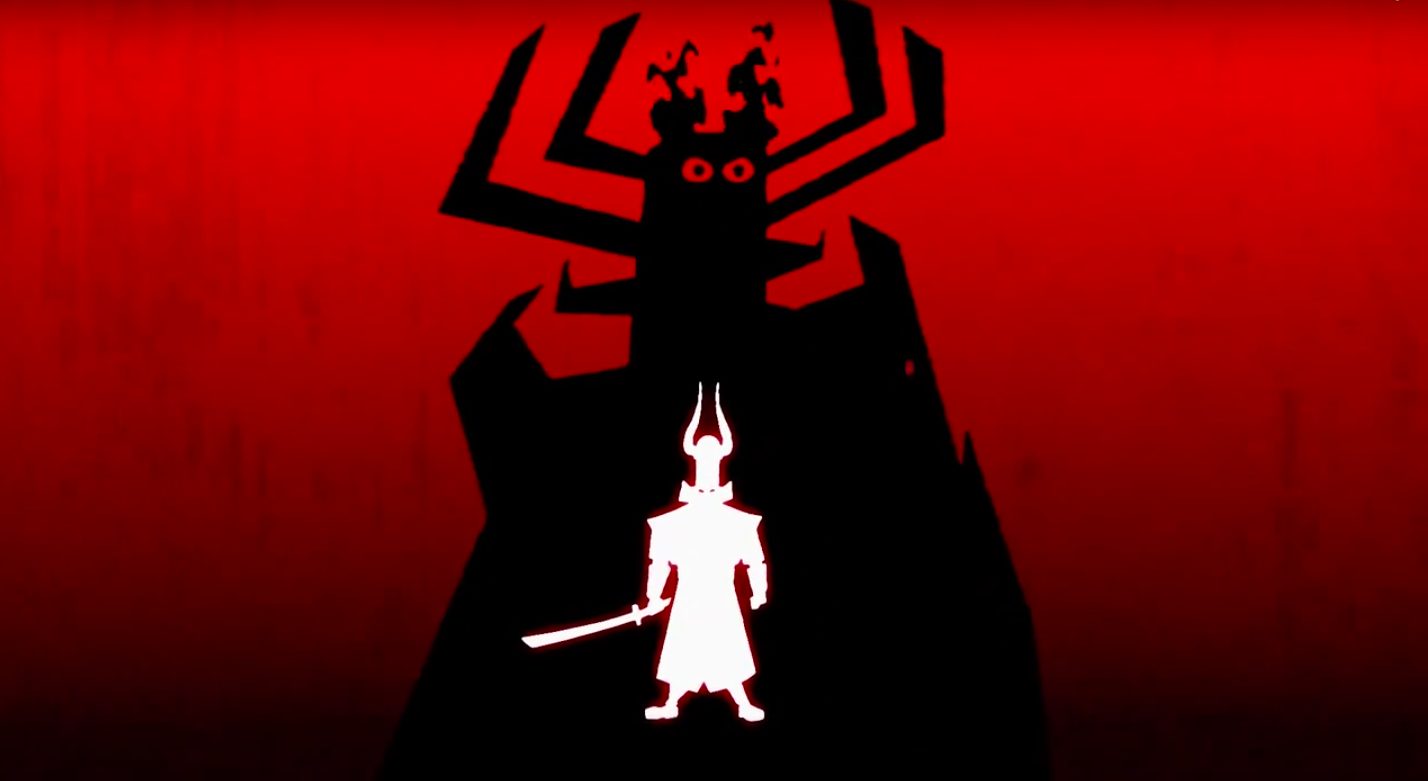
Cartoon Network teased us with a short video today announcing the soon return of an animated series we thought had been forgotten: Samurai Jack.

Genndy Tartakovsky, creator of the series, is attached to what’s being called “a new season for the epic story,” which will premiere on the mostly anime-filled Toonami block.

As for the video itself, we only get a glimpse of what’s to come. The figure in the video is presumably Jack himself, outfitted with new armor along with his signature sword. Aku, his demon rival, is also seen in the background sporting his flaming eyebrows and deadly stare. It’s enough to bring me right back to the original style and flourish I loved from the original run.

Samurai Jack ran on Cartoon Network from 2001 to 2004 before being unceremoniously cancelled, despite any resolution to the show’s singular narrative. Growing up in feudal Japan, the newly-minted samurai (later known as Jack) took on the shape-shifting demon, Aku, in a battle for the entire world. Nearly defeated, Aku threw Jack through a time portal, transporting him thousands of years into the future.

Jack had to use his legendary sword and grit to survive this war-torn wasteland filled with dangerous machines, aliens, and mythological foes on his way to finally confronting Aku again in this new world. Unfortunately, that battle never happened.

In 2016, we may finally get the ending we’ve been waiting over a decade for. And would it be asking too much for some sort of theatrical release? Yeah? OK, just pretend I didn’t ask for that.

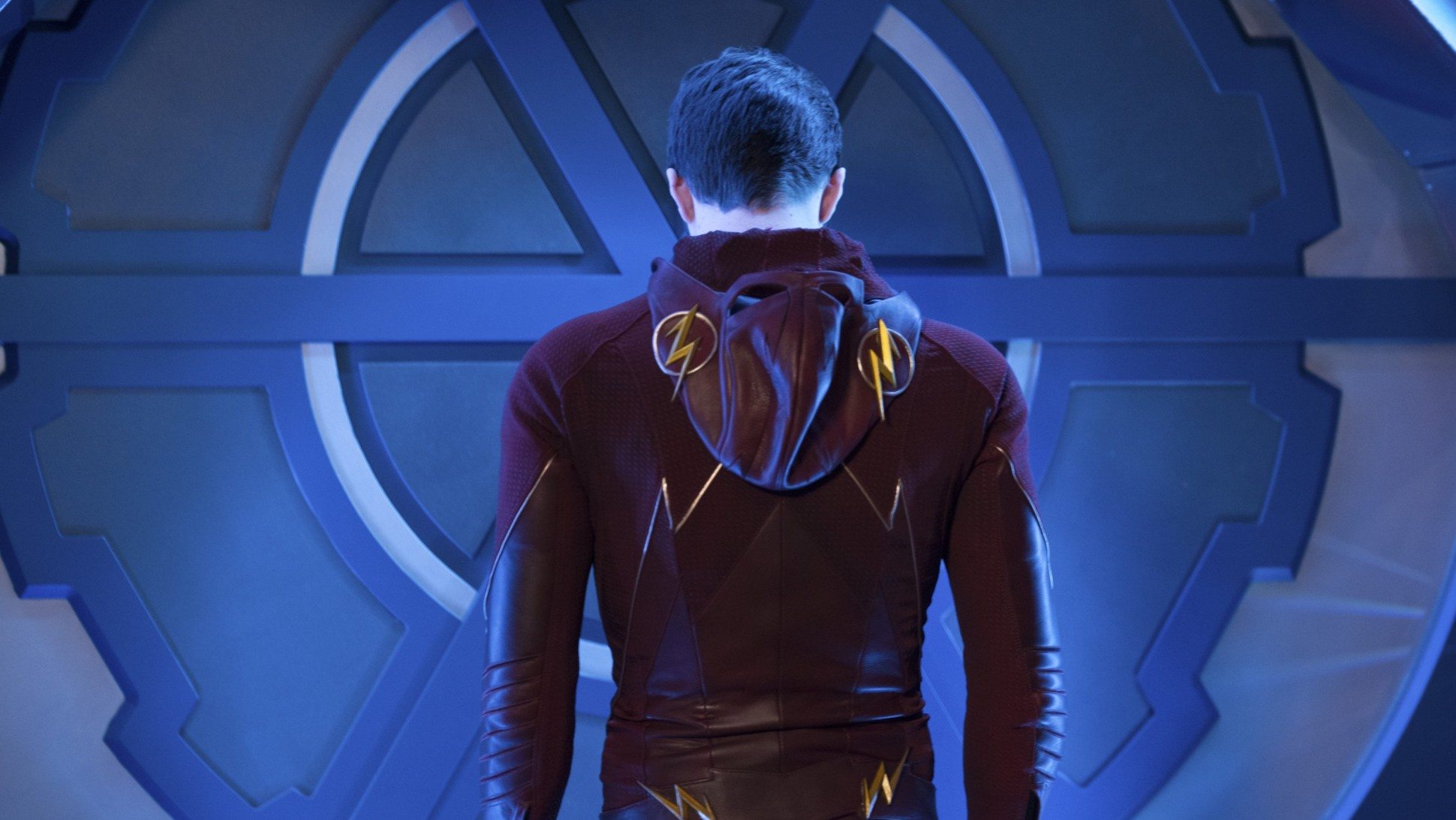
Which Is Better? Arrow vs. The Flash

the flash arrow better

“Which is Better?” is a new editorial series that dares to compare the best of pretty much everything. In this rundown, I’ll break down everything from story to characters in an attempt to declare which of these superhero shows is truly better. 

Back when it was still The WB Television Network, The CW aired a superhero origin series for Superman, which you probably remember as Smallville. It was a great show in its early seasons (its prime), but it faltered over the years due to its own popularity and unwillingness to end. Essentially, things got too complicated, important characters became throwaways…it was a forgettable mess by the time it finished.

But Smallville did set the standard for modern live-action DC Comics shows. It introduced an entire generation of non-comic readers to Green Arrow, prompting the CW to move forward with a new show/remake dedicated to just that character.

You can thank a lot of the creative vision and ambition behind Arrow and other DC shows to Greg Berlanti, who got his start working on Dawson’s Creek (the similarities between these two shows are unmistakable). Though Berlanti has helped produced some major duds, including the Green Lantern movie in 2011, the director/writer/producer has found great success crafting a DC Comics television universe that has branched off into The Flash and the upcoming Legends of Tomorrow. He’s even the executive producer of CBS’s own DC Comics show, Supergirl.

which is better arrow flash

But the main shows we’re talking about today are truer rivals. They’ve crossed over many times, and The Flash was even introduced within an episode of Arrow. And although Arrow has been around since 2012, The Flash is already in its second season, giving us enough time to properly compare what stands out for each series.

So…which is better? (shoutout to user Tonio0064 for suggesting this entry).

It’s a hard question, and from what I’ve observed, The Flash has been considered by critics and audiences to be superior, despite how young it is. Another thing to consider is that a lot of what’s great about The Flash was pioneered by the teams who worked on Arrow, which suffered a bit from some clunky seasons trying to figure out what kind of show it had to be.

I’ve had a great time watching both shows, so I’ll be breaking down their merits in order to figure out which one really is better. But let’s be clear. Neither have failed this city.

BEST LEAD

which is better arrow flash

Both shows have titular main characters, so having a good lead has been critical to their success. Fortunately for Arrow and The Flash, Stephen Amell and Grant Gustin have done a fantastic job as Oliver Queen and Barry Allen, respectively.

They both walk a fine line between doing the comics justice, but also bringing something new to the character that non-comic fans can relate to. Oliver Queen is traditionally a hero known for being more of a left-wing robin hood type looking out for the little guy, but Amell’s take is more of a tortured warrior who fights for the greater good (at least for now).

Grant Gustin pulls off a Barry Allen with fewer wisecracks but more charm as a confident speedster with a heart of gold. And both of these characters work with larger teams instead of on their own, which is a more suitable format for television.

This is a close call, and I really like both characters. But if I had to choose one who goes just a little further with the character, then I have to pick Flash. Amell is a great actor, but he’s a bit more one-note and sullen compared to Gustin, who just seems to be having a lot more fun with his show.

Point goes to The Flash.

BEST SUPPORTING CAST

which is better arrow flash

In other words, Cisco or Felicity?

One of the most fun aspects of Arrow is how well the show has evolved its side characters. Diggle, Felicity, Thea, and even Laurel have grown into interesting characters who add more to the show than they distract from.

At the same time, though, the show often struggles with what their roles are. Specifically, Thea, Laurel, Roy, Quentin, and Sarah of all people have been hit-or-miss over the years, with Roy even leaving the show Teen Wolf-style.

The Flash, on the other hand, does more with less. Even if you compare second seasons to second seasons, Team Flash just seems to have a better sense of identity. Caitlin looks out for Barry’s health, Cisco makes the cool gadgets and decides on bad guy names, Wells comes up with the plans, Joe keeps everyone in check, and Iris is the unattainable love interest (though her character is slowly getting better than that).

This is a result of The Flash learning and avoiding the mistakes of Arrow, which gives them almost an unfair advantage. But the show still manages to learn and apply what’s worked in the past, and that’s no easy feat in the world of network television.

Point goes to The Flash.

BEST VILLAINS

which is better arrow flash

Arrow was lacking a compelling list of villains early in its first season. The enemies ranged from Nolan-verse archetypes to greedy businessmen, not the intriguing assassins and warlords that would populate future episodes. Even Merlyn was a bit underwhelming, despite his arch-villain clout.

The Flash found easy ways to introduce villains with one major event causing their arrival. The particle accelerator gave Barry and many of the villains their powers, making it Barry’s job to round them up (with the exception of foes like Captain Cold).

You’d think that would give The Flash an advantage, but this is something I don’t love about the series. For one thing, it’s a little too reminiscent of Static Shock, the animated series from the early 2000s that used very similar story elements to explain the sudden arrival of foes Static could contend with.

The major villains of The Flash have certainly been interesting in their own right, but not very unique or diverse. Sure, it’s still early, but Reverse Flash and Zoom are really just rival speedsters. Arrow did the same with Merlyn, a rival archer, but at least in its second season, it introduced two new villains who felt drastically more imposing. What made Deathstroke so great, for example, was how his story had been teased from the first season, and the “why” behind his villainy was more satisfying than Eobard Thawne’s mostly uncomplicated treachery.

I like the villains from The Flash, but I’m much more invested in the villains of Arrow, especially Floyd Lawton. Point goes to Arrow.

BEST STORY

which is better arrow flash

Included in this analysis is storytelling. Which show delivers the best experience in terms of drama and character development?

Arrow had a very promising premise in its first season that gave it the steam it needed to survive. Oliver Queen returned from presumed death after five years. While trying to readjust to his life and friends (including the ex-girlfriend he cheated on with her sister who died under his watch), Oliver took up a crusade as a vigilante, trying to redeem his city with the skills he learned while on a mysterious island.

This initial story worked well because we also saw flashbacks to the island that explained how Oliver survived and became “the vigilante.” By the time we reached the third season, however, the flashbacks quickly became pointless, feeling more like fodder for lackluster B plots. There’s a good one every now and again, but for me, these have been pretty skippable.

In contrast, The Flash utilizes “secret endings” at the end of each episode that shed light on a bigger mystery. Who is Harrison Wells, really? Who is the Reverse Flash? Who is Zoom? Strange I’m mentioning it again, but this is something Teen Wolf has excelled at in a grander sense, using mysteries you actually care about to keep you tuning in.

But does that really make the story better? No, and that’s a good thing. These mysteries are accessories to what make The Flash a fun watch, not the entire hook. I’m fine with waiting to find out which character is who because I enjoy Barry Allen’s journey as a superhero. It’s simpler than Arrow, for sure, and I like that because Flash is a less serious character, so when there’s drama, it feels more genuine when mixed with the comic relief.

This is another close call, but I have to give it to The Flash. While it may lack a narrative that hooks you in immediately, it provides a fleshed out universe that feels more fun to sink your teeth into.

VERDICT

which is better arrow flash

Well, I guess the critics are right. The Flash is better than Arrow, but it’s a closer match than I think some people realize. In everything we discussed, Arrow had many bright spots that elevate it above The Flash in some respects, especially when it comes to villains.

But overall, The Flash has benefitted from being more refined from the get-go, which is a testament to the work put in to make this show the best it could possibly be. We owe plenty of gratitude to Arrow for paving the way, but it’s honest to point out that it’s not the best, at least for now.

Agree? Disagree? Sound off in the comments.


Thanks for reading this. To get updates on my theories, books, and giveaways, join my mailing list.

Or just say hey on Twitter: @JonNegroni

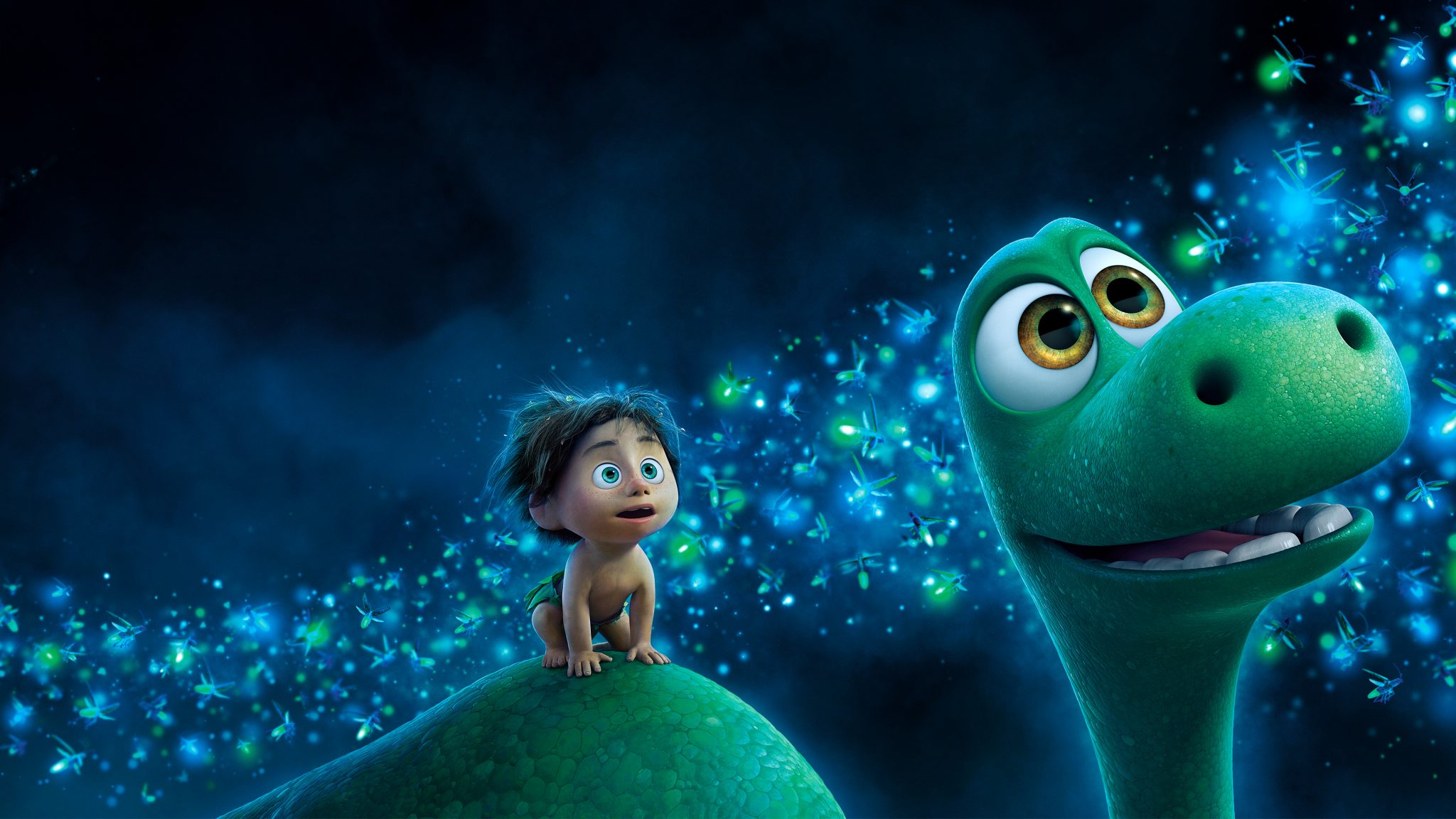
‘The Good Dinosaur’ Review: Finding Dino

the good dinosaur review

(You can read my full review here. Below is the shortened version).

The Good Dinosaur was directed by Peter Sohn and stars (the voices of) Jeffrey Wright, Frances McDormand, Sam Elliot, Raymond Ochoa, and Jack Bright.

What if the dinosaurs had never been wiped out by an asteroid? According to Pixar, this would have led to dinosaurs eventually becoming the dominant species on Earth. The movie opens in what appears to be Wyoming or Montana, millions of years after the asteroid failed to wipe out all dinosaurs and supposedly before the Ice Age, perhaps.

There’s no exposition beyond this. We meet an Apatosaurus family that operates a farm almost like humans would, and the film gets rolling from there. Throughout this movie, you’ll come across these little moments that remind you how new this world is. Things operate differently, and there’s some clever imagination woven into the rules of this alternate universe.

the good dinosaur review

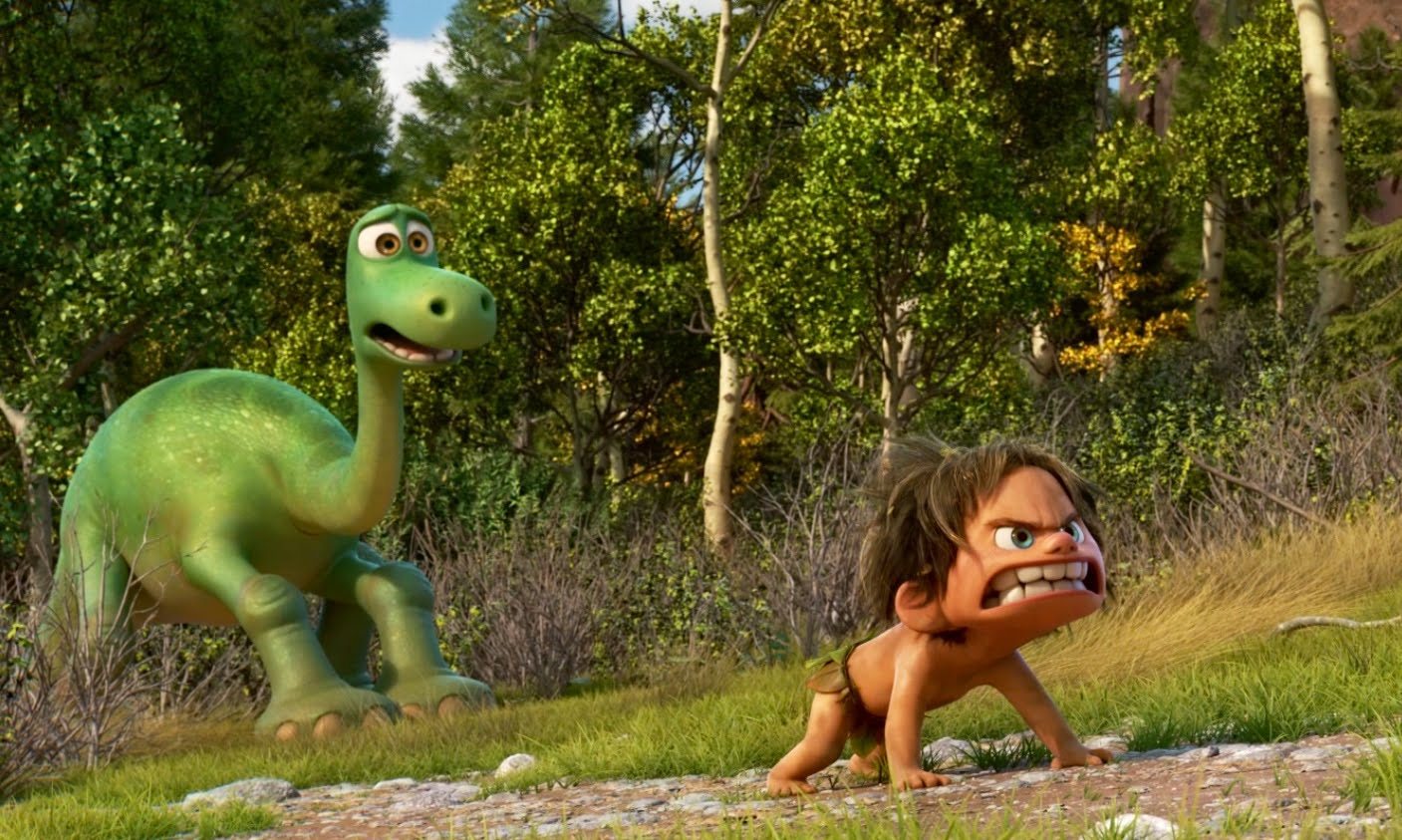
The main plot of the movie involves a young Apatosaurus named Arlo, who gets separated from his farm after getting washed away by a river. He’s incredibly fearful, and it’s led to some awful tragedies in his life, so this adventure is his opportunity to make his mark on the world and prove himself. To do this, he unwittingly befriends and essentially tames a human he names Spot.

Their journey is exciting and wrought with tension and real danger. Creatures die without warning. Arlo gets hurt a lot. And everything feels authentic, which is probably made better by how beautiful the photorealistic environments are. They’re worth the price of admission alone.

This is also a very funny movie, which is a saving grace from some of the more perilous moments that weight it down. And even though not every element about The Good Dinosaur is perfect, it’s the combination of what it does well that impresses. It’s soundtrack elevates the atmosphere. The softness of the voice acting helps the humor feel earned. The gorgeous visuals highlight how authentic the movie feels, which I’ve already stated.

It’s really the harmony of The Good Dinosaur that puts it above every other movie I’ve seen this year. Even Pixar’s other offering this year, Inside Out, just didn’t feel this cohesive and in sync.

Grade A+

the good dinosaur review

As of November, this is my favorite movie of the year, and it happens to be third movie of 2015 that I’ve given an A+. In my opinion, The Good Dinosaur is one of Pixar’s best films period, mostly because it pushes the studio in new directions that excite me for what they have in stored next. If you’re a fan of their work, then this is a film you should not miss.

Extra Credits

  • No cameos or easter eggs from what I can tell. I didn’t even spot A113. Honestly, this was probably for the best. The simplicity of The Good Dinosaur was one of the things I liked the most about it.
  • Shortly after writing my full review, I noticed that most critics disagree with my assessment on this one, and I have a feeling that many people will prefer Inside Out out of the two. That’s fine, of course, but my opinion remains. I walked into this movie not knowing how anyone would perceive it, and it’s stuck with me ever since. Simply put, I hope you enjoy it as much as I did.
  • It gets an A+, but it’s not perfect. One aspect of the movie in particular, the rustlers, was pretty underwhelming and uninspired. I’d also note that the third act trips a little bit, but is ultimately saved by a sequence I won’t spoil.
  • Does it fit in the Pixar Theory? I’ve thought about this plenty, and I’ll certainly have a post coming out soon covering this. But the short answer is: well, yeah.

For a more in-depth look at this movie, come back this Sunday for the Now Conspiring podcast, where we’ll discuss this and other new releases.

I’m Jon and thanks for reading this. You can subscribe to my posts by clicking “Follow” in the right sidebar. Or just say hey on Twitter! @JonNegroni

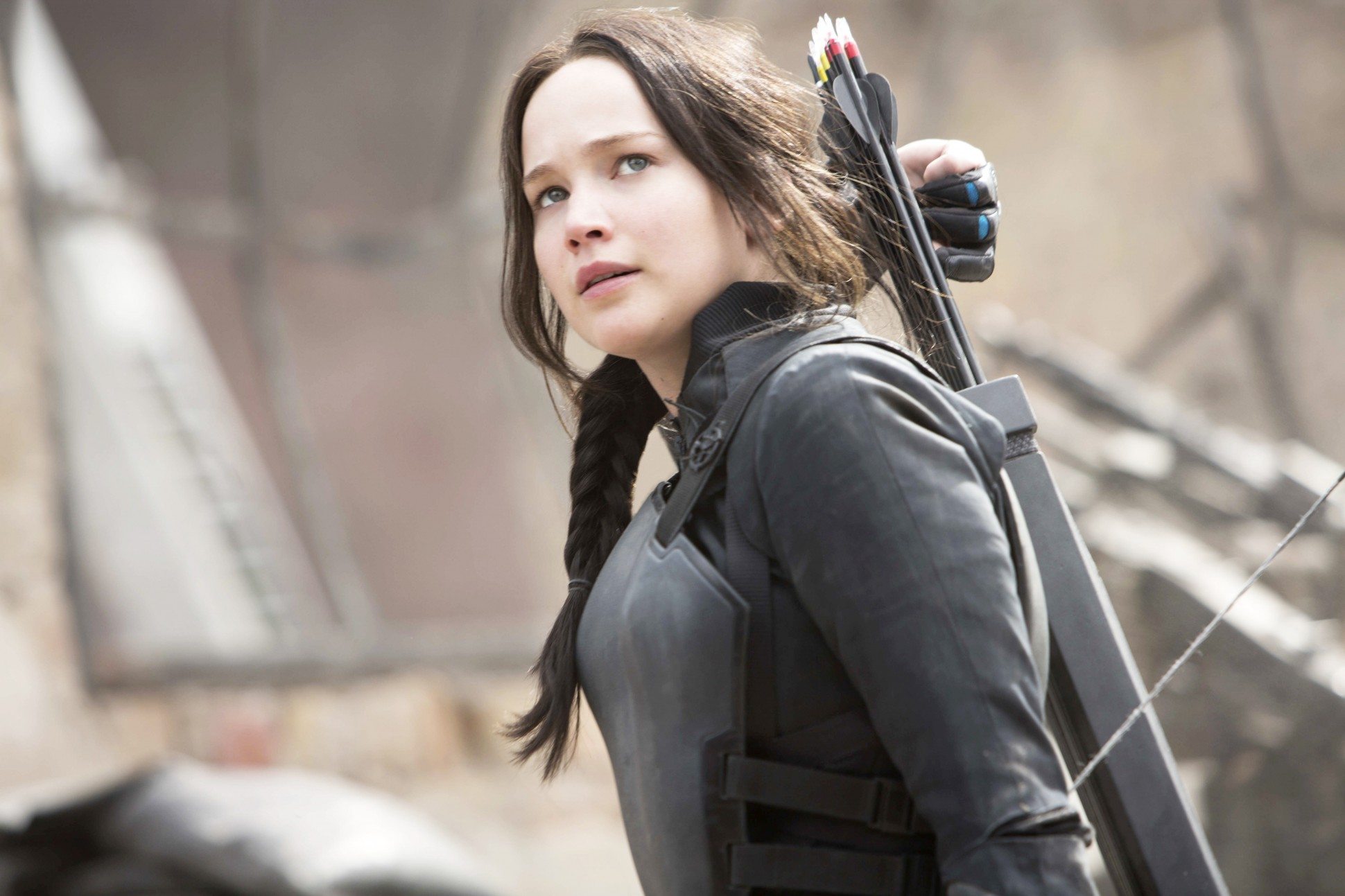
Review: ‘The Hunger Games — Mockingjay, Part 2’

hunger games mockingjay review

Directed by Francis Lawrence, Mockingjay, Part 2 is the fourth and final installment of the The Hunger Games movie franchise, which kicked off in 2012.

I’ve read all three books by Suzanne Collins, but I happen to prefer the film adaptations made by Lionsgate. I think the books were incredibly flawed, both with tone and how certain plot lines lined up. The movies share some of the problems, but they also fix a lot of issues I had with Mockingjay, which was the third and in my opinion, weakest book.

Of course, this is the second half of a two-parter, and certainly the stronger entry compared to last year’s Mockingjay, Part 1. A lot of the complaints I had for that last movie was how painfully slow it was trying to stretch half of a short book into two hours. But if you stuck with MP1, then you’re going to feel satisfaction after MP2, which is pretty much all action and climax.

A lot of things work in MP2 that have worked throughout all of these movies. The locations are beautiful, the camerawork is nearly flawless, and there are brushes of wow-moments and creativity that set this story apart from other dystopia offerings. At this point, Panem feels like a real place with believable characters, and this movie excels with its incredible supporting cast, including the late Philip Seymour Hoffman.

hunger games mockingjay review

But a major weakness in MP2 happens to be the under-utilization of these side characters, who are quite literally brushed to the side in favor of Katniss and her friends. And while I love what Jennifer Lawerence has done with this character overall throughout the series, I can’t help but feel a little underwhelmed with her character’s arc, which is really a criticism toward the books.

In MP2, the story is that Katniss is more of a mythical symbol, rather than a dynamic force who can create real change. And the entire movie is her struggle against the leaders of the rebellion that she can do more than just rally the troops with some propaganda videos. But her singular drive to assassinate Snow eventually becomes tiring, especially as her allies drop like flies, perhaps needlessly.

That’s the point, I suppose. And the highest praise I can give MP2 is how brazen it is with its themes, presenting the rebellion as evil and asking real questions about how war can undermine the good intentions behind a movement. You forget quickly that only two movies ago, the Capitol was perceived as an unstoppable force, mercilessly killing any opposition. By the end of MP2, you’ll wonder what it was all for, and that’s an achievement for a movie aimed at the young adult audience.

hunger games mockingly review

Grade: B+

Paired with Part 1, this is a satisfying conclusion in more ways than one, because it manages to elevate was a disappointing book for many fans like myself. The performances are solid, if not a little underused, and not a moment of it is boring.

For a more in-depth look at this movie, come back this Sunday for the Now Conspiring podcast, where we’ll discuss this and other new releases.

I’m Jon and thanks for reading this. You can subscribe to my posts by clicking “Follow” in the right sidebar. Or just say hey on Twitter! @JonNegroni