Snarcasm: The ‘Star Wars’ Prequels Were The Best Movies All Along

Star Wars prequels

Snarcasm is a weekly series where I encounter and try to understand the worst articles on the Internet. This week, I take on my fellow millennials who’ll say anything for a click. 

OK, we already talked about Star Wars a few weeks ago, but that was more about Piers Morgan and how irrelevant his film commentary is. That said, a similarly contentious article about the revered Star Wars saga was recently dropped on my doorstep with “It’s a trap!” scribbled across the label.

Writing for Toronto Star, Ian Gormely presents his case for why we may have been a little too harsh with the Star Wars prequels. Of course, that means his headline is…

Why the Star Wars prequels are better than the originals

And they say clickbait doesn’t write itself.

Now to be fair, the subhead is a little less sensational:

A generation of fans who grew up with the more recent trilogy make a compelling case that those are the superior films.

*shrugs*

Alright, you have an element of an interesting think piece here because younger viewers like me gave the prequels a pass, which is arguably similar to how older fans forgave the original trilogy for its ample flaws. I don’t agree, but it’s a worthwhile argument.

Then the article starts.

The prequels never stood a chance.

Right. One of the most anticipated films of the last 20 years never stood a chance. And yet the hype surrounding The Phantom Menace was astronomical, more so than this year’s The Force Awakens (because hey, we’ve learned the hard way not to get our hopes up).

The prequels very much stood a chance. People over the age of 15 just didn’t like them.

Hampered by two decades’ worth of expectations and hype, George Lucas’s deep dive back into the Star Wars universe was destined to disappoint.

I’m sure Ian would have said the same thing about The Empire Strikes Back if it had been terrible.

Star Wars (awkwardly retitled Star Wars Episode IV: A New Hope when Lucas rereleased it in 1997) and its sequels were generation-defining movies.

Awkwardly? I grew up in this time period, too, and I don’t remember having an issue with the naming conventions. And if they had kept the name “Star Warsfor just the fourth movie, that would have been way more awkward.

Also, why even bring that up?

When Star Wars Episode I: The Phantom Menace arrived in May 1999 fans were met with a film that was visually (computer-generated effects) and tonally (it was aimed at kids) miles away from their beloved originals.

When he says aimed at kids, he’s implying that the movie was mostly aimed at kids. Which isn’t true at all if you remember any scene from The Phantom Menace about trade negotiations, political squabbling, and multiple Jedi blathering instead of fighting until the last ten minutes.

And just to be clear, I enjoyed The Phantom Menace as much as I did Revenge of the Sith. I think they’re decent, even average movies. Their mediocrity is all the more depressing, of course, when you compare them with the original trilogy. Attack of the Clones is the only Star Wars film (in my opinion) that gets a failing grade.

 Subsequent prequels, Episode II: Attack of the Clones and Episode III: Revenge of the Sith, moved closer to Lucas’s originals, but many fans felt betrayed. This wasn’t their Star Wars.

He’s framing this argument as if Lucas was some sort of visionary trying to create something different, but those pesky fanboys were just too afraid of change. The problem, obviously, was that this change we got in the prequels was filled with annoying issues that even kids pretty much shrugged at.

Granted, we loved the prequels as kids. At the time, they were beautiful spectacles that forced us to wade through hackneyed plots to get to the stylized action. But not once did I ever consider them better than the original trilogy, solely because they were designed to be depressing departures, while the rest of the saga was filled with…well, hope.

J.J. Abrams’ upcoming seventh film, Episode VII: the Force Awakens, will reportedly hew closer in style to the original trilogy. 

Reportedly? Why did this blog spam suddenly remember it’s on a news publication?

But here’s the rub: a lot of people went to see The Phantom Menace — it made a billion dollars at the box office. Now in their 20s, this generation of Star Wars fan grew up not knowing a world without digital effects or Jar Jar Binks.

You know, unless we watched Quentin Tarantino movies instead.

To get a better sense of how they view the Star Wars universe we asked three deeply passionate fans to share their thoughts on the prequels.

Nice prank, Ian! For a second, I thought you were going to crowdsource your opinionated article with anecdotes instead of arguments—

Stuart (do you really want to know his last name? Isn’t privacy a thing in cases like this?)

Current Age: 26, which means he was 10 when Phantom Menace was released in 1999.

Why is this happening?

I’m going to leave out the heaps of personal data Ian dishes out for this guy, including his inclusion of (and I’m not joking) working for Virgin Radio.

I loved Darth Maul. The final lightsaber battle, that was the best lightsaber fight I’d ever seen.

Really? Because even my 8-year-old self still preferred Luke’s freakout in Return of the Jedi. Different strokes, but perhaps you loved that lightsaber battle more because the rest of the movie was so forgettable? Maybe?

Fans of the old series were looking for that nostalgia that they could relive. When the Phantom Menace came out, that’s when I think I was getting the experience that my dad and his generation had when the originals came out.

The problem is you think you had the same experience, but you’ll never know. And that’s fine. It’s great that you enjoyed these movies, but how can you compare that with someone’s else’s experience with a different movie during a different era? It would be like me telling my grandmother that seeing Get Hard was the equivalent of her going to see Gone With The Wind on opening night.

Ian’s next conveniently positive anecdote comes from someone who was 6 when The Phantom Menace came out (I wonder why we aren’t talking about Attack of the Clones at all?)

If you look at Star Wars as an epic Grecian tragedy, (the prequels) contextualize the original trilogy so well. It actually lends the original trilogy a lot more power when you know the history behind it

At times, this happens, sure. Notably in Revenge of the Sith when we get some solid scenes of Anakin getting seduced by the dark side. But come on, that’s a fraction of the whole film, which was mostly nonsense dialogue, deadpan characters, needless explanations of things that were better left to our imaginations, and sand, everywhere.

The worlds, the designs and the sci-fi concepts they introduce (in Attack of the Clones) are the best in all of Star Wars.

No.

No, they are not.

No reasonable fan with a straight face can say that the worlds of Attack of the Clones — Coruscant (which we’d already seen before), Tattooine (which we’d already seen before), Naboo (which we’d already seen before), and an asteroid field (which we’d already seen before) — were superior to anything in the other films, including the prequels.

Scrap those rehashed locations and you’re left with the green screen that is Kamino and Geonosis, which was basically Tattooine with mountains and a CGI factory.

Simply put, saying Attack of The Clones has the best worlds and designs is like claiming Chappie is a better Neill Blomkamp movie than District 9.

They made the political parts of The Phantom Menace that people hated, the political intrigue, actually interesting.

Oh really? I wonder how many people can tell me (without looking it up) why Jango Fett was trying to assassinate Senator Amidala. Or how Palpatine specifically got his emergency powers. Or why the clones were working for Jango, but ended up in the hands of the Republic by the very end. Or why Dooku betrayed the Jedi. Or what Anakin’s deal is with SAND EVERYWHERE, HE’S FROM A SAND WORLD SO HE SHOULD BE USED TO IT.

Sorry. Unresolved issues.

Star Wars was an adventure story and now they give it scope. It’s more than a ragtag team trying to take on the whole world. It almost becomes a political thriller.

Now we’re just throwing words into sentences and calling them paragraphs, people.

A ragtag team? Of a girl, her stalker, and two droids who offer nothing to the plot but are only there because we remember them from other movies? Or were you referring to Obi-Wan and…um…that fat alien from the diner? Oh, those dang misfits!

Ian provides more anecdotes, and what’s funny about them is that these guys completely admit the elements of the prequels are terrible. One guy notes “the crappy love story,” but justifies it by saying people were invested and had to see what’s next. You know, like clickbait.

And that’s it! Ian ends the article…there. No conclusion…hmmm…comments are closed, that’s interesting…

I guess I missed the part where Ian and his friends actually make a case for why the prequels are better than the original trilogy. Or bring up specific things about the original trilogy. All I read was a laundry list of subjective observations and straw grasping for the sake of getting attention. That’s the Snarcasm guarantee.

Guys, I’m not trying to hate on anyone who loves the prequels. I get it. They can be guilty pleasures because we saw them at an age when all we wanted to see on the big screen was a cacophony of lightsaber fights and epic space battles. And the prequels absolutely delivered on that.

But let’s not kid ourselves, pun intended. The prequels were fan service, but for the lowest common denominator. They were the Fast and Furious movies in space, except they were intended to be more compelling, which makes them all the more cringeworthy. I don’t mind re-watching them and appreciating decent moments throughout, but you’re never going to convince true fans of any age that they’re better than what we got with the original trilogy.

And please don’t watch Chappie

Hey! If you’ve come across a silly article that deserves the snarcasm treatment, send it my way via Twitter or the comments below!

I’m Jon and thanks for reading this. You can subscribe to my posts by clicking “Follow” in the right sidebar. Or just say hey on Twitter! @JonNegroni


Which Is Better? The Office vs. Community

community the office

“Which is Better?” is a new editorial series that dares to compare the best of pretty much everything. In this rundown, I’ll break down everything from story to characters in an attempt to declare which of these modern classics is truly better. 

The last decade has been an excellent time for television comedy, much more so than anything we’ve seen on the big screen. And I argue that The Office is the show that kicked everything off when it premiered in 2004.

Not only did it introduce a brand new format for network comedy (at least in America), it ushered in Steve Carell as a mainstream comedian and launched the careers of Mindy Kaling, John Krasinski, Rainn Wilson, and even Ed Helms.

The influence of The Office is undeniable, and it will be remembered as a classic sitcom for years to come. But what I want to know is if it’s better than another show that started on NBC. That show is Community.

Of course, you might think this is a weird comparison. And I did consider Parks and Recreation as a more suitable competitor due to their similarities in both production and status. But to be honest, Community was a show that managed to captivate audiences in a way The Office never did, which is why I think it’s more useful and even interesting to compare one of the most widely recognizable sitcoms of all time with one of the least recognizable, but still beloved, sitcoms of all time.

the office community

In a way, these shows can be considered polar opposites (Community even mocked the mockumentary episode format twice during its run). The Office represents a resistance to change, as do its characters. Everyone wears suits, they work for a paper company, and each of the characters is further along in age.

Community was always a leaner, more youthful show that grew with the times since its pilot in 2009. It was a show that clicked with online viewers the most because it was more of an “Internet” show in both tone and delivery. While The Office lasted nine seasons as a network powerhouse due to the swath of ages it could appeal to.

So, which is better? In order to find out, I’ll be breaking down each aspect of the show and awarding points to the winner.

First, let’s talk about…

BEST LEAD

community the office

There might be some debate on this, but the de facto lead actor for The Office is undeniably Steve Carell as Michael Scott. Granted, he departed the show after seven seasons, but Community also suffered cast shakeups like this that almost ruined the show.

In Community, the lead actor is a little clearer, at least at first. Joel McHale as Jeff Winger was the lead of the first season, to be sure, but a fun twist in Community is that each season presents a different actor as its focus, similar to how the original Teen Titans on Cartoon Network gave each character their own main plot each season.

But to keep things simple, we can reasonably assign Jeff Winger as Community‘s “main” lead if that makes any sense. In a way, though, that’s not good for Community.

Jeff is a great character. He’s well-rounded, provides some of the wittiest lines in the series, and serves as a foil to your expectations in a lead actor. But Michael Scott simply wins in each of these categories, sometimes by a pretty huge margin.

community the office

Like Jeff, Michael Scott is a lovable douchebag, but many of his best scenes aren’t reliant on his supporting cast, unlike Jeff Winger. Steve Carell just has better timing, and his character delivers some huge laughs. He’s also a fresher character that took a lot of people by surprise when the show started.

Jeff does evolve in some unique ways, but when Community starts, he’s a character we’ve all seen before (which is referenced in the show itself). And even the Jeff we get later on just doesn’t hold a candle to Michael Scott.

I’m going to have to give this one to The Office.

BEST ENSEMBLE

the office community

One of my favorite things about The Office was how its mundane cast managed to offer a surprising amount of depth parallel to the lead. You watched the show to see what Michael Scott would do next, but your heart was in the supporting cast, mainly Jim and Pam.

The major downside, though, is that the magic of the supporting cast certainly waned over the years. Storylines between many of these characters failed to get better, and when the show lost Michael Scott, viewers flocked in droves. It’s almost like Michael Scott was too good of a lead for the rest of the cast to lose.

In comparison, Community also had major issues with cast members, notably Chevy Chase as Pierce. By the end of the fourth season, the show was in shambles after losing its creator, Dan Harmon, as well, and we thought the show would finish on a very poor note.

But if you look at the show as a whole, the ensemble of Community was far more consistent than The Office. These characters do rely on each other quite a bit for the best laughs (Troy and Abed in the morning), but that’s not a downside. And even when the fifth season saw the midway departure of Donald Glover, the show managed to pick up the pieces and move on gracefully, much better than The Office in my opinion.

community the office

I think this is because Community simply had better, more realized characters. They were all relatable because they were at a starting point in their lives, and their outcast status is a good reflection of the show overall. The cast in The Office was always set in their ways, so you got more humor from laughing at them, than with them. You were never that excited to go on a sales call with Andy Bernard, but you were thrilled to go on a blanket fort adventure with Troy and Abed.

For me, Community has the better ensemble, hands down.

BEST JOKES

the office community

We’re talking about comedies, so it only makes sense to figure out which one has the best sense of humor. This is a little tough because these shows present their comedic situations in very different ways.

The Office, for the most part, relied on talking heads and “Michael Scottisms” to carry the humor forward, though it also used a lot of cringe moments as well. I was never a big fan of these, but I will give The Office credit for having excellent writing in nearly every season.

Community was also a funny show, but it relied much more on reference humor and parodies. On the one hand, this was a different and refreshing form of comedy that helped cement the show’s cult status. At the time, no other show on network television was doing something this creative with Dungeons and Dragons, claymation, or video game characters.

I can remember a lot of jokes from each show, and I don’t think one is obviously better than the other overall. But I’m going to give this one to The Office because even during its worst season (the eighth), it still managed to provide some great laughs. Community had an abysmal season four that was gracefully short, but incredibly flat on humor.

The point goes to The Office.

BEST STORY

the office community

The story setups for these shows are drastically different from each other, but they’re also similar in a few ways.

The Office starts in the middle of things with characters who already know each other. Its inciting event, downsizing, is resolved pretty early on, and the rest of the show is more of a series of “micro stories” that don’t connect much season to season.

Community also starts in the middle, but much earlier in the middle. When the show begins, the characters have been in the same class for a little while, and they’re just getting to know each other. Unlike The Office, there are clear goals for each character, beyond who’s in love with who.

Jeff wants to become a lawyer again, Annie wants to redeem herself, Shirley wants to start her own business, Pierce wants to have a family, Troy wants to find purpose, Abed wants to understand people better, and Britta wants to prove she can make a difference.

the office community

In The Office, we have far less compelling, and somewhat depressing, stories for everyone. Michael wants everyone to like him, Dwight wants Michael’s job, Jim wants to date Pam, Pam wants to be happy, Oscar wants to get through the day, Kevin wants to become increasingly dumb over the years for no apparent reason, Angela wants everyone to adhere to her values, and so on.

Everyone is sort of just living for the moment, but not much else. And I’d argue it’s pretty difficult, even after nine seasons, to pinpoint the motivations for each character.

What makes Community excel is how much heart it has in its seasons, and that comes from well-written storylines that stick with you. As much fun as it was to wonder who Michael was going to date next or how Jim and Pam would deal with having a baby, I cared more about Jeff’s destiny as a lawyer, the darkest timeline, and how they could save Greendale from Chang.

I have to give this one to Community.

Alright, it’s a tie, so this next one takes it all!

BEST FORMAT

the office community

The Office is a mockumentary, which means it makes you think its characters are being candidly filmed at all times. It helps the writers tremendously, because they can streamline character reactions without making you wonder what they’re thinking. They just say what they think about the episode’s events by talking to the camera one-on-one.

This helps create a solid pace and rhythm for the show, but it has its downsides. Because the format is so rigid, the jokes have to be delivered in the same way every time. Jim always shrugs at the camera. Michael says something insane in his office. Dwight overreacts to something, and someone comments about it in a later interview. This gets pretty stale after a while.

Another downside is that you rarely get to wonder what’s going on in the head of each character because it’s spoon fed to you. To be fair, they didn’t let this happen much in the first two seasons when it came to Jim and Pam’s storyline, as they wouldn’t dare admit their flirtation to the camera. But once this longing was fulfilled, the show started to dumb down a bit.

the office community

Community uses a traditional single-camera setup, which means each scene is shot independently. So the show is a little snappier and relies on a lot of quick edits to move its story along. The nice thing about this is that it forces some great performances out of every character, but there are still some downsides.

The show had a habit of juggling one too many storylines, so the pacing wasn’t always on par with a show like The Office. And like The Office, its simpler setup still elicited some joke repetition. But I have to point out that Community solved this problem early on, ditching its more traditional format in the first season to be zanier and wackier in the second.

That’s actually the beauty of Community and what makes it a blast to watch over and over again. Each season is a self-contained show in a way, but it’s all cohesive. And I think this is because overall, the show had much more freedom to do whatever it wanted. So yes, we got a show done in the style of Law and Order, a two-episode paintball fight, and an homage to chaos theory.

If we’re going to talk about a format that brought out some of the best moments between each show, then Community wins by a small margin. The Office was important, and it was definitely memorable. But its popularity ultimately softened it, while Community‘s simpler format and small expectations allowed it to do huge things that we should have gotten from The Office.

the office community

It’s a tough a call, but the final point goes to the winner, Community.

While The Office is certainly a classic, elements of it are somewhat lacking. But Community manages to have an edge when it comes to story, the ensemble, and format, making it the superior show in my opinion. I won’t deny that The Office is a little funnier and has a better lead, but Community is the show I’ll be returning to more often than not as the years go by.

But hey, that’s just my opinion. Which show do you think is better? Be sure to sound off in the comments.

Extra Credits: 

  • A category I left out was “Jim and Pam” or “Troy and Abed?” If you know me even a little, then you know where I land on this. Just keep in mind that one show had the sense to dial one of these pairings back.
  • Forgot to bring up that Community‘s pilot aired right after The Office, which is how I watched the show for the first time. Full circle, I guess?
  • Sadly, I couldn’t think of a way to weave the dean in, except to point out that Community did a great job of brining side characters into the fold. The Office did the same with Daryl, but for me, my heart will always belong with Dean Pelton.

I’m Jon and thanks for reading this. You can subscribe to my posts by clicking “Follow” in the right sidebar. Or just say hey on Twitter! @JonNegroni

Snarcasm: Well, Someone Has to Hate ‘Finding Nemo’

finding nemo hate

Snarcasm is a weekly series about the worst articles on the Internet, and how we can snarcastically deal with them. 

Now that Pixar has gracefully released the first trailer for Finding Dory, I thought it would be refreshing to dive back into the fun we had with Finding Nemo 12 years ago.

In fact, I tried to find negative articles and opinion pieces about the new trailer, but I surprisingly found no one willing to be that person (outside of your friendly neighborhood comment section).

So I suppose that means Finding Nemo was universally beloved?

Ha, of course not. And that’s not a bad thing! You’ll always find someone who dislikes a movie you enjoy. But that doesn’t mean their reasons always make sense.

finding nemo hate

Back in 2003, Stephanie Zacharek (writing for Salon at the time) wrote one of the most confusing movie reviews I think I’ve ever read. And preparing for this weekly series means I have to read a lot of junk to decide what gets featured, so I hope that sinks in. OK, I’m done with the sea puns.

Anyway, Stephanie recommended her readers skip Finding Nemo altogether with the tagline,

Pixar’s latest animation wonder — a shimmery, velvety undersea coming-of-age story — sure is beautiful. But why should we spend two hours looking at it?

…because it’s beautiful?

Also, that’s not the last time she finds a way to weave in the word, velvet.

There’s no question that Pixar’s “Finding Nemo,” aglow with translucent sea flora and shimmering, iridescent creatures, is beautiful to look at.

Right, even by today’s standards.

Who wouldn’t be entranced by that corps of pink art nouveau jellyfish, twirling about in their deadly underwater ballet, or by the sight of painstakingly adorable Nemo himself, the movie’s hero, a brave little Halloween-colored clown fish with googly eyes and one shrimpy fin?

…Go on.

Every moment in “Finding Nemo” is magnificently orchestrated to tease a response from us

Oh, not this again. From Up to Inside Out, you’ll always find a film critic getting hot and bothered by the fact that Pixar uses emotion to its advantage. Then, a week later, criticize an action movie for being heartless.

and those who don’t fall for it are sure to be denounced as insensitive, blind to the magic of animation and, last but not least, pitiably unable to view the world through the eyes of a child.

So brave, Stephanie. Nothing gets a review started on the right note like defending your criticism with self-victimization.

But after years of cultivating the eyes of a grown-up, I like to think there’s something to be said for using them.

In other words, “All other critics are childish, but I’m not.”

“Finding Nemo” is lovely to look at — and time and again I found myself asking, “Who cares?”

I’d hate to go with you to the Grand Canyon.

It’s possible that “Finding Nemo” — and most computer animation in general, including other Pixar micro-masterpieces like “A Bug’s Life” and “Monsters Inc.” — offer too much of a good thing. 

Too much beauty? Is that really the criticism we’re resorting to? That’s why people should skip this?

How much microscopic detail can the human eye absorb before it stops registering that detail altogether?

“Ah! Shield my eyes! If I can’t grasp it all in one moment, there’s no way I can appreciate this!

Wait, you mean I can come back to the Grand Canyon?”

I certainly noticed that the navy-spotted back of the stingray schoolteacher in “Finding Nemo” looks so velvety it seemed you could reach out and touch it.

The horror.

When the movie’s action took us above the surface of the ocean, I noted the multihued glimmer of that surface and dutifully scribbled in my notebook, “Lovely sun-gold on blue sea.”

You just complained that there’s too much beauty to love, so now you’re bragging about everything you caught that you think everyone else will overlook?

So, not only are critics childish, but audiences are moronic.

It’s all beautiful, all right. But before long I began to feel beaten against the rocks of that beauty

This has to be a prank.

“Finding Nemo” smacks of looky-what-I-can-do virtuosity, and after the first 10 minutes or so, it’s exhausting. Written and directed by Andrew Stanton, the movie is filled with bits of cleverness to keep the adults, as well as the kids, entertained.

Let me guess: the next line is about how you like the thing you just complained about.

And yes, I did laugh at the way the seagulls squawk “Mine! Mine!” as well as at the lobsters’ distinct Boston accents.

There we go. Nothing makes your criticism look as valid as a good old fashioned contradiction. Because if you reread those last few lines, you’ll see that she first complains the movie is exhausting, then she admits that it’s clever enough to keep you entertained.

But “Finding Nemo” works terribly hard for every scrap of charm or humor it imparts. 

Now we’re mad that the movie is a hard worker. Next, we’re going to tear it to pieces for giving characters dimension and rightfully avoiding a romantic subplot.

“Finding Nemo” is teeming with lessons for parents and kids alike: Kids, you can do great things even if you have the human equivalent of a shrunken fin! Parents, don’t shelter your kids from the world to the extent that they never get a chance to live in it! In between lessons, there’s lots of peril to keep things exciting.

“But none of this good stuff matters because I hate you.”

Seriously, does she like this movie or not? Because I’ve only read about two sentences with an inkling of criticism, but they’ve been offset immediately by the rest of her comments.

Peril always equals drama in the Disney version (Disney co-produces with Pixar), and if your kids can take it, or actually like it, more power to them.

Can you imagine if kids liked dangerous situations? I sure can’t. That’s why I’m the biggest fan of Powerless Rangers.

I don’t think there’s anything particularly traumatizing in “Finding Nemo,” and admittedly, if Marlin and Dory didn’t face danger at every turn, there would be no story at all.

“It’s traumatizing, but not traumatizing at all.”

But what we get is still a snoozer.

Clearly. Since you just talked about the useful life lessons, entertaining story, dramatic situations, and beautiful imagery.

But hey, maybe she’s about to explain why it’s a snoozer! (Spoiler alert: she doesn’t).

There are lots of grown-up jokes in “Finding Nemo,” including a 12-step gag and a caravan of aged surfer-dude stoner sea turtles, both of which are sure to make adults laugh knowingly, which is surely the least fun kind of laughing there is, although it counts for something.

In one sentence, Stephanie compliments the movie, gives that compliment a caveat, criticizes the compliment itself, and then says it counts for something. I’m almost impressed.

Also, she’s actually saying that the “least fun kind of laughing” is reference humor. You read it here first. Never mind that in order for her to get it across that she doesn’t like the movie, she has to belittle the things about it the you like.

And I do confess to being at least somewhat captivated by Gill (Willem Dafoe), the tough-guy king of the fish tank who takes Nemo under his fin.

I’m just going to say this one more time, for emphasis. There are more compliments in this review than criticisms. This is actually happening.

“Finding Nemo” sure looks technically flawless,

hopes raise

for those who are impressed by such things.

Am I reading a drama essay by Doug Funnie’s sister, Judith?

I don’t really know what’s involved in making a feature that’s as clearly ambitious as “Finding Nemo” is. I can’t tell you how many hours were spent getting the picture to look just so (I’m sure it was a lot), and I would never question how much raw talent the individuals who worked on it possess (I doubt it can even be measured).

Your ignorance is noted.

Will lots of little kids (and big ones) enjoy “Finding Nemo”? Absolutely. 

But…

 Is it an achievement? Without a doubt.

I have no words.

It’s all of those things, and less — the littlest fish in the sea masquerading as a whale, failing to take into account its conspicuous lack of warm blood.

How is this a comparison? OK, so she finishes the review here with the biting metaphor that Finding Nemo is basically a collection of small elements working together to “masquerade” as something bigger…but it’s hollow…or something.

Despite the fact that moviemaking itself is all about small elements working together to pull off an illusion. Maybe if this was Blackfish, Stephanie would find a reason to be glad this movie exists, but even then, she doesn’t even count the “lessons” she touted earlier as being very useful, anyway.

finding nemo hate

Can you see why this is one of the most confusing film reviews I’ve ever read? In it, Stephanie hardly criticizes the film at all and instead gives it vain praise like she’s one of Regina George’s underlings. Sure, her adjectives are pretty, and she found fancy ways to illustrate what works visually throughout the movie. But none of the ideas in this review give you any sense of whether or not Finding Nemo is worth seeing.

Since she gave the film less than 2 stars, however, that essentially means that she recommends you skip it. Despite all of the praise you read above, including the admission that the movie is an achievement that will be loved by children.

Nope! You need to skip this because…well, I’m not sure why.

I did a little digging into other movies reviewed by Stephanie Zacharek, and unsurprisingly, she’s pretty good at what she does. She was even nominated for a Pulitzer Prize in criticism at one point (although I think it’s fair to mention that she gave Hot Pursuit a passing grade, calling Sophia Vergara and Reese Witherspoon a terrific team).

hot pursuit
But “Finding Nemo” tries too hard.

I also dug through her reviews of animated movies, and it was pretty telling. For one thing, her criticism of Minions is identical to the line she uses in Finding Nemo, essentially stating that it’s “too much of a good thing.”

She did say that How to Train Your Dragon 2 (mostly) works, and she apparently loves the first one more than any other DreamWorks movie. But looking through her pedigree, it’s painfully clear that she just doesn’t have a thing for computer animated films, or at least the technical aspects behind them that make the movies even more impressive.

Obviously, this isn’t a big deal because this is just the opinion of one critic. My only complaint is that if you’re going to recommend that someone pass on a movie (especially one that’s universally praised), you better provide a better explanation for why.

And yes, that’s exactly what I said last week about Room. I think I’m starting to see a trend with these film reviews.

Hey! If you’ve come across a silly article that deserves the snarcasm treatment, send it my way via Twitter or the comments below! 

I’m Jon and thanks for reading this. You can subscribe to my posts by clicking “Follow” in the right sidebar. Or just say hey on Twitter! @JonNegroni
‘Spectre’ Review: It Might Be Time For Another Reboot

SPECTRE review

Spectre is the latest addition to the decade-spanning James Bond franchise. It was directed by Sam Mendes and written by John Logan, Neal Purvis, and Robert Wade.

For the fourth time, Daniel Craig reprises his role as the globe-trotting spy (well, assassin at this point) in yet another mission where he takes on a shadowy organization tied to the last three films and picks up a loosely related Bond girl in the process.

In Skyfall, we finally watched Bond’s full transformation into the suave 007 being built up since Casino Royale (still the best James Bond movie in decades). That’s why I find it strange that Mendes was chosen to direct the followup, considering the fact that Spectre should (by its franchise’s standards) be an evolution.

But Spectre is really just a very small step sideways. Granted, it’s beautiful and well-acted thanks to Mendes’s distinct, signature vision for these “origin” movies. And to the film’s credit, it merges much of what we know and love from the Connery films with this new iteration, effectively closing the loop on Craig’s story. The only problem is that this is executed to feel more like a needless homage, instead of a revival.

SPECTRE review

Perhaps Martin Campbell should have returned to direct, but he’s probably on retainer for the next actor’s take on the franchise. Though Mendes delivers much of what we want from Skyfall, his writers give us what amounts to a boring, overwritten script that could have used another rewrite.

Still, there are memorable set pieces throughout, including a long take early in the film that deserves to be seen on the big screen. The action scenes and editing are just as good as they were in Skyfall, and we have the best Bond girl since Vesper with Madeleine (Léa Seydoux), though her character somewhat falters throughout the last act.

So elements of Spectre work well, including the quips, choice of locations, and Craig’s performance. Like Mission: Impossible Rogue Nation, our side characters, including Ben Wishaw’s Q, have more to do than ever, and it helps the film tremendously.

If you’re already invested in the James Bond universe, you’ll probably have a good time with Spectre. But the film doesn’t come together as well you’d expect, especially with Christoph Waltz’s Franz Oberhauser ultimately being relegated to a minor role for most of the film (similar to how Dr. No was structured).

SPECTRE review

Grade: B

Overall, Spectre is a good James Bond movie (and much better than Quantum of Solace). But its script and uneven story hold it back from being a good movie on its own.

For a more in-depth look at Spectre, come back this Sunday for the Now Conspiring podcast, where we’ll discuss this and other new releases.

I’m Jon and thanks for reading this. You can subscribe to my posts by clicking “Follow” in the right sidebar. Or just say hey on Twitter! @JonNegroni

Snarcasm: There’s Only One Reason To Hate ‘Room’

room movie

Snarcasm is a weekly series about the worst articles on the Internet, and how we can snarcastically deal with them. 

Warning, this week’s Snarcasm contains spoilers for Room. Read at your own risk! 

Room is one of my favorite movies of the year, but it’s no surprise that not everyone feels that way. But my face went inside out when I read that veteran film critic of San Diego Reader, Matthew Lickona, gave it 1/5 stars.

Ouch.

That’s fine, I said aloud in a room full of people I didn’t know. Lickona always has his reasons. Sure, sometimes I disagree, but at least he gives good explanat—then I read the review.

Let’s start!

A cowardly movie about brave people. 

This isn’t even a sentence, but OK. Lickona begins his review with what Rotten Tomatoes will extract for a blurb. I can almost hear Lickona knocking on wood in celebration that he’s come up with the perfect “finish him” moment.

Part one is heartrendingly human, bordering on wise: a considered portrait of motherly love under extreme duress.

Well, that sounds nice.

To wit: Ma (Brie Larson) is both captive and sexual slave to a dim Midwestern monster, trapped in a soundproofed shed with a son (Jacob Tremblay) who has never seen the world outside. (Well, except on TV.)

See, this is good writing. Clear, concise, no nonsense. You know, like Lickona’s other reviews.

Wonderfully and believably, she gives the boy a life, an education, a cosmology, and a family; what is more, she manages to shield him from the horror of her own situation.

Go on…

It’s only when the boy’s innocence is threatened that she resolves to set him free. (Spoilers, of a sort, to follow.)

This is a nitpick, but that’s not entirely true. So yeah, spoilers if you don’t want to get spoiled…

Her choice to enact an escape plan isn’t solely intended to protect Jack’s innocence. The inciting event is clearly the revelation that her captor has been laid off for six months, and he’ll soon have no more money left to sustain their captivity. She’s literally fighting for their lives at this point.

Free him she does, and that’s when the film loses its nerve,

And…I can say the same for this review.

transforming from an unflinching look at love amid suffering into an embarrassing bout of wishful thinking. 

Nothing about this sentence makes sense if you’ve watched the movie or…otherwise. Because the main point of the second two acts is that they’re still suffering. But the problem is that their love for each other is strained. What is embarrassing about this? In what way is this wishful thinking on the part of anyone Lickona is referring?

It makes sense for Ma to fall apart once the ordeal is over.

Right.

But it does not make sense — psychologically, developmentally, but above all, narratively — for an anger-prone child whose entire, largely happy world has been ripped asunder to magically become both moppet and angel of salvation.

Cherrypicking. Call the child anger-prone, and you can get away with propping him up as a one-dimensional character, even though this same child is also (as we see in the first act): adventurous, loving, curious, and filled with ingenuity.

But Lickona couldn’t look past one element of his character to leave room (get it?) for a story arc.

In other words, Lickona seems to despise Room because he doesn’t think Jack should’ve adapted so easily to the world. Never mind it takes incredible acting to get that across or that the movie provokes you to rethink Jack as a character throughout the entire movie.

room movie

No, Lickona claims  Room is wishful thinking because one character reacts harshly to a tough situation, but the innocent child finds a way to thrive in the way his mother did in the first act.

Seriously. 1/5 stars.

Of course, I’ve been responding as if I accept Lickona’s premise that Jack is a moppet throughout the movie. Except, Jack doesn’t immediately adjust to the world, especially not physically. He’s quiet, hard to talk to, combative, and distant throughout the second act, which is artfully demonstrated by his physical limitations early on.

And overall, he’s not that much of a salvation for his mother, despite saving her life a second time. The film ends with her barely gripping with the fact that she was a selfish parent all along.

The true angel of salvation in this movie was Jack’s grandmother, who served as a narrative gift that Ma truly wanted for her son: someone to connect with. That moment when Jack tells his grandmother that he loves her is an earned moment, not just the words of a moppet. And then there’s that second moment when Ma sees him in the backyard connecting with someone else without her help. 

room movie

Oh, and this is the end of the review! I left nothing out. Lickona gives no basis for his assertions here, effectively saying that the film’s cinematography, score, and performances offer no merit beyond 1/5 stars. It’s a “bad” movie because Lickona got hung up on one aspect of the story that’s arguable at best. How is this a review?

Look, if you didn’t like the structure or coherence of Room, that’s one thing. I even criticized the pacing in my own review. Maybe that makes the film a 3/5, or maybe even a 2 for some. But to pan the film based on the delivery of a story for reasons that amount to your own cloudy expectations is lazy to say the least.

Now, you might be thinking, “Jon! Why should we care if one critic didn’t like Room?”

Well, what’s really got me frustrated is that someone is going to read Lickona’s lackluster review and write off a movie that deserves to be seen. A movie that person may have cherished. My point is that if you’re going to demolish a film, at least give us more than a paragraph explaining why.

Hey! If you’ve come across a silly article that deserves the snarcasm treatment, send it my way via Twitter or the comments below! 

I’m Jon and thanks for reading this. You can subscribe to my posts by clicking “Follow” in the right sidebar. Or just say hey on Twitter! @JonNegroni

Review: ‘Room’ is as Captivating as it is Devastating

room review

This review contains mild spoilers that are also revealed by the trailer. If you haven’t seen the trailer and don’t want anything about Room to be spoiled for you, then you should click away now, 

Room was directed by Lenny Abrahamson and is based on the novel of the same name by Emma Donoghue. She also wrote the screenplay for this adaptation, which stars Brie Larson and Jacob Tremblay as a mother and son forced into captivity before the son’s birth.

The film begins by skipping its explanation for why this mother and son are trapped in what they call “Room.” Instead, we watch them live their daily routines within the harsh confines of a world that feels smaller with every scene.

For that reason, many will enjoy the first half of Room the most, because that sense of discovery and dread holds as you realize how tiny their living space is. Of course, it will also make you yearn for their escape, making Room a clenching thriller on par with the drug wars of Sicario.

room review

As the trailer reveals, “Ma” and “Jack” do manage to escape, and a second “movie” picks up as a pseudo sequel for they must adjust to life outside of Room. Strangely, this is where the film’s most devastating moments occur, mostly because Donoghue has chosen to present this as a fictional story.

She portrays the darkest aspects of Ma and Jack, raising questions we wouldn’t dare ask (out loud) if they were based on real people. This makes Room the boldest risk-taker I’ve seen all year, as it challenges how we perceive victims of major tragedies.

Room strikes a delicate balance between hope and despair that other well-intentioned movies tend to fall short of, as it can be difficult to keep any movie from overwhelming with too much of either extreme. That said, several moments drag on a bit, and some of the narrated exposition actually sheds light on how the second act is a little too slow compared to its superior beginning and end. But that might be Abrahamson’s intention, as it clearly illustrates what we’re supposed to glean from the new life of these characters.

What truly surprised me about Room, however, was its score. Do yourself a favor and look up “New End” by Stephen Rennicks, as well as the rest of this film’s soundtrack. It is my favorite of the year so far, surpassing both Inside Out and Paddington. It might even be my favorite score of the last two years.

I wasn’t surprised by Larson’s Oscar-worthy performance. Since Short Term 12, many like myself have been waiting for the actor to get the attention she deserves as a serious performer. And Room is easily her best movie yet. She conveys multiple, conflicting emotions throughout, allowing every decision she makes to feel earned and inevitable, but also sympathetic. I’m not sure I could picture any other actor disappearing into this role.

room review

And Jacob Tremblay is a revelation, surpassing the also-talented Abraham Attah from Beasts of No Nation as the most promising child actor of the year. It astounds me how well nine-year-old Tremblay can act at his age, portraying a young child who must adjust to a world where he is no longer the master of everything around him. It’s a subtle, heartbreaking, and even joyous performance.

Grade: A

While it suffers from seemingly intentional pacing issues, Room is one of the best movies of the year and a drama that deserves to be remembered for a long time.

Extra Credits

  • Seriously, it’s called “New End.” Look it up.
  • I should also mention that Room is an artful movie, and thankfully so. Some of its most pleasant moments come from the imagery that rhymes the first and third acts, including snowfall and simple moments in the backyard.
  • Abrahamson also directed Frank, the musical dramedy I fell in love with last year. Room is certainly proving that the Irish filmmaker is one of cinema’s best.
  • Keep an eye on the ending credit for Brie Larson. It’s a nice touch.
  • A24 Films is having an incredible 2015. They’ve released While We’re YoungEx MachinaThe End of the Tour, and Room, which are all among the top films of the year.

For a more in-depth look at Room, come back this Sunday for the Now Conspiring podcast, where we’ll discuss this and other new releases.

I’m Jon and thanks for reading this. You can subscribe to my posts by clicking “Follow” in the right sidebar. Or just say hey on Twitter! @JonNegroni
Review: ‘Burnt’ Is a Decent Chef Movie You’ve Already Seen

burnt review

Bradley Cooper has had a rough go this year. Though American Sniper was a hit and got him an Oscar nomination, it greatly polarized critics and audiences. Serena and Aloha were train wrecks, though Cooper’s next ensemble with Jennifer Lawrence is still on the horizon. Strangely, Burnt is probably the quirkiest of these offerings.

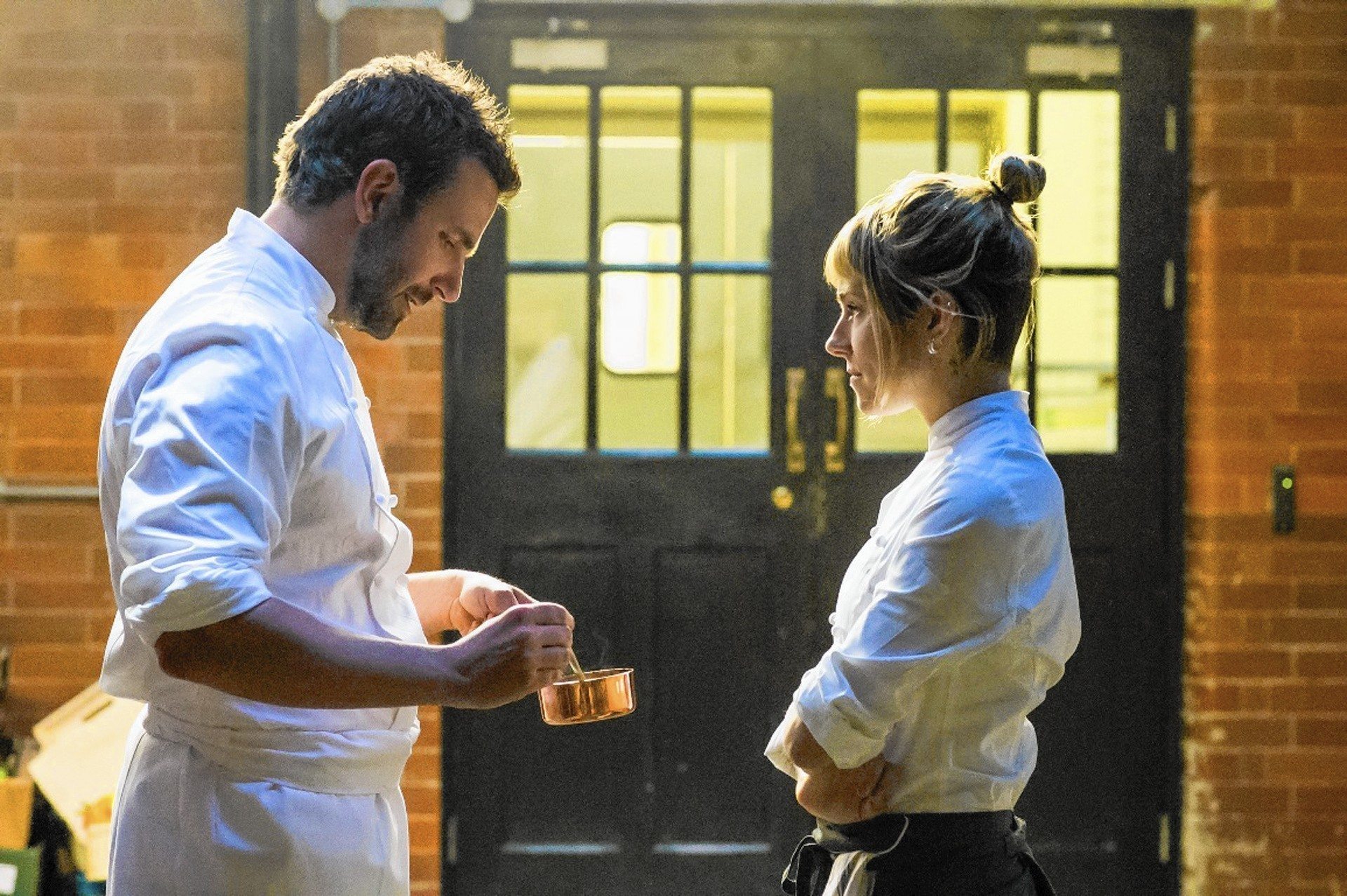
The film was directed by John Wells, with the screenplay done by Steven Knight. Cooper plays Adam Jones, a once-legendary American chef who “f***ed it all up” with drugs and alcohol in Paris, forcing him to pay his penance by shucking countless oysters in a hovel.

A few years pass, and Jones goes to London for a refresh. He wants to gain a third, coveted Michelin star (one star, as a character explains, is like being Luke Skywalker; three makes you Yoda…or Darth Vader, quips Sienna Miller’s Helene).

The first act of the film is its best, as we watch a recovered Jones hop about London penniless with few friends who want to help him make the best restaurant in the world. It’s more or less a heist movie at this point, as Jones runs into old friends and finds that rookie “who doesn’t know how good she is.” Once he finds his dream team, however, everything crashes when he erupts into a Gordon Ramsay furor over their performance.

burnt review

From there, the film becomes far less interesting, which is a shame because the characters and background it establishes has enough intrigue to give the story its steam, but it instead ignores most of these threads in favor of a redemption arc you’ll steadily lose interest in.

The writing is noticeably weak in places, and Sienna Miller starts strong, but finishes as a poor version of what could have been a compelling character. But when Burnt works, it’s an entertaining ride through the world of fast-paced kitchens and heated rivalries you’ll forget have been manipulated into a Hollywood drama. For all of its cheese, Burnt is a brisk movie that would be celebrated if it was made for television.

Grade: B-

Extra Credits: 

  • It goes without saying, but you should eat before watching this movie.
  • Steven Knight did this story already in the superior Eastern Promises. It’s worth a look if you have the time.
  • Alicia Vikander has a surprise cameo (if you ignoring the opening credits). Is there any movie she didn’t agree to act in this year? That’s not a complaint.
  • My biggest takeaway from this movie, honestly, is that Sienna Miller is a woefully underutilized actor. Though Daniel Brühl was clearly having more fun than anyone else in this.
  • I consider this a solid date movie if you don’t want to watch a straightforward romantic comedy. It’s not very funny, but it’ll hold your attention.

For a more in-depth look at Burnt, check back in this Sunday for the Now Conspiring podcast, where we’ll discuss this and other new releases.

I’m Jon and thanks for reading this. You can subscribe to my posts by clicking “Follow” in the right sidebar. Or just say hey on Twitter! @JonNegroni