Why is Pixar Making ‘Toy Story 4?’

toy story 4

When I heard the news yesterday, I almost felt robbed. Excited, but robbed.

The Toy Story trilogy is something I treasure as being one of the few “perfect” (whatever that means) things I grew up with. It’s something that started great, got better and then ended perfectly.

So the news that there would be another entry immediately terrified me. The thought of something sullying the unsullied Toy Story movies is just unbearable.

But that’s my gut reaction, and gut reactions have a tendency to be ruled by emotion, rather than logic. And logically, there a few important things to consider about this news. The “facts.”

This isn’t B Team working on this. Toy Story 4 is reportedly being put together by John Lasseter, Lee Unkrich, Pete Docter and Andrew Stanton. If you need a refresher, that’s Pixar’s round table of masterminds. They’re the talent behind pretty much everything good that’s been going on with Pixar for 20 years now.

One thing’s for sure. This project is in good hands.

John Lasseter:

“We love these characters so much; they are like family to us. We don’t want to do anything with them unless it lives up to or surpasses what’s gone before. Toy Story 3 ended Woody and Buzz’s story with Andy so perfectly that for a long time, we never even talked about doing another Toy Story movie. But when Andrew, Pete, Lee, and I came up with this new idea, I just could not stop thinking about it. It was so exciting to me, I knew we had to make this movie — and I wanted to direct it myself.”

Good enough for me.

Celebrating 10 Years of ‘The Incredibles’ (With Myth-Busting)

Today marks the 10th anniversary of one of Pixar’s most treasured films, The Incredibles. A sequel is in the works, but it’s not due for another few years. In the meantime, let’s take a look at some myths about the movie that deserve to be busted.

Specifically, one of my favorite websites (as you know) is Cracked.com, and they’ve celebrated the anniversary by poking some light-hearted fun at the movie and Pixar. Let’s take a look!

incredibles

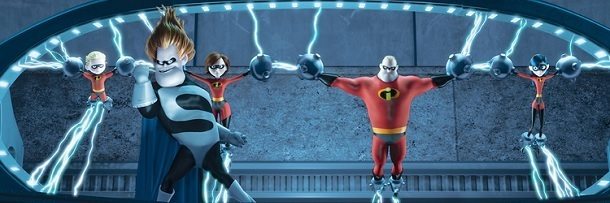
Mark Hill and JM McNab | ‘The Incredibles’ is Disney’s ‘Watchmen:’

The Incredibles shares more than just a premise with the graphic novel Watchmen, which later became a movie itself, albeit one that replaces the source material’s Reagan-era malaise with emo hissy fits. As pointed out by Baltimore Sun writer Michael Sragow, both stories concern a world where superheroes exist but have been forced to retire after the American government outlaws their work for political reasons (apparently Canada and Mexico don’t have any crime worth fighting).

Both movies feature a pathetic hero who feels emasculated in retirement — Nite Owl in Watchmen, Mr. Incredible in The Incredibles. They’re getting old, they’re getting fat, and they’re disillusioned by their mundane lives.

Both superheroes are drawn out of retirement to investigate the disappearances of other retired superheroes. They eventually discover that the murderers are exceptionally intelligent supervillains with no actual powers. There’s Ozymandias in Watchmen and Syndrome in The Incredibles — both once wanted to be superheroes, and even as villains they believe they’re serving the greater good. Also, they both have dumb hair.

There are a lot of issues with that last point, the main one being that Ozymandias wasn’t an outsider to the superheroes like Syndrome was. And his motivations have nothing to do with being accepted as a superhero, as opposed to Syndrome. Their goals, endgame and character arcs are wildly distinct.

The hair thing is pretty accurate, though.

incredibles

Going further, the reasons for why superheroes were outlawed are vastly different between to the two stories. In Incredibles, supers were banned because of their collateral damage and perceived negative influence on the world. Humans just wanted them gone.

In Watchmen, superheroes weren’t really necessary anymore because Mr. Manhattan was a demigod who could solve everyone’s problems (and wars) at will. So the differences between these stories come down to need vs. want.

Lastly, Mr. Incredible is not “drawn out of retirement to investigate the disappearances of other retired superheroes.” That’s just completely false. He’s lured out of retirement to relive the glory days and work for what he believes to be a top-secret government agency. He just wants to be a super again. He doesn’t even realize superheroes are being hunted and killed en masse until a while after Syndrome betrays him on Nomanisan.

I suppose Syndrome believes he’s serving the “greater good,” but it’s certainly not in the same vein as the more serious Ozymandias. Syndrome is really only concerned with satisfying his own ego and eliminating the very concept of being “special” or super. Ozymandias carries his plan forth because he honestly believes it’s the best solution for mankind.

incredibles

Mike Guernsey | The Incredibles — The Return of Heroes Means the Return of Villains:

The ban on heroism prevented heroes from heroing without the fear of legal action, but the supervillains were already operating outside the law — the ban opened the door to a whole new world of crime. You’d half-expect the newly unstoppable villains to take over the planet, but flash-forward 15 years and there’s no evidence of mass slavery, destroyed cities, a villain king — nothing. The supervillains are apparently as extinct as the heroes. When Mr. Incredible sneaks out to do some occasional crime fighting by night, he’s taking on regular old petty criminals.

The article also points out that not long after the Incredibles return to the public eye at the end of the movie, the Underminer arises (literally out of nowhere) as a new, malicious supervillain. Mike, the author, makes the assumption that he’s the first supervillain in a long time, thus claiming the Incredibles to be the cause of some sort of supervillain outbreak.

This isn’t really grounded in any tangible proof, though. Supervillains may not be running around on the screen during the movie (besides Syndrome), but that doesn’t mean they don’t exist. And even if it did, that’s correlation, not causation.

incredibles

Also, that makes me wonder the motivations of these supposed villains. Why would it make sense for you to only be a supervillain if there are superheroes around? Is the assumption that they’re bored and only willing to commit crimes if there’s someone as strong as them ready to foil their plans? When you think about it, the whole thing falls a bit flat.

I think it’s more reasonable to assume that the super villains were still around, but never a pervasive threat. In fact, there probably weren’t that many of them at all to begin with. Mike even points out that the villains (like Bomb Voyage) don’t have any “super powers,” which means the authorities were probably enough to deal with them.

They just did what they pleased and avoided capture, which became that much easier once the superheroes were banned. We also don’t know if superheroes still fought villains as vigilantes (similar to Mr. Incredible and Frozone) over the years despite the ban.

So there you have it. 10 years later and we’re still talking about The Incredibles. Now that’s how you know Pixar is good at making movies.

incredibles

Thanks for Reading! You can subscribe to this blog by email via the prompt on the sidebar. Otherwise, be sure to stay connected with me on Twitter (@JonNegroni). I’ll follow you back if you say something witty and awesome.

Pixar’s Rules For Storytelling #1: Finding Ideas

You may recall Bloop Animation as the group who put together the video for my post, The Pixar Theory. Recently, they’ve been delving even deeper into what makes Pixar, well, Pixar with a new series about storytelling. The video is below, along with a transcribed version.

(The following is a transcript of a video written by Dean Movshovitz and based on The 22 rules of storytelling by Emma Coats):

Choosing an idea is all about finding the essence of your story. Most good stories revolve around watching a character struggle outside of their comfort zone.

We love watching characters have their polar opposites thrown at them.

A rat who wants to be a chef? Think about that idea for a moment. What could be worse for a rat than to have a passion for cooking? To dream to be a chef in a gourmet French restaurant?

Like most storytelling rules, this one is as old as time.

Go on…Pixar’s Rules For Storytelling #1: Finding Ideas

The Pixar Detective, Chapter 13: “The Babysitters”

Hey everyone! Welcome to The Pixar Detective, a serial novel I put together based on the Pixar Theory. The following is a fictional story that explains the theory that all of the Pixar movies are connected and exist within the same universe, using original characters and artwork. The story answers a lot of questions you may have about this theory, but through its own ongoing narrative.

The story originally launched in April, and since then we’ve finished Part 1 and Part 2!

Both are available as iBooks on iTunes, which you can check out here. If you can’t use iBooks, can also download the PDF versions:

Part 1: (PDF version)

Part 2: (PDF version)

Once you’re finished, check back to our Table of Contents, where we’ll be continuing the story through Part 3. A new chapter is released every two weeks on Tuesdays. And please be sure to leave your feedback in the comments for us to read through. Enjoy!

pixar detective chapter 13

Previously on the Pixar Detective!

Still searching for their missing friend, Mary, Stevin and the gang now find themselves in Australia during the year 2001. They’re searching for the future version of Mr. Sumner, the monster they found in the 1930s,  who can hopefully point them to their missing friend.

Meanwhile, a “Hero” named Logan has teamed up with students from Pixar University to initiate a 2319 — an invasion of the monster world — in order to stop the monsters from strategically abducting children.


Use the prompt on the sidebar to subscribe for updates or just follow me and Kayla on Twitter to stay connected – @JonNegroni – @KaylaTheSavage

Thanks for reading! What did you think of Chapter 13?

The First Inside Out Teaser Is Pretty Much Everything You Want.

Details surrounding Pixar’s next big film (and first original since Brave) have been scarce to say the least. But that’s changed with the release of the first ever teaser (and footage) of Inside Out. It begins with an extended look at some of Pixar’s greatest hits and explores the idea of what makes us love these movies to begin with: emotion.

Check out the full teaser below:

Inside Out comes to US theatres in 3D on June 19, 2015.

From an adventurous balloon ride above the clouds to a monster-filled metropolis, Academy Award®-winning director Pete Docter (“Monsters, Inc.,” “Up”) has taken audiences to unique and imaginative places. In Disney•Pixar’s original movie “ Inside Out,” he will take us to the most extraordinary location of all—inside the mind. 

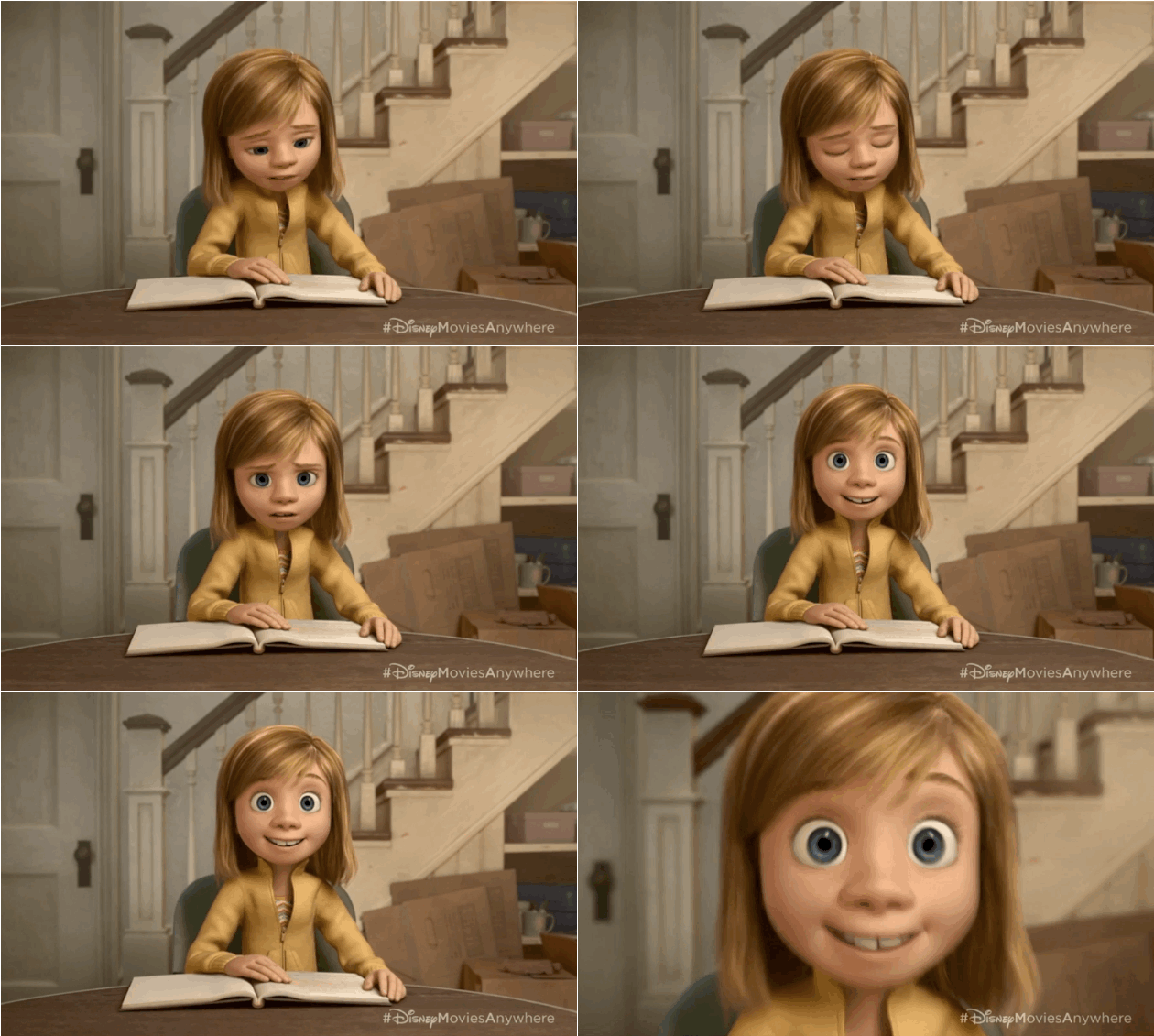
Growing up can be a bumpy road, and it’s no exception for Riley, who is uprooted from her Midwest life when her father starts a new job in San Francisco. Like all of us, Riley is guided by her emotions – Joy (Amy Poehler), Fear (Bill Hader), Anger (Lewis Black), Disgust (Mindy Kaling) and Sadness (Phyllis Smith). The emotions live in Headquarters, the control center inside Riley’s mind, where they help advise her through everyday life. As Riley and her emotions struggle to adjust to a new life in San Francisco, turmoil ensues in Headquarters. Although Joy, Riley’s main and most important emotion, tries to keep things positive, the emotions conflict on how best to navigate a new city, house and school.

The Pixar Detective, Chapter 11: “2319”

Hey everyone! Welcome to The Pixar Detective, a serial novel I put together based on the Pixar Theory. The following is a fictional story that explains the theory that all of the Pixar movies are connected and exist within the same universe, using original characters and artwork. The story answers a lot of questions you may have about this theory, but through its own ongoing narrative.

The story originally launched in April, and since then we’ve finished Part 1 and Part 2!

Both are available as iBooks on iTunes, which you can check out here. If you can’t use iBooks, can also download the PDF versions:

Part 1: (PDF version)

Part 2: (PDF version)

Once you’re finished, check back to our Table of Contents, where we’ll be continuing the story through Part 3. A new chapter is released every two weeks on Tuesdays. And please be sure to leave your feedback in the comments for us to read through. Enjoy!

chapter 11 pixar detective


Previously, on the Pixar Detective

pixar detective part 1 coverIn the year 2014, two kids embarked on a mission to find their missing friend, Mary. The friends, Stevin Parker and Wallaby Jones, teamed up with their mysterious teacher, Alec Azam, who mentored Mary in the arts of magic and traveling through time by use of doors.

Along the way, Stevin and Wallaby gained new allies, including a monster from another world and a girl with dangerous superpowers. Eventually, they were forced through a door that would lead them to the location of their next clue: Sydney, Australia.


Use the prompt on the sidebar to subscribe for updates or just follow me and Kayla on Twitter to stay connected – @JonNegroni – @KaylaTheSavage

Ranking the Pixar Movies By Box Office Success

Trying to compare the Pixar films according to quality and personal affection is a pointless task, in my opinion. Of course, I could easily tell you what my favorite films are and rank them, but how does that really help anyone?

Everyone has their favorites, but everyone also loves lists and comparisons. So for the sake of this post, I’m pointing out how successful each one was compared to the other. Prepare to be surprised.

To crunch the numbers, I added the domestic and foreign totals to provide the worldwide figures. I also adjusted everything according to inflation in 2014, so you’re really seeing which films made the most value in their day.

I did not rank these in order of profitability, as in I don’t point out how much it cost to make the film versus how much it made. Instead, I kept it simple and only pointed out how much money the film made overall.

Let’s begin!


#1. Finding Nemo

ranking  the pixar movies

How much it made: Many assume that Toy Story 3 was the first Pixar film to make over $1 billion worldwide, and they’re technically right. In 2003, Finding Nemo just barely came short of the billion mark with $936 million made worldwide. But when you adjust for inflation, the underwater animated film actually made $1.2 billion worldwide, easily surpassing the threequel.

Why? This is pretty impressive considering the fact that Finding Nemo had fewer advantages than more recent Pixar films. This was before foreign markets were becoming the brunt of Disney Pixar’s audience. In fact, I’d argue that it opened the floodgates to how well U.S. films can perform overseas.

Put simply, Finding Nemo benefitted from having extremely wide appeal. While movies about toys, superheroes, and balloon houses are fun concepts, many people of different ages found a reason to check out this film about a father finding his lost son in an endless ocean.


#2. Toy Story 3

ranking  the pixar movies

How much it made: The possibly final entry in the Toy Story franchise is also its most successful. It was the first Pixar film to make $1 billion worldwide ($1.1 billion adjusted for inflation), and unlike Finding Nemo, its gap between money made domestically and foreign is much narrower.

Why? Waiting a decade to finish the franchise was a smart decision on Pixar’s part. Strong word-of-mouth, the return of the original cast, and an emotionally wrenching premise made this a can’t-miss film for the countless people who fell in love with Toy Story over the course of 15 years.


#3. Up

ranking  the pixar movies

How much it made: It didn’t just collect Oscars. Up pulled in an impressive $731 million worldwide. Adjusted from 2009, that’s over $812 million.

Why? The film had broad international appeal thanks to its setting, and it came at a time when Pixar was hitting its stride with back-to-back hits. It also benefitted from a strong opening that had critics raving over the score and memorable characters. That, and this was also the first Pixar film to reap the benefits of 3D ticket prices.


#4. The Incredibles

ranking  the pixar movies

How much it made: Following the success of Finding Nemo was an impossible task, so leave it to the superhero film to accomplish just that. The Incredibles made a whopping $631.million worldwide in 2004, which is actually $795.8 million by today’s standards.

Why? One of the main advantages of mashing up several genres like superheroes, family drama, comedy, animation, and spies is that you can generate a ton of interest in your movie. Families and young adults came out to this film in droves, and it didn’t hurt that audiences were still enamored with the success of Finding Nemo.


#5. Monsters University

ranking  the pixar movies

How much it made: This 2013 prequel to Monsters Inc. narrowly surpassed its predecessor by raking in $743.5 million worldwide ($760 million adjusted for inflation). It’s important to note that it made the bulk of its money overseas, like many of the recent Pixar films.

Why? As a rule, sequels and even prequels tend to build upon existing audiences, no matter the downgrade in quality. Plus, the film was quite enjoyable and a step up from Pixar’s previous outings (Cars 2 and Brave).


#6. Monsters Inc.

ranking  the pixar movies

How much it made: This is the Pixar film that showed critics just what the studio was capable of, as it was the first of the films to spike in profit. The 2001 film made an impressive $562.8 million worldwide ($756.4 adjusted), with an almost even split between domestic and foreign markets.

Why? This film came out after a 1-year hiatus for Pixar, and it had been three years since the studio had released a non-sequel. Thanks to Monsters Inc., the momentum for Pixar as it entered the 21st century was set early, and high.


#7. Ratatouille

ranking  the pixar movies

How much it made: Only Pixar can make a film about a rat learning to cook in Paris a huge success with over $623 million made globally ($716.7 million adjusted).

Why? Foreign markets definitely carried this film, representing about 2/3 of the profits. Also, audiences who were displeased with Cars were happy to see a Pixar film with more traditional storytelling (even though it was anything but).


#8. Toy Story 2

ranking  the pixar movies

How much it made: That’s right, one of Disney’s first forays into a sequel (they’re notorious for not doing big screen sequels at all) was a Pixar film. And it totally paid off. Toy Story 2 ran away with $485 million worldwide. These days, that’s nearly $700 million. Keep in mind that this was in 1999; a time when the box office competition was fierce.

Why? As we now know, the film was just as good if not better than the original, and that prompted millions of people who loved the first film to go see this one. And it helped that VHS sales build a lot of hype for this film four years after the original. The lesson, of course, is that there should be a lot of time in between sequels for the sake of direction and precision. Not many people have learned this lesson, sadly.

#9. Cars 2

ranking  the pixar movies

How much it made: Pixar’s follow-up to the record-breaking Toy Story 3 was yet another sequel. And they suffered for it. Cars 2  brought in about $559 million worldwide, or $593 million adjusted for inflation. A little more than half of what Pixar made the previous year.

Why? Some are wondering why it made so much when it shouldn’t. Others may be wondering why it didn’t make as much. Both questions are answered by the fact that the film was both helped and hurt by its predecessor, Cars. Yes, it had plenty of interest from fans of the original, but the problem was that there weren’t that many fans anyway. But it still made good money, especially overseas. This was partly due to the various locales seen in the film and Disney’s expertise at managing foreign markets by 2011.


#10. WALL-E

ranking  the pixar movies

How much it made: This may surprise a lot of you, but WALL-E only brought in $521 million worldwide. Adjusted for this year, that’s only about $576.8 million.

Why? Oddly, this is celebrated as one of Pixar’s best films, both by audiences and critics. And yet it is one of the least successful. Sadly, this is mostly because the film came out during the onset of Great Recession, which badly hurt money made domestically. On top of that, many moviegoers were put off by the film’s lack of dialogue, especially in the early parts of the film.


#11. Toy Story

ranking  the pixar movies

How much it made: The first of the Pixar films performed pretty well for a forerunner. It made $362 million worldwide, with most of that money being domestic. Nowadays, that translates to about $566 million, which is nothing to scoff at.

Why? Unlike its successors, Toy Story didn’t have the luxury of Pixar being a household name. It earned its success solely from being a good film and shattering expectations as the first computer-animated film ever. In fact, I’m more surprised that this isn’t lower on the list considering the risk that was put into making it. Toy Story truly is a miracle of film.


#12. Brave

ranking  the pixar movies

How much it made: Still hurting from the disappointment that was Cars 2, this 2012 film also disappointed with a meager $539 million worldwide total ($559 million adjusted). That’s still pretty good, though it is certainly low compared to the rest of the Pixar family.

Why? Entire research papers could be written about the mystery surrounding Brave‘s underwhelming premise. I’m not sure I fully understand why it fell short for me, personally. Whatever the reason, Brave just didn’t click or resonate with people as deeply as previous Pixar films, which made this an animated outing for only a certain group of moviegoers (kids and their parents looking for a getaway).


#13. Cars

ranking  the pixar movies

How much it made: Released in 2006, Cars didn’t really deliver for Pixar as much as they hoped with a decent $462 million worldwide ($546 million adjusted). Of course, it was still incredibly profitable for Pixar, seeing as it only cost $120 million to make.

Why? You know a film has problems when it falls so short after two massive hits like Finding Nemo and The Incredibles. It even had the benefit of coming along after a 1-year hiatus. Still, audiences weren’t impressed with the premise, and Cars ultimately suffered. Strangely, the sequel was still green-lit and made a bit more money years later.


#14. A Bug’s Life

ranking  the pixar movies

How much it made: Pixar’s second film was great in its own right, even though that didn’t necessarily translate to box office sales. It made just $363 million worldwide, which is about $530.5 million adjusted for inflation. Interestingly, it made more money overseas than Toy Story did, and it was the first of the Pixar films to make most of its money in foreign markets.

Why? Put simply, the novelty of computer animation had worn off a bit. So A Bug’s Life had to rely on just being a good movie. That’s why it made as much as it did, but the basic fact is that a film about toys coming to life was more appealing than a film about bugs fighting grasshoppers.


Conclusions:

One of the most interesting things about this list is that even the lowest entry of Pixar’s films is a box office success that stands up to most of the films that are coming out today. That means in 14 films over the course of 19 years, Pixar hasn’t had a single flop. No other studio in history can compare to that kind of consistent success.

In the years to come, we’ll see if Pixar can maintain the status quo or make another huge leap forward. Inside Out premieres next summer, and it could prove to be the next Monsters Inc. in terms of reviving the studio’s creative fortunes. And with new sequels like Finding Dory and The Incredibles 2 on the horizon, along with some other originals like The Good Dinosaur, Pixar may be poised for its first renaissance.
ranking  the pixar movies

Thanks for Reading! You can subscribe to this blog by email via the prompt on the sidebar. Otherwise, be sure to stay connected with me on Twitter (@JonNegroni). I’ll follow you back if you say something witty and awesome.