Is ‘Cars 3’ The Best ‘Cars’ Movie? — Cinemaholics

I’ve spent the last seven days or so talking about Cars 3Cars, and Pixar in general, but my recent sit-down with Will Ashton and Kayla Savage on Cinemaholics was a true highlight. We reviewed Cars 3, of course, but we also spent a considerable amount of time discussing the Cars franchise as a whole and why it’s Pixar’s most controversial brand.

We also shared our thoughts on two big movies that released this week: 47 Meters Down and Rough Night. Will Ashton saw the former and Kayla Savage and I saw the latter. Hopefully, you’ll appreciate our newly titled segment at the beginning of the episode, “But Our Emails,” where we took a few minutes to read your messages over the last few weeks.

Send us your questions! Cinemaholicspodcast[@]gmail.com. 

Go on…Is ‘Cars 3’ The Best ‘Cars’ Movie? — Cinemaholics

‘Cars 3’ Review: A Surprisingly Good Sports Drama, But With Cars

Is Pixar’s Cars franchise worth another lap with Cars 3

One of the stark differences between the Cars movies and many of the other Pixar films is that there’s no explicit purpose for its own high concept…except to sell toys. There’s no real commentary on what it means to be a car or own one, and audiences are instead given a “human” comedy that replaces the characters with cartoon sketches simply for visual and experiential distinction.

Even Zootopia, a Disney film that appears to do the same with animals, allows its story to be controlled and guided by the real implications of a society governed by anthropomorphized animals in order to say something relevant about humans. Pixar’s magic has been to get away from that type of storytelling with films like Toy Story, which commit to the real differences between the plight of toys and the separate experience of being a human.

Go on…‘Cars 3’ Review: A Surprisingly Good Sports Drama, But With Cars

Every Pixar Film Ranked By Their Box Office Success

pixar movies

From Toy Story to Finding Dory, which Pixar movies found the most financial success with audiences? 

A few years ago, I did a ranking just like this in the year leading up to Inside Out. It was simple: I took the worldwide box office returns for each Pixar movie and adjusted for inflation, though I measured the numbers according current rates of inflation (2014 at the time). A faulty metric, now that I take a second look.

Honestly, it’s hard to rank these movies on the same playing field, because so many circumstances determined their profits. 3D ticket sales and a widening international market make it harder to define which Pixar movies were more “successful” than others based on their own terms and fair context.

So this time, I’m only looking at two factors: domestic box office and a rate of inflation with 1995, the year that Toy Story came out. So all of the numbers you’re about to see bolded are NOT the actual numbers you’ll find online, but rather they’ve been modified to match what they were worth 22 years ago. UPDATE: I’ve since added Cars 3 and Coco to this list. 

Let’s start at the bottom of the list this time with…

Go on…Every Pixar Film Ranked By Their Box Office Success

The Mummy Comes At Night — Cinemaholics

I’m still working on putting the mental pieces of my brain back together after sitting through The Mummy, and strangely enough, I’m almost as equally confused about It Comes At Night, A24’s would-be horror classic beloved by critics and ravaged by just about everyone else. Luckily, I had plenty of help on the show this week to navigate these new films and then some.

We finally managed to lasso in Andy Herndon from The D-Cast for the “Mummy” segment of this week’s episode. True, we brought him in for something completely removed from Disney (which he of course pointed out with sharp irony), but as expected, we had a great conversation and will have him back again soon.

Go on…The Mummy Comes At Night — Cinemaholics

‘It Comes At Night’ Tries Way Too Hard To Make You Think It’s A Horror Movie

It Comes At Night

It Comes At Night is yet another horror film from A24 that promises to wrap viewers up in an atmospheric resurgence of creepy tales that rely less on jump scares and more on pure dread. Unfortunately, It Comes At Night falls slightly short of both.

 Any film that can transport me into a creepy setting I haven’t thought of in a while, even for a few short moments, is enough to praise the director for pulling off one of the horror genre’s greatest challenges. Trey Edward Shults (Krisha) wrote and direct It Comes At Night, which mostly delivers on what I love the most about these movies. I felt like I was alone in the dark of the woods, or the flashlight brazed wooden hallways of the main house. The fact that this film is centered around a lone survivalist family living in a large house in the woods while an undefined virus wipes out humanity in the nearby cities is just a bonus.

Joel Edgerton plays Paul, the patriarch with the keys to the house wrapped safely around his neck, making the rules for his wife and son and taking as few risks as possible to ensure their safety. Shults mines a lot of symbolism and relatability out of this simple premise, especially when a new young family shows up and is allowed to share the house with Paul, Sarah, and Travis. The growing paranoia that inevitably becomes a boiling point between the two families is wonderfully set up and established, in no small part thanks to Travis’s frequent nightmare sequences that serve as mini-prophecies that effectively delay the climax.

Only when the climax does come, it’s revealed that the entire movie is essentially a misdirect. Though some in the audience will welcome this, if only because they were too caught up in the real movie in front of them, many more will feel let down by quite a few things. The title, It Comes At Night, is an intentional prank. Though it can be stretched to fit what’s truly to come, you’ll feel less convinced as Shults places extraneous scenes of suggestive catastrophe that receive no payoff within their own terms.
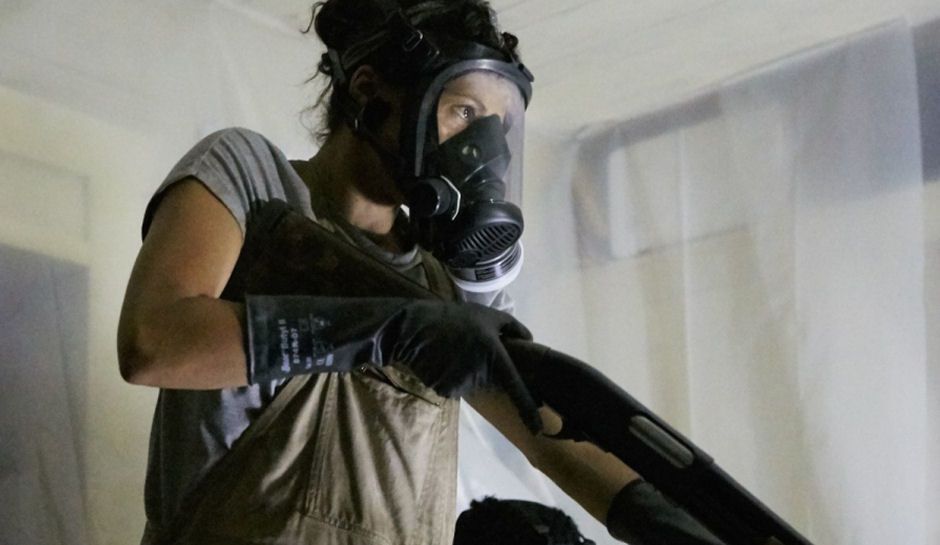
It Comes At Night

It’s almost impressive how overstuffed the film feels anyway with its ambiguous visual storytelling, a highlight at times, while maddening the next. At one moment, you might be trying to understand the significance of the red door, the only way in and out of the house. Is it meant to invoke Passover, or some type of paradox in how it means “Welcome?” The film doesn’t offer its own stance and instead  rushes to an equally ambiguous ending that at first glance leaves many questions unanswered.

For this reason, It Comes At Night feels like a mandate to give it multiple viewings and a wide array of interpretation for the full effect. Though I never felt at any point during the runtime that this is the main draw, deservedly. What could have been an unconventional post-apocalypse narrative drenched in nihilism instead comes off as one of the Walking Dead episodes that tries to be more meaningful than it really is. It’s a passable (albeit beautiful) thriller infatuated with horror, while never bothering to commit.

Grade: B


Thanks for reading this. To get updates on my theories, books, and giveaways, join my Mailing List.

Or just say hey on Twitter: @JonNegroni


Why There Are No Humans In Pixar’s ‘Cars’

We all know that CarsCars 2, and Cars 3 are confusing enough when thinking about how their world works or makes sense compared to ours. But for Pixar Theory fans, we have a lot of great arguments to hang our tin-foil hats on. The following is a transcription of the video you can watch above explaining all of this.

Despite what you may think of them, people love the Cars movies. No, they’re not in love with the stories, characters, or visuals, though some are. They’re just in love with talking about the conceptual implications of an animated movie that raises a ton of questions about its in-universe logic.

The random truth is that dissecting these colorful, magical kids’ movies is actually pretty fun, even for me, someone who was never in love with the Cars movies themselves or all that interested in the question: “did the Cars take over mankind and if they did, how?” I think it’s fairly obvious that the filmmakers at Pixar didn’t have a meta-commentary in mind about A.I. taking over the world through the cars we love or any other idea in that vein…well, maybe they did.

Go on…Why There Are No Humans In Pixar’s ‘Cars’

Wonder Woman and Captain Underpants: The First Epic Movie Reviews — Cinemaholics

This week on Cinemaholics, I’m joined by special guest Kayleigh Donaldso, writer for ScreenRant and Pajiba. We talked about Wonder Woman, of course, and had a spirited discussion about the state of the DCEU and how we’d rank the movies so far.

Will Ashton was on the show as well to talk about Captain Underpants: The First Epic Movie, which I unfortunately had to miss this weekend. But I did get a chance to share my thoughts on the first season of Riverdale (finally), and Maveryke Hines tried to convince me to finally catch up on House of Cards now that Season 5 is out.

Go on…Wonder Woman and Captain Underpants: The First Epic Movie Reviews — Cinemaholics