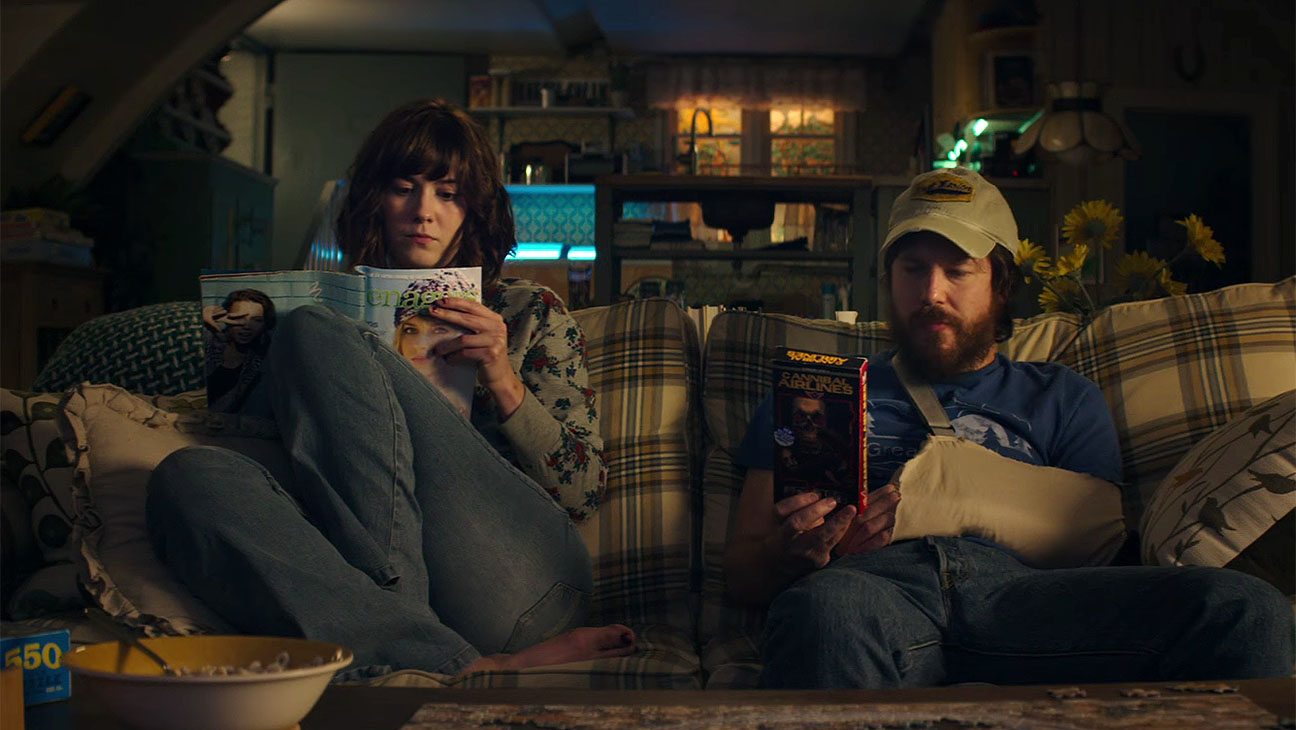
‘It Comes At Night’ Tries Way Too Hard To Make You Think It’s A Horror Movie

It Comes At Night

It Comes At Night is yet another horror film from A24 that promises to wrap viewers up in an atmospheric resurgence of creepy tales that rely less on jump scares and more on pure dread. Unfortunately, It Comes At Night falls slightly short of both.

 Any film that can transport me into a creepy setting I haven’t thought of in a while, even for a few short moments, is enough to praise the director for pulling off one of the horror genre’s greatest challenges. Trey Edward Shults (Krisha) wrote and direct It Comes At Night, which mostly delivers on what I love the most about these movies. I felt like I was alone in the dark of the woods, or the flashlight brazed wooden hallways of the main house. The fact that this film is centered around a lone survivalist family living in a large house in the woods while an undefined virus wipes out humanity in the nearby cities is just a bonus.

Joel Edgerton plays Paul, the patriarch with the keys to the house wrapped safely around his neck, making the rules for his wife and son and taking as few risks as possible to ensure their safety. Shults mines a lot of symbolism and relatability out of this simple premise, especially when a new young family shows up and is allowed to share the house with Paul, Sarah, and Travis. The growing paranoia that inevitably becomes a boiling point between the two families is wonderfully set up and established, in no small part thanks to Travis’s frequent nightmare sequences that serve as mini-prophecies that effectively delay the climax.

Only when the climax does come, it’s revealed that the entire movie is essentially a misdirect. Though some in the audience will welcome this, if only because they were too caught up in the real movie in front of them, many more will feel let down by quite a few things. The title, It Comes At Night, is an intentional prank. Though it can be stretched to fit what’s truly to come, you’ll feel less convinced as Shults places extraneous scenes of suggestive catastrophe that receive no payoff within their own terms.
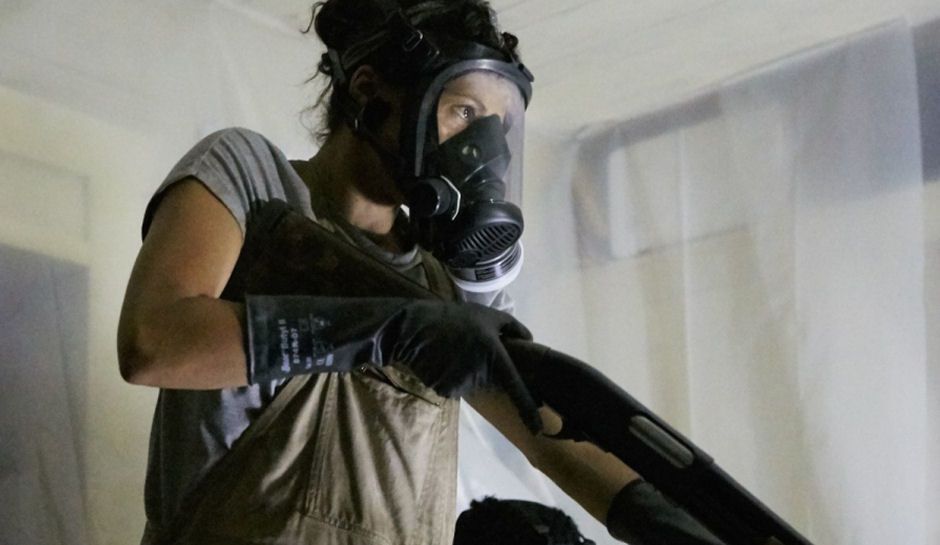
It Comes At Night

It’s almost impressive how overstuffed the film feels anyway with its ambiguous visual storytelling, a highlight at times, while maddening the next. At one moment, you might be trying to understand the significance of the red door, the only way in and out of the house. Is it meant to invoke Passover, or some type of paradox in how it means “Welcome?” The film doesn’t offer its own stance and instead  rushes to an equally ambiguous ending that at first glance leaves many questions unanswered.

For this reason, It Comes At Night feels like a mandate to give it multiple viewings and a wide array of interpretation for the full effect. Though I never felt at any point during the runtime that this is the main draw, deservedly. What could have been an unconventional post-apocalypse narrative drenched in nihilism instead comes off as one of the Walking Dead episodes that tries to be more meaningful than it really is. It’s a passable (albeit beautiful) thriller infatuated with horror, while never bothering to commit.

Grade: B


Thanks for reading this. To get updates on my theories, books, and giveaways, join my Mailing List.

Or just say hey on Twitter: @JonNegroni


Review: 10 Cloverfield Lane Explores Clever New Ways to Build a Franchise

10 cloverfield lane review

10 Cloverfield Lane is built on a premise that goes beyond itself: what if you could watch a sequel to a movie without knowing anything about it?

The news of this semi-followup to the found-footage monster movie Cloverfield only dropped this past January. Scant and frankly uninformative marketing materials and trailers have done little to paint what 10 Cloverfield Lane truly is as a film, and that’s for a best. This is a movie that relies heavily on how you engage with its story and characters, and that’s much easier when you have no idea what they’re going to do next.

In other words, it’s a fantastic thriller that also happens to be brimming with surprises. If you haven’t seen the movie yet and want to have the same “pure” experience I had, then I strongly suggest you stop reading this review now.

While the original Cloverfield centered on a city-wide disaster, this sequel (if you want to call it that) is mostly contained within a small, underground bunker. After crashing her car, Michelle (played by Mary Elizabeth Winstead) is saved by an ex-navy farmer named Howard (John Goodman). He takes her to his shelter just as an attack from “who knows where” renders the air completely toxic. They’re joined by Emmet, the hired hand who helped build the bunker (John Gallagher Jr). Unlike Michelle, he saw the chaos unfold and fought his way in just as Howard was shutting the door for good.

10 cloverfield lane review

From there, 10 Cloverfield Lane explores the deep tension between three claustrophobic characters. Michelle is convinced something is afoot, despite Emmet’s confidence that the world really has ended. They’re both terrified and somewhat perplexed by Howard’s eccentric behavior, and their dynamic serve as a sort of surreal take on the “suburban” family.

The moving parts of this film are just as diverse. There are ample scares and tense moments, but the movie also contains a good amount of humor carried by Goodman’s mesmerizing performance as the unpredictable conspiracy theorist. And the characters frequently find themselves having genuine breakthroughs with each other emotionally, adding even more weight to the overt symbolism that is their three-person family trapped under unusual circumstances.

Winstead as Michelle is terrific throughout, always thinking on her feet and fighting solutions just as quick as she causes the problems she finds herself in. Lesser films would be content to leave Michelle to a reactionary state, letting luck dictate her development. Instead, she is as quick to action as any other character, further generating the tension for this film’s best scenes, including a chilling board game session.

Right after seeing this film, many will solely talk about the ending, which is both the weakest and strongest aspect of the movie. It’s strong when it comes to ambition and unbridled entertainment, but it ultimately holds the film back from being one cohesive narrative. There’s something to be said of a moment being too surreal to work as an ending, even if it’s done well. And there’s something about the tail end of the final act that doesn’t feel quite right when held up against the rest of what is otherwise a killer experience.

Grade: B+

10 cloverfield lane review

Extra Credits:

  • This is a movie that I think a lot of people (including myself) will love in spite of its flaws. It’s just so tightly written and full of big moments that stick with you long after the credits.
  • This is a fantastic directorial debut for Dan Trachtenberg. Granted, he had a lot of help from J.J. Abrams and it shows, but I’m definitely excited for his sophomore attempt.
  • There’s a reason John Goodman’s “Howard” is written so well. Damien Chazelle from Whiplash (my favorite movie of 2014) co-wrote the screenplay along with Josh Campbell and Matthew Stuecken.
  • Finally, Mary Elizabeth Winstead is getting great roles again. She’s one of the most underutilized talents period. In this film, she goes toe to toe with John Goodman at his best and doesn’t bat an eye.
  • Speaking of Goodman, I haven’t had this much fun watching him onscreen since his stint on Community. Or even Big Lebowski. At his age, it’s great he’s still delivering superb performances.
  • Ah, the mystery box strikes again.


Review: ‘Nightcrawler’ is Jake Gyllenhaal’s Most Memorable Performance Yet

Nightcrawler, not to be confused with a certain X-Men who is yet to get his own movie (not that he should), is the answer to a question you’ve probably never asked:

What happens when a criminal becomes a journalist?

After all, plenty of people already consider the media to be run by criminals. Nightcrawler expands that concept to believable, and unforgettable lengths.

The movie stars Jake Gyllenhaal as Lou Bloom, a driven sociopath who has one basic goal. He wants to make money (illegally if he has to) by doing something he loves. The problem is that when he wants something, he’ll do anything to get it. At his core, he’s ultimately a thief of both possessions and even ideas.

His cold, calculating mind is offset by a nearly convincing extraversion. He smiles as he delivers the lines of dialogue that haunt the audience as his story unfolds. The first act expertly introduces us to Bloom by not just showing that he’s a criminal. He proves to us that he’s a sociopath, for reasons that get into spoiler territory.

Ultimately, his actions lead to business success as a nightcrawler (an offhand term for freelancers who record video from crime scenes late at night). The movie is shot almost entirely from his perspective as we watch him negotiate and force himself into the world of journalism with his suspiciously caught video of violent crimes that cater to a specific audience. You can probably see where this is going, and it doesn’t take much to acknowledge the rampant nods that this is also a satire of modern media.

Written and directed by Dan Gilroy, brother of Tony Gilroy (Michael Clayton), Nightcrawler is an intense, thrilling movie with a dark sense of humor, to the point where you may laugh at just how twisted it frames Bloom up to the “critical moment.”  It warranted more laughs from the audience than some comedies I’ve seen.

I wouldn’t say it’s Gyllenhaal’s best performance ever, but it’s certainly his most memorable in my opinion. Like Matthew McConaughey, he’s had a pretty epic string of great movies these past few years. And Nightcrawler is certainly a highlight.

Definitely worth watching.

Thanks for Reading! You can subscribe to this blog by email via the prompt on the sidebar. Otherwise, be sure to stay connected with me on Twitter (@JonNegroni). I’ll follow you back if you say something witty and awesome.