The Ocean’s 11 Series (Anyway, That’s All I Got)

ocean's 11

This week, we decided to look back on the series of films that has led up to this past week’s release of Ocean’s 8. We start all the way back in 1960 with The Rat Pack, make our way through Steven Soderbergh’s trilogy, and finally arrive at the newest installment. Afterwards, we take some time to read some of YOUR feedback (we’re sorry it took this long), which will be concluded in next week’s episode. Hosted by Sam Noland, Jason Read, and Anthony Battaglia!

Question For You: What is your favorite heist movie? Leave a comment below, send us an email (ataigpodcast@gmail.com), or hit us up on Twitter: @AnywayCast

Go on…The Ocean’s 11 Series (Anyway, That’s All I Got)

Review: ‘Money Monster’ Is Almost, But Not Quite, a Buy

money monster review

Films about Wall Street, greed, and the likely combination of the two have always been reserved for a certain type of moviegoer. Mostly the ones who care enough to understand the differences between the DOW and the NASDAQ, for example.

Last year’s The Big Short might have started a new trend, though, when it comes to films about how “big money” affects everyone, not just rich stockbrokers. And if that film was a prototype for how a complicated financial crisis could be better explained to outsiders or newcomers, then Money Monster feels like its made-for-TV spinoff.

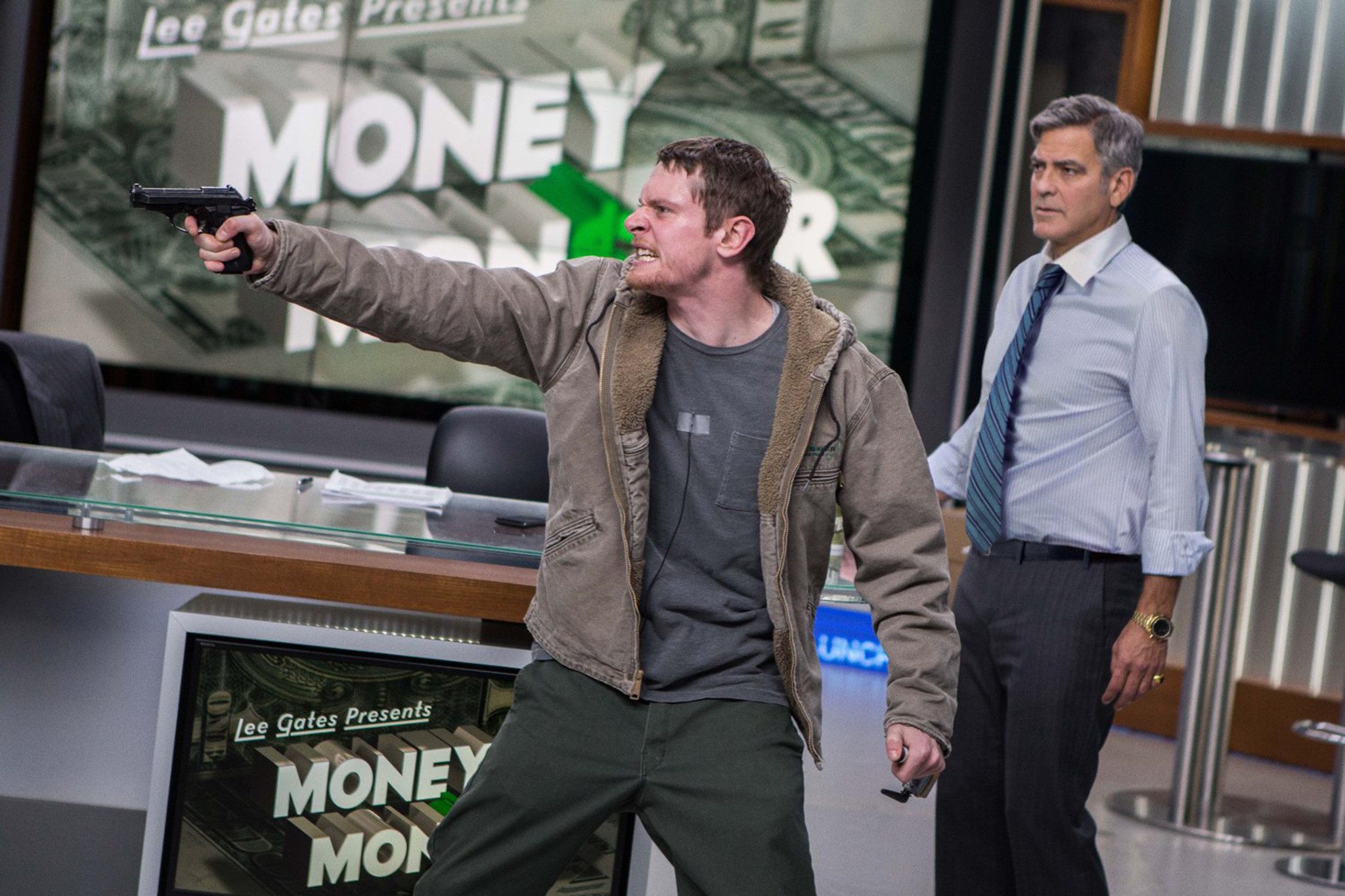
That’s not to disparage the movie, outright, but simply illustrate the downsizing in scale and entertainment value. To hook viewers, Money Monster begins as a hostage thriller, when a disgruntled victim of a bad call (played by Unbroken star, Jack O’Connell) hijacks a live Mad Money TV show clone hosted by George Clooney playing George Clooney if he had Jim Cramer’s job.

But as a whole, Money Monster wants to be about more than a singular man in search of answers while his finger is on a trigger, ready to set the studio to explode on live TV. It tries hard to place universal attention on the millions of people we didn’t really see on The Big Short. The ones who lost big when they bet big.

money monster review

The movie even transitions its multi-camera editing to ample shots of normal people reacting normally and nonchalant to what is frankly a terrifying situation occurring down the street. The intention is to drive home the point that people care little about the details of where their digitized money goes, but it falls flat about the seventh time the viewer (who has so far been hooked into a competent psychological showdown) is shown seemingly random scenes of hackers across the world playing video games while all of this goes down.

It’s these dramatic and abundant tonal shifts that weaken what could have otherwise been an effective, even moving film carried well by Julia Roberts, who plays the director in charge of keeping the cameras running per the gunman’s demands. The three-way-tug between her, O’Connell, and Clooney is easily Money Monster at its most interesting and somewhat unique. It’s just a shame that director Jodie Foster felt the need to cram quasi-relevant pop culture and news junkie references all over this film to drive home a point that could have been made with much less.

Grade: C+

Extra Credits:

  • Despite the low grade, I still think this movie is worth seeing for a lot of people. They just have to put up with a lot of eye-rolling fake news clips and Vine references while waiting for the good stuff the movie does provide (eventually).
  • I have a soft spot for Jack O’Connell, mostly due to his lightning-in-a-bottle performance as Cook in Skins. It’s almost a problem for me because I can’t unhear his British accent.
  • I didn’t say much about George Clooney for the same reason I didn’t in Tomorrowland or most of his other movies. The guy knows that at this point, he’s best at his most familiar. Though I’m craving an artistic renaissance from him, because we all know his talent didn’t stop at Up in the Air.
  • The above goes double for Giancarlo Esposito, who plays the one-note police captain.
  • I forgot to mention that this movie’s attempts at humor land about half the time. And when it doesn’t work, it really doesn’t work.
  • I’m going to rate Money Monster a SELL. Or however a C+ translates.

I’m Jon and thanks for reading this. You can subscribe to my posts by clicking “Follow” in the right sidebar. Or just say hey on Twitter! @JonNegroni

Review: ‘Tomorrowland’

Tomorrowland is the kind of movie you watch as a kid and love for your whole life, even though adults hated it when it came out.

It’s very imperfect, and the ending is truly atrocious and mishandled. But the good in Tomorrowland far outweighs the bad.

Specifically, this is a Brad Bird film through and through. The cinematography and grand vision behind the movie are unique and incredibly entertaining (isn’t that what a movie should be?) The action and set piece moments are beautifully shot and for once, I can say they’re inspiring.

The film’s saving grace is its superb writing, though I have to give the actors a lot of the credit here. The dialogue is good, but George Clooney, Britt Robertson, and newcomer Raffey Cassidy make it exceptional. Cassidy in particular is about to have a stellar career.

Perhaps I’m going easy on Tomorrowland due to my fondness for Brad Bird as a director and the fact that this film is wholly original (it’s no adaptation or remake). But I was honestly inspired by many moments in this film, even if they were a little uneven and went in strange directions. There’s still plenty to appreciate in this ambitious script of whimsy, and this is a film that kids shouldn’t miss.

Grade: B+. 

Disney's TOMORROWLAND

Extra credits

  • I just want to reiterate how enchanting Raffey Cassidy was in this film. Just please, Disney, hold off on shoehorning her into some kind of superhero role.
  • Hugh Laurie’s part in this film felt unfinished, much like the location of Tomorrowland itself. Still, he had some great lines as Governor Nix.
  • The house invasion scene is probably the film’s high point, and the set of moments in Tomorrowland that made me feel like a kid again. There’s so much potential in this source material.
  • I’ve been waiting for Britt Robertson to have a truly good performance since…eh…The Longest Ride. She’s great.
  • Yes, the overall message is pretty preachy, but it shouldn’t put anyone off. The “big idea” of Tomorrowland should resonate with everyone. We can and should do better.

Tomorrowland was directed and written by Brad Bird. It was also written by Damon Lindelof. It stars Britt Robertson as Casey Newton, George Clooney as Frank Walker, Hugh Laurie as David Nix, and Raffey Cassidy as Athena. It’s now playing in theaters everywhere.

Thanks for reading! If you like this blog, you can subscribe for weekly updates by clicking the “Subscribe” button on the right sidebar. Or just follow me on Twitter for the latest updates – @JonNegroni

The Batman Theory Of Everything

batman theory

The Tim Burton “Batman” movies and the Joel Schumacher “Batman” movies exist in the same universe. To explain how and possibly why, let’s answer a real quick question:

Who is the real Batman?

Is it Christian Bale? Ha, that’s a laugh (or a scream).

Adam West?
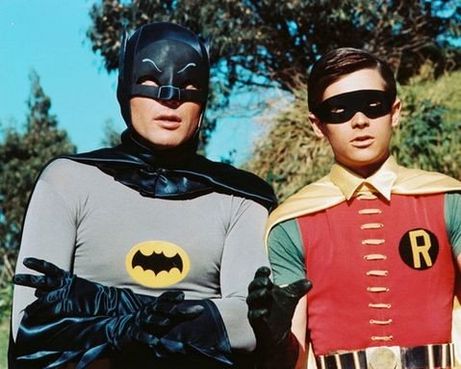
batman theory

Maybe.

But what if the “real” Batman is Michael Keaton, who appeared in 1989’s Batman and 1992’s Batman Returns? Both of which are Tim Burton films, by the way.

The Batman Theory is that Michael Keaton’s version of Batman is the “original” Batman. And the subsequent movies featuring Val Kilmer and George Clooney in Batman Forever and Batman & Robin are simply movies about Batman taking place in Tim Burton’s version of Gotham.

batman theory

Now this isn’t my theory, to be clear. In fact, I’m having trouble pinpointing the originator of this theory, but here’s how I came across it. Cracked author Adam Wears recently highlighted this theory in an article. He cites a Redditor who brought it up in r/fantheories, though he claims it’s not his theory either.

Wears greatly expands the Redditor’s idea in the article, and I’m going to expand further. But here’s the basic rundown.

The Tim Burton movies starring Michael Keaton were the first “serious” Batman movies after years of the character being seen as a campy, comical superhero. Batman and Batman Returns are gritty and dark interpretations that haven’t really been mimicked since they came out (save for Fox’s Gotham, which delivers a spiritual prequel reminiscent of Burton’s vision).
batman theory

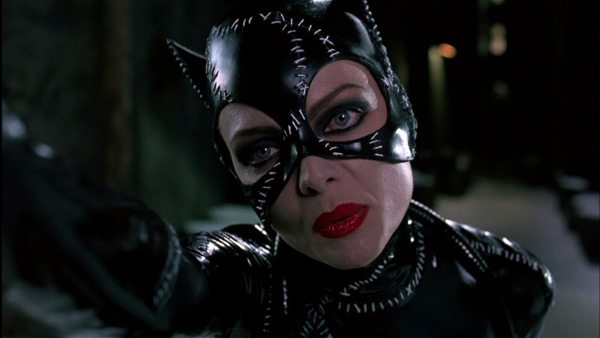
Now at the end of Batman Returns, Bruce Wayne believes Catwoman has run out of her nine lives, leading to her death. Though she was a villain initially, Bruce and Selina (Catwoman’s alter ego) developed a romantic relationship. Even though she (as Catwoman) plotted to kill Batman at one point.

At the end of the movie, Bruce believes she is dead, though we see she is still alive. Heartbroken, this would lead Bruce to “retiring” as Batman and confessing he is Batman to the rest of the world. Personally, I just think he died or was killed eventually. And from his remains, people figured out who he was.

batman theory

The theory is that someone would come along and make a movie out of his life, which would lead to the Joel Schumacher movies. These “movies” would be based on the Michael Keaton version of Batman.

This would explain why there is such a tonal and stylistic change between the two sets of films, and why there are different actors for Bruce Wayne in both movies (even though other actors like Chris O’Donnell stay the same, and Harvey Dent goes from being Billy Dee Williams to Tommy Lee Jones).

And of course, it explains why the Joel Schumacher movies suck…unless you were a kid when they came out. And why we should never regard them as canon ever again.

Wears brings up that these changes are apparent when you compare the screenshots of the Tim Burton movies against the Joel Schumacher ones.

batman theory

327828_v1

These screenshots capture a city that is very “industrial and gothic,” as Wears puts it. Contrast that with Batman Forever and Batman & Robin:

batman theory

327832_v1

And of course these “re-imaginings” of Gotham are more vibrant and colorful. For a city that is so bankrupt morally and optimistically, it makes sense that they would have over-the-top movies that appeal to kids, showing off a lighter, campier version of Gotham.

But what of Alfred? Michael Gough plays Alfred in all four of these dang movies. Same goes for Pat Hingle playing Commissioner Gordon in all of them.

batman theory

Are we really supposed to believe that these guys would play themselves in movies about Batman?

Well, sure. One thing we know about Gotham is that it’s the opposite of the land of opportunity. Not everyone has a Batman Credit Card, so if your one job was working for the Batman but he suddenly died, then what else are you going to do? (Oh yeah, this is why the retirement idea doesn’t work for me).

batman theory

So Alfred would carry on the Batman legacy by helping produce these films, inspiring the children of Gotham that crime is bad. Same goes for Commissioner Gordon, the super cop who is not actually incompetent and should be seen as the hero of law enforcement.

After all, the news of their connection to Bruce Wayne would instantly elevate them to celebrity status. What would you do with that level of fame? Probably what other people do. Make movies.

Basically, the Joel Schumacher movies are propaganda that are used to carry on the effectiveness of the cowl beyond the grave. Of course, this is assuming Bruce Wayne/Michael Keaton would really be dead, when really, he’s probably just off with Catwoman (who’s also believed to be dead) in another country. Hey, what does that remind you of?

batman theory

Checkmate, Mr. Wayne.

Thanks for Reading! You can subscribe to this blog by email via the prompt on the sidebar. Otherwise, be sure to stay connected with me on Twitter (@JonNegroni). I’ll follow you back if you say something witty and awesome.

Review: ‘Gravity’

Gravity

Is Gravity out of this world or should it be grounded? 

Go on…Review: ‘Gravity’