Why We Hate Destiny’s Story (And How It Could Have Been Way Better)

If you’re reading this as someone who is looking into buying Destiny, please wait until the end of this article before you let my opinions influence your purchase decision. If you’re reading this as someone trying to make sense of the confusing mess that is Destiny, then I hope this write-up puts your thoughts into coherent words.

The game in question is a recently released sci-fi epic available on Xbox One, PS4 and last-gen consoles. There’s been a lot of hype for this game as being one of the first “true” next-gen games to show off what’s next in gaming.

But if you’ve recently read a review for Destiny, then you’ve likely come across this exact sentiment: “It’s fun, but blah blah, story.”

destiny

I’m doing the same thing with this post, sort of. Except I’m digging deep into the why behind Destiny’s clumsy execution. Especially when you consider how Bungie spent a whopping 5 years putting this thing together (and hundreds of millions of dollars).

Destiny is a fascinating game. What’s even more fascinating is the fact that Destiny’s flaws are just as fascinating as the things that make Destiny a fun game.

But not even all of that fun in this FPS/RPG/MMO (first person shooter/role-playing game/massive multiplayer online) can save it from one thing that no one seems to like: the story.

destiny

This is especially sad for me, because the story of any game is just as important as the gameplay and graphics. Or at least the reason behind what you’re doing in the game.

That said, a good narrative doesn’t have to be the main reason for why I want to play a game.

Take Titanfall for example. In that game, there’s hardly a story, but I still enjoyed it.

But with Destiny? Also not much of a story, but that’s a bigger problem than with Titanfall. Why? Do I hate Bungie? Do people just hate Bungie for no reason?

destiny

That’s an obvious “no.” The Halo franchise is one of the most celebrated sagas in gaming history.

There are a lot of reasons for why Destiny’s story doesn’t work. And those reasons contribute to why everyone is so disappointed with Bungie’s latest outing. I’ll sum it up on word:

Expectations.

One of the main things that makes a story great is surprise. If the person experiencing the story has a hard time predicting the outcome of the story, then that increases the chances of them being pleased by what does happen.

The main way to make your story “surprising” is by being creative. Originality for the sake of originality doesn’t accomplish much. But creativity for the sake of telling a good story does more for your story than clever names for your characters will ever do.

destiny

Destiny tries very hard to create immersion. And they set your expectations very high by creating a world that you want to be immersed in. But ultimately, the writers had it backwards (I don’t know why).

Immersion doesn’t happen unless the story behind your world is compelling.

The world of Destiny, though curiously interesting, is hardly compelling. And Bungie made some rookie errors in that respect.

For example, the removal of a “codex” so that you can pester people into visiting your website is 100% a stupid decision. Specifically, the game will choose not to give you a back story into a certain event or character because you’re expected to stop playing and check it out on Bungie’s website.

destiny

That’s so wrong, it’s Raven. Bungie is essentially asking you to step out of the immersive world they’ve created to increase traffic to their own website. It doesn’t look good for them, and it’s certainly inconvenient for you.

The other problem is that if you don’t want to visit Bungie’s site to get more info on what the heck is going on in Destiny, then good luck figuring out what the heck is going on in Destiny.

These are relatively minor problems, though. Bungie could easily fix them in Destiny 2 or even the next update (not that they will). But there’s a bigger, deeper problem with the story and world of Destiny.

Conceptually, it’s an artistic mess. Let’s break that sentence down.

Conceptually: what makes Destiny, “Destiny.”
Artistic: what makes Destiny interesting and unique.
Mess: mess.

destiny

Destiny is a game full of good story ideas dressed up in overcomplicated flair. It has a cool structure, but to be simple: it tries too hard. It just tries way, way too hard.

The good story ideas come down to the setting and overall plot. Earth in the distant future? Fine. Takes place all over the solar system? Cool. Even the character designs and classes are somewhat new and interesting.

But when you go deeper, you find that everything else about the game is horribly generic. And when you combine generic execution with a creative foundation, you get, well, an artistic mess.

If you’ve played the game, yourself, then you know what I’m talking about.

destiny

The only people around (pretty much at all) in this world are called Guardians. First of all, that’s boring in and of itself. You never meet or talk to anyone who isn’t a fellow darkness-attacker.

I had to ask myself too many times, “Just who am I fighting for in this game? The guy with the mask? Myself? Peter Dinklage?”

And of course, “Guardians” is one of the laziest names they could have used as a classification. What isn’t a “Guardian” anymore these days? It’s a horrendously overused and uninteresting word at this point. Same goes with Hunters. Sure, Titan and Warlock are an improvement, but not by much.

The game is littered with odd naming choices like this. The Crucible (the hub for multiplayer) was “Mass Effected” just a couple of years ago. Sure, that one instance doesn’t ruin the name, but it does for plenty of people who are sick of seeing that word all over their video games and movies (and Arthur Miller novels).

destiny

And if you thought “Guardians” was lazy, then wait until you hear Peter Dinklage go on about “The Darkness.” You know your game’s story has a problem when it reads like a young adult novel by Stephanie Meyer.

And your robots are called “Ghosts?” Bungie (and Activision), we are sick and tired of everything being “ghosts,” especially since Call of Duty named an entire game after the concept a year ago. In Destiny, it doesn’t even make thematic sense that your robot companion is a “Ghost.”

Again, these are all simple problems that, on their own, don’t deserve much scrutiny. But all of these cringe-worthy story elements combined seriously prevent gamers from enjoying what Destiny has to offer in terms of gameplay and beautiful settings (of which I have little complaint, actually. The story is that bad).

destiny

And we haven’t even gotten to the story of the story — what’s driving you from going on those tedious fetch quests that barely vary, if at all. As you can imagine, it’s easily the game’s biggest, most obvious problem.

Because odd choices in your world and aesthetics can easily be forgiven if you have an engaging story with memorable characters.

Destiny doesn’t (really) have characters at all. Don’t get me wrong, it has placeholders. Characters, though? Can’t say I came across one.

The only character we actually get to know and listen to is our Ghost companion, voiced by Peter Dinklage (Game of Thrones). His role is essentially “male Cortana.” And that’s about all the thought they put into him.

destiny

[The role of Cortana merged with the design of 343 Guilty Spark, basically]

All he does is direct you on your missions. He lets you know what you’re supposed to be doing, what to look out for, and he provides occasional insights into the ever-elusive backstory of this strange, postapocalyptic world.

The problem? All of these things are the same, essentially. Your missions are astoundingly similar to each other, and the script reads as if it were put together in a matter of minutes.

This is mostly evidenced by Peter Dinklage’s clear boredom as he voices his character. Yes, it’s so tedious that Tyrion himself can’t find much to like about it. Some people want to blame him for the dry performance, but it’s not his fault if he has nothing interesting to talk about.

It’s easy and sort of necessary to compare Destiny to Halo, which is Bungie’s true claim to fame. The “magic” of Halo just doesn’t exist here, even though the games are fairly similar to each other (and not just when it comes to gameplay).

With Halo, you had a simple story set within a fascinating world. Even the aliens were the stars. That’s why Elites, Grunts, Jackals and Hunters would remain memorable figures as Halo aged.

destiny

Destiny, in comparison, is a complicated story set within an even more complicated world (and forgettable enemies). In Halo, my mission was straightforward. I was a powerful soldier (with other soldiers at my side to prove my scale) trying to survive on a mysterious world.

Many good games have this kind of simple story structure to draw you in. Far Cry 3 starts with the imperative that you have to save your friends on an island filled with dangerous pirates. Mass Effect is all about stopping a madman from resurrecting a genocidal race of super aliens. Fallout just comes down to surviving the nuclear wasteland.

But in Destiny, it’s not clear what I’m trying to do or why I’m anywhere the Ghost sends me. There’s no intrigue. No motivation. I’m lifted out of the rubble and told to join some movement, without a second thought (kind of what Destiny expects out of us as gamers).

destiny

I just shoot evil aliens. That’s enough, I suppose, to justify buying it. But it’s nowhere near enough to say that Destiny is a special game.

And a simple explanation for all of these problems is the oft-cited observation that Destiny has a bit of an identity crisis. It tries to be all things to all people, and this lack of focus makes the overall game suffer.

I would add that Destiny is also an example of why a good recipe is more than just combining two things. Because on paper, the game should work pretty well — it has all of the things we like about Halo, Call of Duty, and the best MMOs — but it’s not any better than the sum of its parts.

destiny

And the saddest thing about all of this is that it doesn’t take a professional team of writers to make a better narrative than what we got. My own version, if this project was handed to me, would be as follows:

Centuries after Earth was abandoned for unknown reasons, a coalition of humans and robots returned to the Solar System to recolonize the still resource-rich worlds. But they find that new, feral species have appeared, and they’re organized. Thus begins a war for who will reclaim the Solar System. Will it be the “new” humans? Or this seemingly selfish race of aggressive “aliens” that (Plot twist!) actually inhabited the Solar System long before humans, making them the rightful rulers of Earth and the rest all along?

I came up with that on the fly. Bungie on the other hand had years to churn this out, and the best they could come up with was the same “humanity versus invading alien forces that vaguely look like robots. Again.”

destiny

Here’s just one more take on the Destiny universe:

Centuries in the future, the Solar System is abandoned. No one knows what happened to humans, who were on the brink of faster-than-light travel before they mysteriously disappeared without a trace. New governments and migrating species have since colonized the 8 planets (and Pluto), but a struggle for control ensues when a schism divides the Solar System into two warring factions. You’re a member of an order of scavengers who loot the battle-torn areas of this conflict. But in your pursuit of fortune, your order encounters an even more dangerous secret that could change the galaxy forever. 

Seriously, Bungie. Step it up.

destiny

Overall, Destiny is a mindless game. But while other mindless games get a free pass, Destiny doesn’t because it wants you to think it’s not mindless. By dressing up its world with seemingly creative ideas that fall short of your expectations.

But, and this is a big but, Destiny is still (miraculously) worth playing if you like good shooters with some RPG elements. In those respects, the game excels and is addicting fun. You just have to immerse yourself out of the story to better enjoy it.

What do you think of Destiny?

Thanks for Reading! You can subscribe to this blog by email via the prompt on the sidebar. Otherwise, be sure to stay connected with me on Twitter (@JonNegroni). I’ll follow you back if you say something witty and awesome.

What Was the Best Movie of Summer 2014?

Let the debate begin. There were plenty of enjoyable big screen outings this summer, but which one was your favorite? The best?

On this week’s episode of the Agents of FILM podcast, we answer that question as best we can. And stick around for the end of the show to hear about new films that will be coming out this weekend.

You can watch the show below, or download the audio version here.

Cool things we mentioned:


Thanks for Reading (and/or Watching)! You can subscribe to this blog by email via the prompt on the sidebar. Otherwise, be sure to stay connected with me on Twitter (@JonNegroni). I’ll follow you back if you say something witty and awesome.

Robert Downey Jr. Just Revealed the Fate of ‘Iron Man 4’

Will there be yet another Iron Man installment?

Sadly, no. At least if Robert Downey Jr. is to be believed. Variety got ahold of him at the Toronto Film Festival recently for an interview, where he broke the news.

“There isn’t one in the pipe,” said Downey Jr. “No, there’s no plan for a fourth Iron Man.”

He did mention that he’s signed on for at least two more Avengers sequels. That includes “Age of Ultron,” which will be coming out next May. As well as the third Avengers film in 2018.

iron man 4

This is important news because Iron Man is the first of Marvel films to open during the “Marvel Cinematic Universe.” It was the first to complete a trilogy (with Captain America, Thor, and perhaps even Hulk to finish their own within the next few years).

If there won’t be an Iron Man 4, then should we also believe that the rest of the MCU films will follow suit?

Fourth installments are rarely successful, with films like Rocky IV being the rare exception. It makes sense why Marvel Studios would want to shy from over saturating these franchises, and the fact that Disney is really running the show is important to note. Disney is, after all, notorious for avoiding big budget/big screen sequels.

Still, this could mean that we won’t see a standalone Iron Man film for a long time. Perhaps as a reboot with a new actor. And right now, it’s hard to imagine anyone besides Robert Downey Jr. being the man inside that armor.

Thanks for Reading! You can subscribe to this blog by email via the prompt on the sidebar. Otherwise, be sure to stay connected with me on Twitter (@JonNegroni). I’ll follow you back if you say something witty and awesome.

Ranking the Pixar Movies By Box Office Success

Trying to compare the Pixar films according to quality and personal affection is a pointless task, in my opinion. Of course, I could easily tell you what my favorite films are and rank them, but how does that really help anyone?

Everyone has their favorites, but everyone also loves lists and comparisons. So for the sake of this post, I’m pointing out how successful each one was compared to the other. Prepare to be surprised.

To crunch the numbers, I added the domestic and foreign totals to provide the worldwide figures. I also adjusted everything according to inflation in 2014, so you’re really seeing which films made the most value in their day.

I did not rank these in order of profitability, as in I don’t point out how much it cost to make the film versus how much it made. Instead, I kept it simple and only pointed out how much money the film made overall.

Let’s begin!


#1. Finding Nemo

ranking  the pixar movies

How much it made: Many assume that Toy Story 3 was the first Pixar film to make over $1 billion worldwide, and they’re technically right. In 2003, Finding Nemo just barely came short of the billion mark with $936 million made worldwide. But when you adjust for inflation, the underwater animated film actually made $1.2 billion worldwide, easily surpassing the threequel.

Why? This is pretty impressive considering the fact that Finding Nemo had fewer advantages than more recent Pixar films. This was before foreign markets were becoming the brunt of Disney Pixar’s audience. In fact, I’d argue that it opened the floodgates to how well U.S. films can perform overseas.

Put simply, Finding Nemo benefitted from having extremely wide appeal. While movies about toys, superheroes, and balloon houses are fun concepts, many people of different ages found a reason to check out this film about a father finding his lost son in an endless ocean.


#2. Toy Story 3

ranking  the pixar movies

How much it made: The possibly final entry in the Toy Story franchise is also its most successful. It was the first Pixar film to make $1 billion worldwide ($1.1 billion adjusted for inflation), and unlike Finding Nemo, its gap between money made domestically and foreign is much narrower.

Why? Waiting a decade to finish the franchise was a smart decision on Pixar’s part. Strong word-of-mouth, the return of the original cast, and an emotionally wrenching premise made this a can’t-miss film for the countless people who fell in love with Toy Story over the course of 15 years.


#3. Up

ranking  the pixar movies

How much it made: It didn’t just collect Oscars. Up pulled in an impressive $731 million worldwide. Adjusted from 2009, that’s over $812 million.

Why? The film had broad international appeal thanks to its setting, and it came at a time when Pixar was hitting its stride with back-to-back hits. It also benefitted from a strong opening that had critics raving over the score and memorable characters. That, and this was also the first Pixar film to reap the benefits of 3D ticket prices.


#4. The Incredibles

ranking  the pixar movies

How much it made: Following the success of Finding Nemo was an impossible task, so leave it to the superhero film to accomplish just that. The Incredibles made a whopping $631.million worldwide in 2004, which is actually $795.8 million by today’s standards.

Why? One of the main advantages of mashing up several genres like superheroes, family drama, comedy, animation, and spies is that you can generate a ton of interest in your movie. Families and young adults came out to this film in droves, and it didn’t hurt that audiences were still enamored with the success of Finding Nemo.


#5. Monsters University

ranking  the pixar movies

How much it made: This 2013 prequel to Monsters Inc. narrowly surpassed its predecessor by raking in $743.5 million worldwide ($760 million adjusted for inflation). It’s important to note that it made the bulk of its money overseas, like many of the recent Pixar films.

Why? As a rule, sequels and even prequels tend to build upon existing audiences, no matter the downgrade in quality. Plus, the film was quite enjoyable and a step up from Pixar’s previous outings (Cars 2 and Brave).


#6. Monsters Inc.

ranking  the pixar movies

How much it made: This is the Pixar film that showed critics just what the studio was capable of, as it was the first of the films to spike in profit. The 2001 film made an impressive $562.8 million worldwide ($756.4 adjusted), with an almost even split between domestic and foreign markets.

Why? This film came out after a 1-year hiatus for Pixar, and it had been three years since the studio had released a non-sequel. Thanks to Monsters Inc., the momentum for Pixar as it entered the 21st century was set early, and high.


#7. Ratatouille

ranking  the pixar movies

How much it made: Only Pixar can make a film about a rat learning to cook in Paris a huge success with over $623 million made globally ($716.7 million adjusted).

Why? Foreign markets definitely carried this film, representing about 2/3 of the profits. Also, audiences who were displeased with Cars were happy to see a Pixar film with more traditional storytelling (even though it was anything but).


#8. Toy Story 2

ranking  the pixar movies

How much it made: That’s right, one of Disney’s first forays into a sequel (they’re notorious for not doing big screen sequels at all) was a Pixar film. And it totally paid off. Toy Story 2 ran away with $485 million worldwide. These days, that’s nearly $700 million. Keep in mind that this was in 1999; a time when the box office competition was fierce.

Why? As we now know, the film was just as good if not better than the original, and that prompted millions of people who loved the first film to go see this one. And it helped that VHS sales build a lot of hype for this film four years after the original. The lesson, of course, is that there should be a lot of time in between sequels for the sake of direction and precision. Not many people have learned this lesson, sadly.

#9. Cars 2

ranking  the pixar movies

How much it made: Pixar’s follow-up to the record-breaking Toy Story 3 was yet another sequel. And they suffered for it. Cars 2  brought in about $559 million worldwide, or $593 million adjusted for inflation. A little more than half of what Pixar made the previous year.

Why? Some are wondering why it made so much when it shouldn’t. Others may be wondering why it didn’t make as much. Both questions are answered by the fact that the film was both helped and hurt by its predecessor, Cars. Yes, it had plenty of interest from fans of the original, but the problem was that there weren’t that many fans anyway. But it still made good money, especially overseas. This was partly due to the various locales seen in the film and Disney’s expertise at managing foreign markets by 2011.


#10. WALL-E

ranking  the pixar movies

How much it made: This may surprise a lot of you, but WALL-E only brought in $521 million worldwide. Adjusted for this year, that’s only about $576.8 million.

Why? Oddly, this is celebrated as one of Pixar’s best films, both by audiences and critics. And yet it is one of the least successful. Sadly, this is mostly because the film came out during the onset of Great Recession, which badly hurt money made domestically. On top of that, many moviegoers were put off by the film’s lack of dialogue, especially in the early parts of the film.


#11. Toy Story

ranking  the pixar movies

How much it made: The first of the Pixar films performed pretty well for a forerunner. It made $362 million worldwide, with most of that money being domestic. Nowadays, that translates to about $566 million, which is nothing to scoff at.

Why? Unlike its successors, Toy Story didn’t have the luxury of Pixar being a household name. It earned its success solely from being a good film and shattering expectations as the first computer-animated film ever. In fact, I’m more surprised that this isn’t lower on the list considering the risk that was put into making it. Toy Story truly is a miracle of film.


#12. Brave

ranking  the pixar movies

How much it made: Still hurting from the disappointment that was Cars 2, this 2012 film also disappointed with a meager $539 million worldwide total ($559 million adjusted). That’s still pretty good, though it is certainly low compared to the rest of the Pixar family.

Why? Entire research papers could be written about the mystery surrounding Brave‘s underwhelming premise. I’m not sure I fully understand why it fell short for me, personally. Whatever the reason, Brave just didn’t click or resonate with people as deeply as previous Pixar films, which made this an animated outing for only a certain group of moviegoers (kids and their parents looking for a getaway).


#13. Cars

ranking  the pixar movies

How much it made: Released in 2006, Cars didn’t really deliver for Pixar as much as they hoped with a decent $462 million worldwide ($546 million adjusted). Of course, it was still incredibly profitable for Pixar, seeing as it only cost $120 million to make.

Why? You know a film has problems when it falls so short after two massive hits like Finding Nemo and The Incredibles. It even had the benefit of coming along after a 1-year hiatus. Still, audiences weren’t impressed with the premise, and Cars ultimately suffered. Strangely, the sequel was still green-lit and made a bit more money years later.


#14. A Bug’s Life

ranking  the pixar movies

How much it made: Pixar’s second film was great in its own right, even though that didn’t necessarily translate to box office sales. It made just $363 million worldwide, which is about $530.5 million adjusted for inflation. Interestingly, it made more money overseas than Toy Story did, and it was the first of the Pixar films to make most of its money in foreign markets.

Why? Put simply, the novelty of computer animation had worn off a bit. So A Bug’s Life had to rely on just being a good movie. That’s why it made as much as it did, but the basic fact is that a film about toys coming to life was more appealing than a film about bugs fighting grasshoppers.


Conclusions:

One of the most interesting things about this list is that even the lowest entry of Pixar’s films is a box office success that stands up to most of the films that are coming out today. That means in 14 films over the course of 19 years, Pixar hasn’t had a single flop. No other studio in history can compare to that kind of consistent success.

In the years to come, we’ll see if Pixar can maintain the status quo or make another huge leap forward. Inside Out premieres next summer, and it could prove to be the next Monsters Inc. in terms of reviving the studio’s creative fortunes. And with new sequels like Finding Dory and The Incredibles 2 on the horizon, along with some other originals like The Good Dinosaur, Pixar may be poised for its first renaissance.

ranking  the pixar movies

Thanks for Reading! You can subscribe to this blog by email via the prompt on the sidebar. Otherwise, be sure to stay connected with me on Twitter (@JonNegroni). I’ll follow you back if you say something witty and awesome.

9 New Movies You Need to Check Out This Fall

Hey guys, we have a podcast now! I started Agents of FILM with some fellow movie writers, and this is our first episode. Hope you guys like it.

If you prefer audio, then you can download the audio podcast here.

Otherwise, you can watch the full episode here: [for the main segment, skip ahead to 18:24]

Cool things we mentioned:


The Agents of FILM will return next Monday. Follow on Twitter @JonNegroni to stay updated.

New Featurette Shows Off First-ever Footage of Pixar’s ‘Inside Out’

It was a long time coming, but we finally have some great footage of Inside Out to gawk out at.

The footage comes courtesy of the Disney Movies Anywhere app, which means I can’t share the full thing here. But thanks to ScreenCrush, you can view some gifs of the film below.

If you want to see it for yourself, download the app and check out the latest Monsters University fact video. The featurette comes at the end.

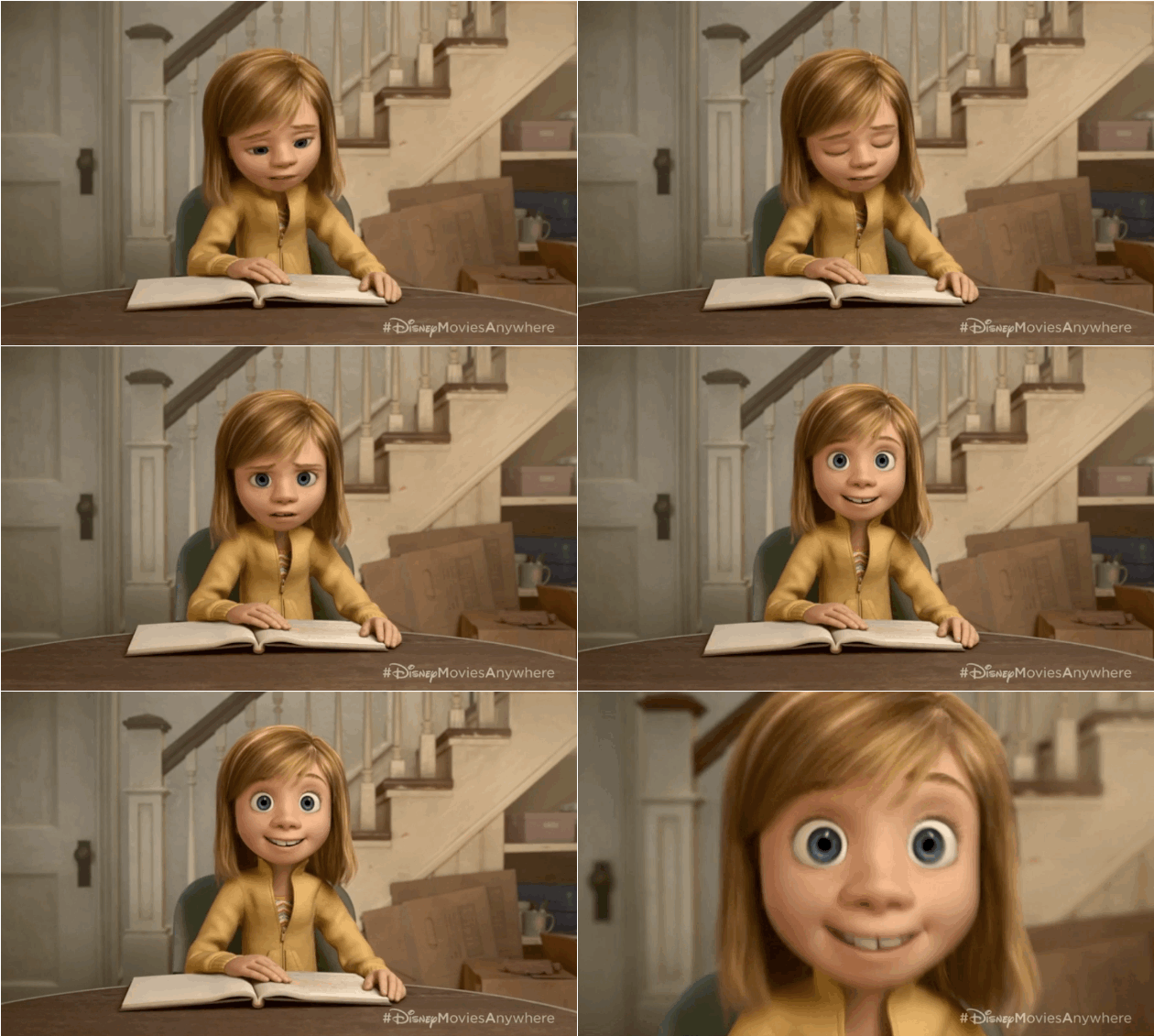
And you’ll catch a glimpse of what my face looked like when I watched it:

pixar inside out footage

The girl you see there is the latest version of the film’s main character (and location, technically): Riley. She’s an 11-year-old girl whose family has just moved from Minnesota to San Francisco. Her adjustment to this big change marks the focal point of the film’s story.

One cool thing I love about the animation here is how much care they put into her facial expressions. You can truly tell that there is a battle between her emotions in the way she slowly lights up.

Pete Docter (Up) pretty much describes the emotions as “their version of the Seven Dwarfs.”

While the above is more traditional animation for Pixar, the shots below capture something new for the studio:

pixar inside out footage

As you can see, this footage takes place within Riley’s mind, and it’s noticeably more stylistic. Here, you can see Joy (Amy Poehler) throwing marshmallows at Anger (Lewis Black).

And here:

pixar inside out footage

You can see that the flames produced by Anger’s, well, anger is being used to roast marshmallows.

As Pete Docter and producer Jonas Rivera (also from Up) explain it, they’re using new and classic animation techniques (like “squash and stretch”) to make something we’ve never seen before.

We’ll see if that’s true next June…


Thanks for Reading! You can subscribe to this blog by email via the prompt on the sidebar. Otherwise, be sure to stay connected with me on Twitter (@JonNegroni). I’ll follow you back if you say something witty and awesome.

The Three Steps to Writing Your First Story

For the first time on this site, I’ve opened up a post to someone else. The following is a guest think piece written by Tim Wilkinson, who was gracious enough to lend some of his advice on writing to you guys.

Tim majored in Screenwriting in college and has taken a variety of creative writing classes on the side. He moved to Hollywood and hung out with other writers while doing freelance work on the side. During his time there, he met a lot of great (and not-so-great) writers who have helped shaped his strategy for making what you make, well, great. Enjoy!


By Tim Wilkinson.

A strange mistake writers make when they decide to write something is when they think they have to start by crafting a novel. If you were just learning how to sew, you wouldn’t start by making a California King-sized quilt, just like if you started running yesterday, you wouldn’t attempt a marathon this coming weekend.

Don’t get me wrong, I want you to get to wherever it is you want to be (creatively speaking). I just think you’re going to need to start by developing your tools and endurance (yes, writing a novel is an exercise in endurance) before tackling the beast.

Part the First: About Writing Itself

The first mistake that many intrepid young writers make is to think that writing is “easy.”

Nothing could be further from the truth.

Writing can be fun, rewarding and extremely satisfying, but I’ve never once considered it especially easy. As a result, many new writers tend to dive in and quickly flame out on their project. Or just get lost in the world they were trying to create. Then they stick it in a drawer and never look at it again.

My advice is simple:

Read. As much as you can. You can’t write if you don’t read. Don’t like to read? Guess what? You’re not a writer. Sorry, that’s just the way it is.

Reading helps you develop your own voice (likely by first emulating writers you love and then growing from there) and keeps your brain in what I like to call word mode. I read every day on my commute and most nights before bed.

Write. Every. Day. This one is even harder. There are days when you’re not going to want to. Days when the words won’t come. Days when you think everything you’re writing is crap and you’ll be right.

It’s going to suck sometimes, but you’ve just got to muscle through it. All professional writers do it, and they’ll all admit to having days when they want to pull their hair out and scream until they lose their voices. But they still do it.

Study. You need to learn story structure. I’ve heard too many new writers say, “I don’t need to learn story structure because it will mess up my story” or some other line that implies that they are too “artistic” to bow to the traditional guidelines of storytelling.

If you’re one of these people, let me tell you something: you’re just like everyone else who thinks they’re a genius until that moment comes when you discover that your really cool plot twist or story structure was actually done (better) by someone before you were even born.

Writing is extremely humbling if you’re doing it correctly.

So just suck it up and learn story structure. Pick up a copy of Story by Robert McKee (it’s targeted to screenwriters, but the story elements translate to prose fiction as well) and On Writing by Stephen King. Read the crap out of them.

Then grab a copy of Strunk and White’s Elements of Style and learn it by heart. I also recommend The Little Red Writing Book by Brandon Royal. But grammar and spelling are only important if you want other people to read your work.

Find a Community (but don’t get too caught up in it). This is optional and not for everyone. I’m sure that if you’ve started writing something already, you’re a bit annoyed because writing sounds like a lot of hard, lonely work.

It is.

That’s why it’s good to have friends who understand what you’re putting yourself through.

Search for a good local writers group (lots of libraries have them, depending on where you’re located) or even online. Reddit (r/writing) is a nice place to hang out as well. These people will be a tremendous resource for you and will help you find your way—or at least be a support group that your non-writer friends won’t be able to be.

However: Note that there is a fine line between being a writer and playing the writer. People who play the writer want to have all the “perks” of being a writer—the prestige, being able to say you’re a writer to impress people at parties, etc.—without actually writing. So be sure you’re finding an actual writing group that will help you progress.

Okay, now you’ve established the building blocks. Hopefully this means you’ve started kicking out a few pages every day. Awesome. Now we can move on to:

Part the Second: About Writing a Novel

All novels start with one thing: An idea.

You need an idea that is going to keep you interested for at least a year, probably more. The idea that birthed my novel was simple: What if a teenaged boy became obsessed with capturing proof of the giant monster living in the local lake?

(Side note: Don’t be paranoid about not telling people ideas like this—you can’t copyright an idea, and even if they did steal it, their story would be completely different from yours. Just look at vampire and zombie novels if you don’t believe me).

So now that you have your idea, you’ve got to figure out a few things:

  • What genre will my novel be?
  • What is your narrator’s point of view?
  • Will you follow one character or jump around between multiple ones?

I find knowing these few things at the outset to be tremendously helpful. I’ve actually rewritten an entire project because I decided after one draft that past-tense/third person was the wrong way to go and changed it to present-tense/first person.

Now this is where things get tricky. You have to decide if you’re a gardener or architect.

Gardeners plant a story and let it grow organically, often starting at the beginning and then letting it grow as they write.

Architects plot everything out in advance so they know how to build their story.

For example: Stephen King is a gardener; J.K. Rowling is an architect.

I am very much an architect. As such, I’ll walk you through my process.

Start with a deck of 3×5 index cards. Write out each scene in one sentence on the card. If you find you’re adding more than one or two sentences, tear it up and start over.

Your sentences should be simple, like:

Jeff kicks in the door, shoots the guy on the couch and takes the drugs on the table.

Worry about the details of it when you’re actually writing. If you obsess over the details now, you’ll have nothing to keep your interest when you finally start to write.

Write all of your scenes out like this. Now lay them out and read through them. You may start to notice that this scene here would go better there, and so on.

This is why you use index cards and vague-ish scenes. So you can move them around.

Rearrange, add, subtract and generally play with it to your heart’s content. Then, once your satisfied, number them (trust me) and then type them up in a single document.

Viola! Instant outline!

Now you begin to write. Set a daily goal. My current one is 500 words a day because I work full-time and have a pregnant wife. It’s what I can do, but I make sure to do it every single day. And yes, there are plenty of days when I don’t want to at first.

Now write and write and write and write and one day it will be done.

And it will be horrible. Or at least, you’ll hate it. You’ll hate everything about it. You’ll consider self-immolation. You’ll consider taking up an “easier” artistic outlet, like painting with fresh rattlesnake blood that you procured yourself.

In the immortal words of Douglas Adams: Don’t Panic.

This is normal. Calmly put your hard work aside and do not look at it for at least one month. Maybe longer. Fight the urge to tool around with it. Start something new. Go have an adventure. Just don’t touch it. Right now, your manuscript is a wad of dough, and it needs time to breathe and rise. Which brings us to…

Part the Third: Turd Polishing

After enough time has lapsed, go back and read it.

Don’t start rewriting immediately. Read it.

All the way through.

Tough it out. It might hurt in places, but you’ll also notice little pockets of prose that you don’t hate. Feel free to keep a notepad handy, but don’t spend more time writing than you do reading that first time. Re-acquaint yourself. Note any large plot issues, but save the finer stuff for later.

After your read through, it’s time to rewrite.

Start by fixing any gaping plot holes and work down to the smaller details. Take good notes. A good rule of thumb I’ve learned is that your second draft should be 10% shorter than your first draft. Usually, this can be easily achieved by editing out extraneous words.

One thing we should talk about here is grammar, which is literally the last thing you should worry about. Your first draft (as well as everyone else’s) will be a hot, steaming turd. You don’t ever want to polish a fresh turd. Your successive rewrites will act as a coat of varnish on your turd, making it nice, shiny and less horrifying.

Once you’ve applied several coats of Rewrites™ brand varnish, you’ll be able to polish (or, if you prefer, proofread) without getting dirt under your fingernails. Besides, what’s the point of correcting spelling and grammar if you might just rewrite that whole section anyway?

Now it’s just a matter of banging it into shape until you’re happy with it. Once you’re satisfied that your story is absolutely as good as it is going to get, then you can fix your grammar and spelling. Once you’re done, find that one friend of yours who, when asked for story feedback, only ever points out your typos.

“Uh, it was good but you misspelled butt cheek like six times in chapter nine.”

All writers have this one friend, I promise you. Right now, he’s your best friend.

Now you’re finally ready to show your bad boy off. Ask a few trusted friends to read it and give you feedback. This will likely spur another round of revisions—again this is totally normal.

Also, be sure to give a copy of your manuscript to your mother (or whoever loves you unconditionally).

Because who doesn’t occasionally need to hear how great they are? Just don’t expect it from anyone else. You’re going to have to earn it from everyone else.

I really hope you find this piece helpful. If you’re a little freaked out now, that’s good.

If you still want to write a novel, that’s very good.

One final note: Find what you’re comfortable writing on and stick with it. Clive Barker writes his novels longhand and then types them up. I use a program called OmmWriter to do my daily 500 words, then paste it into Scrivener, an amazing (and cheap) writing program that has its own index card system (which I now use instead of actual index cards).

Just find what works for you and do it.


Thanks for reading! You can follow @Tim_Wilkinson on Twitter.