


Every Pixar movie is connected. I explain how, and possibly why.
In 2012, I watched a video on Cracked.com that introduced the idea (at least to me) that all of the Pixar movies actually exist within the same universe. Since then, I’ve obsessed over this concept, working to complete what I call The Pixar Theory, a working narrative that ties all of the Pixar movies into one cohesive timeline with a main theme. Another, longer, title is “The Grand Unifying Theory of Pixar Movies.”
This theory covers every feature-length movie made by Pixar Animation Studios since 1995. They include:
- Toy Story
- A Bug’s Life
- Toy Story 2
- Monsters Inc.
- Finding Nemo
- The Incredibles
- Cars
- Ratatouille
- Wall-E
- Up
- Toy Story 3
- Cars 2
- Brave
- Monsters University
- Inside Out (in Part 2)
- The Good Dinosaur (in Part 3)
- Finding Dory (in Part 4)
- Cars 3, Coco, Incredibles 2, and Toy Story 4 will be included in the upcoming book
The point of this theory is to have fun and exercise your imagination while simultaneously finding interesting connections between these fantastic movies. The trick is not take any of it too seriously. If you would like to experience a shorter version of this theory, check out the visualized Pixar Theory Timeline.
In fact, I highly suggest you watch this video I made with Screen Junkies/Fandom below. It more thoroughly lays out this theory and its most complex ideas. It’s also a far more “current” version of the theory compared to the rest of this post. Plus, it has more movies included! Enjoy.
The original Pixar Theory:
As of this writing in 2013, Brave is the first and last movie in the timeline. Obviously, this movie about a Scottish kingdom during the Dark Ages is the earliest time period covered by the Pixar films, but it’s also the only Pixar movie that actually explains why animals in the Pixar universe behave like humans sometimes.

In Brave, Merida discovers that there is “magic” that can solve her problems but inadvertently turns her mother into a bear. We find out that this magic comes from an odd witch seemingly connected to the mysterious will-of-the-wisps. Not only do we see animals behaving like humans, but we also see brooms (inanimate objects) behaving like people in the witch’s shop.
We also learn that this witch inexplicably disappears every time she passes through doors, leading us to believe that she may not even exist. Don’t get ahead of me, but we’ll come back to Brave. Let’s just say that for now, the witch is someone we know from a different movie in the timeline.

[Some of you have pointed out that the animals in Brave gradually regress back into an animal state, disproving the idea that this is the source of animals acting like humans. My rebuttal is simple. They regress because the magic wears off. Over time, their evolving intelligence grows naturally.]
Centuries later, the animals from Brave that have been experimented on by the witch have interbred, creating a large-scale population of animals slowly gaining personification and intelligence on their own.
There are two progressions: the progression of the animals and the progression of artificial intelligence. The events of the following movies set up a power struggle between humans, animals, and machines.
The stage for all-out war in regards to animals is set by Ratatouille, Finding Nemo, and Up, in that order. Notice I left out A Bug’s Life, but I’ll explain why later.
In Ratatouille, we see animals experimenting with their growing personification in small, controlled experiments.

Remy wants to cook, which is something only humans explicitly do. He crafts a relationship with a small group of humans and finds success. Meanwhile, the villain of Ratatouille, Chef Skinner, disappears. What happened to him? What did he do with his newfound knowledge that animals were capable of transcending their instincts and performing duties better than humans?
It’s possible that Charles Muntz, the antagonist of Up, learned of this startling rumor, giving him the idea to begin inventing devices that would harness the thoughts of animals, namely his dogs, through translator collars. Those collars indicated to Muntz that animals are smarter and more like humans than we think. He needed this technology to find the exotic bird he’s obsessed over, and he even comments on how many dogs he’s lost since he arrived in South America.

But then Dug and the rest of his experiments are set free after Muntz’s demise, and we don’t know the full implications of that, but what we do know is that animosity between the animals and humans is growing steadily. Now that humans have discovered the potential of animals, they are beginning to cross the line. To develop this new technology, the humans begin an industrial revolution hinted at in Up.
[Some have pointed out that Muntz was working in South America before the events of Ratatouille. This is true, but it is not explicitly stated how and when he developed the collars. Also, we know Ratatouille takes place before Up for several reasons. In Toy Story 3, a postcard on Andy’s wall has Carl and Ellie’s name and address on it (including their last names to confirm). This confirms that in 2010, the time of Toy Story 3, Ellie is still alive or hasn’t been dead long. This supports the idea that Up takes place years later.]

In the beginning of Up, Carl is forced to give up his house to a corporation because they are expanding the city.
Wait a second. What corporation is guilty for polluting the earth and wiping out life in the distant future because of technological overreach?

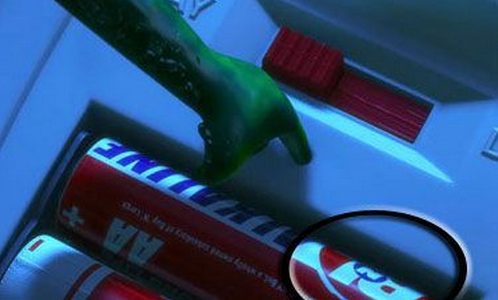
Buy-n-Large (BNL), a corporation that runs just about everything by the time we get to Wall-E. In the“History of BNL” commercial from the movie, we’re told that BNL has even taken over the world governments. Did you catch that this one corporation achieved global dominance? Interestingly, this is the same organization alluded to in Toy Story 3:
In Finding Nemo, we have an entire population of sea creatures uniting to save a fish that was captured by humans. BNL shows up again in this universe via another news article that talks about a beautiful underwater world.
Lines are being crossed. Humans are beginning to antagonize the increasingly networked and intelligent animals.
Think about Dory from Finding Nemo for a second. She stands apart from most of the other fish. Why? She isn’t as intelligent. Her short-term memory loss is likely a result of her not being as advanced as the other sea creatures, which is a reasonable explanation for how rapidly these creatures are evolving.

It’s likely that the sequel to Finding Nemo, which is about Dory, will touch on this and further explain why. We may also get some more evidence pointing to animosity between humans and animals.
[Some great users have pointed out that Dory is actually more intelligent and shows signs of growth due to her ability to read and communicate with whales. This would actually show signs of how the animals are beginning to change in intelligence gradually.]
And that is the furthest movie in the “animal” side of things. When it comes to A.I., we start with The Incredibles. Who is the main villain of this movie? You probably thought of Buddy, a.ka. Syndrome, who basically commits genocide on super-powered humans.

Or does he? Buddy didn’t have any powers. He used technology to enact revenge on Mr. Incredible for not taking him seriously. Seems a little odd that the man went so far as to commit genocide.
[A lot of people have been arguing about where The Incredibles actually takes place because we see technology from modern times and the 1980s even though everything has a 1960s vibe. This is cleared by Brad Bird, the director, who says the movie takes place in an alternate 1960s, which means the movie opens in the 1950s.]
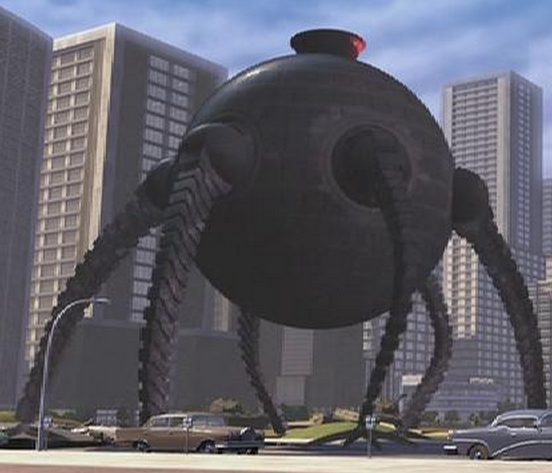
And how does he kill all of the supers? He creates the omnidroid, an A.I. “killbot” that learns the moves of every super-human and adapts. When Mr. Incredible is first told about this machine, Mirage mentions that it is an advanced artificial intelligence that has gone rogue.
Mr. Incredible points out that it got smart enough to wonder why it had to take orders. The omnidroid eventually turns on Syndrome, and starts attacking humans in the city. Why would an A.I. want to just attack randomly? Do machines have an inherent hatred of humans?
The movie even shows clips of the superheroes with capes being done in by inanimate objects, such as plane turbines…accidentally.

But why would machines want to get rid of humans in the first place? We know that animals don’t like humans because they are polluting the Earth and experimenting on them, but why would the machines have an issue?
Enter Toy Story. Here we see humans using and discarding “objects” that are clearly sentient. Yes, the toys love it Uncle Tom style, but over the course of the Toy Story sequels, we see toys becoming fed up. But wait, toys and inanimate objects aren’t necessarily machines, so how do they have some kind of intelligence?
Syndrome points to the answer. He tells Mr. Incredible that his lasers are powered by Zero Point Energy. This is the electromagnetic energy that exists in a vacuum. It’s the unseen energy we find in wavelengths and a reasonable explanation for how toys and objects in the Pixar world draw power.

By the events of the Toy Story movies, we are in the 90s until 2010. It’s been 40-50 years or so since the events of The Incredibles, giving A.I. plenty of time to develop BNL.
Meanwhile, Pixar is hinting at dissatisfaction among pockets of toy civilizations. The toys rise up against Sid in the first movie. Jesse resents her owner, Emily, for abandoning her. Lotso Huggin’ Bear straight up hates humans by the third movie.
Toys are obviously not satisfied with the status quo, providing a reason for why machines and objects alike are ready to take over.
So, by the 2000s, the super-humans are all but gone, and mankind is vulnerable. Animals, who want to rise up Planet of the Apes style, have the ability to take over, but we don’t see this happen.
Also, A.I. never takes over humans by force. Why do you think that is? It’s reasonable to assume that machines did take over, just not as we expected. The machines used BNL, a faceless corporation (which are basically faceless in nature) to dominate the world, starting in the 1960s after the Omnidroid fails to defeat the Incredibles.
In each of the Toy Story movies, it’s made painfully clear that sentient objects rely on humans for everything. For fulfillment and even energy. It’s hinted at that the Toys lose all life when put away in “storage” unless they are in a museum that will get them seen by humans.

So machines decide to control humans by using a corporation that suits their every need, leading to an industrial revolution that eventually leads to…pollution. When the animals rise up against the humans to stop them from polluting the earth, who will save them? The machines.
We know that the machines will win the war, too, because after this war, there are almost no animals left on Earth. Who’s left?

Because the machines tip everything out of balance, Earth becomes an unfit planet for humans and animals, so the remaining humans are put on Axiom (or Noah’s Ark if you want to carry on the Biblical theme where Wall-E is basically Robot Jesus and his love interest is aptly named Eve) as a last-ditch effort to save the human race.

On Axiom, the humans have no purpose aside from having their needs met by the machines. The machines have made humans dependent on them for everything because that is how they were treated as “toys.” It’s all they know.

Meanwhile on Earth, machines are left behind to populate the world and run things, explaining human landmarks and traditions still being prominent in Cars. There are no animals or humans in this version of Earth because they’re all gone, but we do know that the planet still has many human influences left.
[Some have noted that the world of Cars can’t be after humans left because there’s no pollution shown in the movies. If you look carefully at Wall-E, however, the world is never shown during this time, so we don’t really know how badly the Earth was polluted.]
[It’s possible that the machines sent humans away to curb overpopulation and fix the environment without them, but the world was drained of resources as a result of machines populating the Earth. That would explain why the machines abandoned Earth entirely, leaving only Wall-E behind.]
In Cars 2, the cars go to Europe and Japan, making it plain that this is all taking place on Earth as we know it. So what happened to the cars? We’ve learned by now that humans are the source of energy for the machines. That’s why they never got rid of them.
In Wall-E, they point out that BNL intended to bring the humans back once the planet was clean again, but they failed. The machines on Earth eventually died out, though we don’t know how.
What we do know is that there is an energy crisis in Cars 2, with oil being the only way society trudges on despite its dangers. We even learn that the Allinol corporation was using “green energy” as a catalyst for a fuel war in order to turn cars away from alternative energy sources. That “clean” fuel could have been used to wipe out many of the cars, very quickly.

[Someone pointed out that “all in all” means the same thing as “by and large” making the connection between Cars and Wall-E even more substantial.]
Which brings us back to Wall-E. Have you ever wondered why Wall-E was the only machine left? We know that the movie begins 800 years after humans have left Earth on Axiom, governed by the AutoPilot (another A.I. reference).
Could it be that Wall-E’s fascination with human culture and friendship with a cockroach is what allowed him to keep finding fulfillment and the ability to maintain his personality? That’s why he was special and liberated the humans.
He remembered the times when humans and machines lived in peace, away from all of the pollution caused by both sides.

After Wall-E liberates the humans and they rebuild society back on Earth, what happens then? During the end credits of Wall-E, we see the shoe that contains the last of plant life. It grows into a mighty tree. A tree that strikingly resembles the central tree in A Bug’s Life.


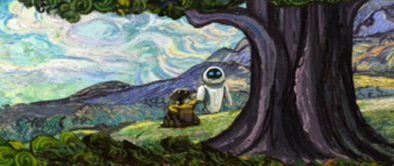
That’s right. The reason no humans show up in A Bug’s Life is because there aren’t a lot left. We know because of the cockroach that some of the insects survived, meaning they would have rebounded a bit faster, though the movie had to be far enough in the timeline for birds to have returned as well, though they’re noticeably less intelligent than the bugs.
[I’ll admit, the trees looking similar isn’t enough to support the idea that A Bug’s Life takes place after Wall-E, but there’s definitely more reasons for why it’s likely. Also, I’ll bring the tree up again later because it appears in Up as well.]
There’s something strikingly different about A Bug’s Life when compared to other Pixar portrayals of animals, which leads me to believe it takes place in the future. Unlike Ratatouille, Up, and Finding Nemo, the bugs have many human activities similar to what the rats in Ratatouille were merely experimenting with.
The bugs have cities, bars, advertisements, their own machines, know what a bloody mary is and even have a traveling circus. This all assumes that the movie is in a different time period.
The other factor that sets A Bug’s Life apart from other Pixar movies is the fact that it is the only one, besides Cars and Cars 2, that doesn’t revolve (or even include) humans.

[Okay there is a a lot of contention over the idea that A Bug’s Life takes place post-apocalypse, but hear me out. The reason I am so inclined to push the idea is because of how different the bug world is from the “animal” movies. No other Pixar movie has animals wearing clothing, wild inventions, animals creating machines, or so much human influence like bars and cities.]
[In Finding Nemo, the most human thing we see is a school, and even that is pretty stripped down. But in A Bug’s Life, we have a world where humans are barely even implied. At one point, one of the ants tells Flik not to leave the island because there are “snakes, birds, and bigger bugs out there.” He doesn’t even bring up humans.
[Yes, there are some humans, like the kid who allegedly picked the wings off of the homeless bug, but that still fits in a post Wall-E world. Also, the bugs have to be irradiated for them to live such long lifespans. The average lifespan of an ant is just 3 months, but these ants all survive an entire summer and allude to being around for quite some time by saying things like “this happens every year.” One of the ants even says he “feels 90 again.” That works if you accept that the ants are sturdier due to evolution and mutated genes.]
There’s another Pixar movie that was supposed to be released in 2012, but it was cancelled and replaced with Brave. This movie was called Newt, and I believe it might have fit in this part of the timeline post-Wall-E. The movie’s supposed plot: “What happens when the last remaining male and female blue-footed newts on the planet are forced together by science to save the species, and they can’t stand each other?”

A movie about an endangered species rebuilding itself could lend itself nicely to this theory, but since the movie was never released, I’m just speculating.
So what happens next? Humanity, machines, and animals grow in harmony to the point where a new super species is born. Monsters. The monsters civilization is actually Earth in the incredibly distant future.
[Someone wisely pointed out that in Monsters University, the college is said to be founded in 1313. If we’re really in the future, then that means the monsters could have reset society and begun using their own calendar. That could mean Monsters Inc. takes place up to 1400 (or more) years after A Bug’s Life.]
Where did they come from? It’s possible that the monsters are simply the personified animals mutated after the diseased earth was irradiated for 800 years.
[Not during Wall-E. I would guess that it took hundreds of years after Wall-E for the animals to become monsters]

Whatever the reason, these monsters seem to all look like horribly mutated animals, only larger and civilized. They have cities and even colleges, as we see in Monsters University.
[An issue some have found is that this doesn’t properly explain what happened to humans. I haven’t settled on a theory I really like yet, but I’m leaning towards the idea that monsters and machines eventually forgot that they need humans and got rid of them again, not realizing their mistake until all humans died out. Another explanation is that humans just couldn’t survive on Earth anymore.]
In Monsters Inc., they have an energy crisis because they are in a future earth without humans. Humans are the source of energy, but thanks to the machines, again, the Monsters find a way to use doors to travel to the human world. Only, it’s not different dimensions.

The monsters are going back in time. They’re harvesting energy to keep from becoming extinct by going back to when humans were most prominent. The peak of civilization, if you will. Though a lot of time has passed, animosity towards humans never really went away for animals/monsters.
Monsters must have relied on anti-human instincts to believe that just touching a human would corrupt their world like it did in the past. So they scare humans to gather their energy until they realize that laughter (green energy) is more efficient because it is positive in nature.
[An alternative explanation that fits even better that some of you brought up: The machines and monsters created the time travel doors but realized that messing with time could erase their existence and change history. So, they falsely trained monsters to believe that humans are toxic and from another dimension, making it suicide for a monster to interact too much with their world.]
[Another issue is how the monsters seem to worry about kids “being less scared these days.” It’s likely that going in the past takes a lot of energy, so the monsters can only go back as far as the practice still returns a profit in energy. To them, they’re just moving through the same dimension of time, but the monsters at the top know that eventually, they’ll run out. This is why Waternose is so bent on capturing children and enslaving them.]
We even see a connection between A Bug’s Life and Monsters Inc. via the trailer we see in both movies. As you can see, the trailer looks exactly the same, except the one in A Bug’s Life is noticeably older and more decrepit, while the one in Monsters Inc. (where Randall is sent via a door) has humans and looks newer.

Look at the picture above. On the left is the trailer from A Bug’s Life and the one on the right is from Monsters Inc. The one on the left looks older and more rundown. Even the vegetation is noticeably dryer and there’s less of it. The trailer on the right has humans and the frame even includes tall grass and a tree hanging overhead.
[Some have argued that the trailer in A Bug’s Life should be nothing but dust. I disagree based on how barely intact other buildings were in Wall-E. They also bring up the bug zapper that is powered by electricity. The zapper could easily be solar powered, just like Wall-E. The bugs probably used it as a light source to signal other bugs to “Bug City.” Also, the trailer in A Bug’s Life never shows lights in the trailer like it does for Monsters Inc.]
That said, Monsters Inc. is so far the most futuristic Pixar movie. By the end, humans, animals, and machines have finally found a way to understand each other and live harmoniously.
And then there’s Boo. What do you think happened to her? She saw everything take place in future earth where “kitty” was able to talk. She became obsessed with finding out what happened to her friend Sully and why animals in her time weren’t quite as smart as the ones she’d seen in the future.
She remembers that “doors” are the key to how she found Sully in the first place and becomes…

A WITCH. Yes, Boo is the witch from Brave. She figures out how to travel in time to find Sully, and goes back to what she believes is the source: The will-of-the-wisps.
They are what started everything, and as a witch, she cultivates this magic in an attempt to find Sully by creating doors going backwards and forwards in time.
[Just to clarify: The theory is that Boo discovered a way to use doors to travel through time on her own, possibly by developing magic on her own. She probably went back in time to the Dark Ages to get more magic from the will-o-wisps.]
How do we know? In Brave, you can briefly see a drawing in the workshop. It’s Sully.
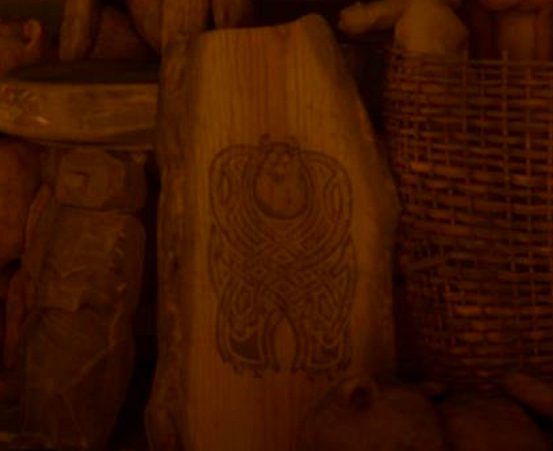
We even see the Pizza Planet truck carved as a wooden toy in her shop, which makes no sense unless she’s seen one before…(and I’m sure she has since that truck is in almost every Pixar movie). If you look closely, you can see the carved truck below.

You remember Merida opening doors and the witch constantly disappearing? It’s because those doors are made the same way from Monsters Inc. They transport across time and that is why Merida couldn’t find the witch later in the movie.
[A lot of people have brought up how easter eggs are scattered throughout all the Pixar movies. I barely scratch the surface, but a great theory offered by some that I support is that these easter eggs are planted by Boo either intentionally or accidentally as she travels through time to find Sully. Some support for that is the fact that every easter egg in Brave lies in her workshop.]
But wait. How did Boo travel in time in the first place, and why is she obsessed with wood? Boo must have discovered that wood has been the source of energy all along, not just humans. The machines and monsters in Monsters Inc. use doors because they’re made of wood and found a way to use that energy to travel in time.
[Many have pointed out how the door that banishes monsters is metal. That’s probably because wood is used to harness this magic, and using a metal door would stop a banished monster from going back through it.]
Obsessed with finding Sully, Boo travelled across the Pixar universe using doors.
[It’s even possible that the wood from the tree in A Bug’s Life is the source of Flik’s ingenuity, due to his fascination and respect for seeds growing into trees. The tree also bears a resemblance to the one in Up that Carl and Ellie frequented, which could be the source of Carl’s wild creativity in using balloons to transport his house.]
[This also explains why Flik and Heimlich from A Bug’s Life show up in Toy Story 2, which would be centuries before their time. Boo was trying to go to the future and could have fallen short by landing in the post-Wall-E time. She would need wood to keep time traveling, but there’s not much around yet, so she stumbles upon the tree in A Bug’s Life. She could have accidentally brought back a few bugs with her when traveling backwards in time.]
So Boo went back to the Dark Ages, probably because she could use plenty of wood there for her experiments or to study the will-o-wisps. We know that her first encounter with Mor’du ended with her turning him into a monstrous bear, but he regresses.
She probably wanted to turn him into a bear because Sully resembles a bear, and she is still trying to figure out where Sully comes from.
Does Boo ever find Sully? I like to think so. He surely reunited with her at least once as a child at the end of Monsters Inc., but eventually, he had to stop visiting.
But her love for Sully is, after all, the crux of the entire Pixar universe. The love of different people of different ages and even different species finding ways to live on Earth without destroying it because of a lust for energy.
And that is the Pixar Theory.
For Inside Out, The Good Dinosaur, and Finding Dory, the story continues in Parts 2,3, and 4 respectively, so here are some other helpful links for your reading pleasure:
- The Pixar Theory – What about Planes?
- The Pixar Detective – an expanded universe novel that explains the theory as a full narrative.
Thanks for reading this. Be sure to say hey on Twitter: @JonNegroni
All images courtesy of Disney/Pixar
In an extra for Toy Story 2, there is a scene in which Flick and that Caterpillar guy are talking to one another. Then, Buzz and the other toys come crashing through the grass, interrupting the bugs. My question is, doesn’t that disprove the theory that bugs life is post apocalyptic? Because this means that bugs life takes place in the exact same time frame as toy story 2.
As Boo traveled through time, she discovered the Bug’s Life tree and used the wood for her doors. Flick and Heimlich just got taken along for the ride when she visited the Toy Story timeline.
At the very end of the theory, Negroni says “This also explains why Flik and Heimlich from A Bug’s Life show up in Toy Story 2. Boo was trying to go to the future and could have fallen short by landing the post Wall-E time. She would need wood to keep time travelling, but there’s not much around yet, so she stumbles upon the tree in A Bug’s Life. She could have accidentally brought back a few bugs with her when travelling backwards in time.]”
Monsters Inc. taking place after Wall-E actually makes sense because when Sulley thinks Boo gets caught in the trash compacter, the trash is made into a cube, just like Wall-E does with his garbage.
Reblogged this on My Blog.
See, but if the doors are time-travel devices, why do the monsters monitor time zones, as seen in Monsters, Inc, when it is announced they will be going to the “Eastern Seaboard”? Also, they main conflict in Monster, Inc is that children have become desensitized to scaring due to things like violent television and rock music (as hinted) and drastic measures need to be taken to get the energy required to run the Monster world. If the doors opened wormholes in time, why would they continually visit the “present” looking for energy from unscareable (that’s a word now) children?
Because the monsters don’t know they’re going back in time. They think they’re crossing dimensions. If they all knew they were actually going back in time, some could purposefully change history and ruin the timeline, so the higher ups tell them that humans are “toxic” and they shouldn’t linger.
WHOA!!! wait what if we have only seen the small picture on this hear me out I think I figured it out…..
So Pixar works with Disney, and maybe this guy works for Pixar. What if they are trying to tell us something; like Disney is becoming B-n-L and will destroy or control us. Think it through Pixar is made up of smart creative people who love and enjoy their job and have uncovered what Disney is trying to do. They are trying to tell us what is going on as creative and as discreetly as they can. This is how it all probably started, Disney was started by a guy whose first big icon was a mouse that talks, sings, and acts. In the beginning the mouse wasn’t such a nice guy and eventually that changed and Walt began to create other odd characters. Maybe that’s when Walt started to be controlled by Mickey a mouse (animal), drawing (object), and character (machine) each is its own group controlled by one head honcho. Kids started to fall in love with him which is how he started to suck in and control the first generation then each one after just followed suit. He then created a theme park, which now as we all know is how he gets all his money by just upping the price and we are all buying into it anyways. This led to going across the U.S. with an even bigger one, then eventually leading to other countries because he wasn’t satisfied with one country. But before that once Mickey realized he could run everything by himself and the other characters there was no need for Walt, but Mickey is a smart mouse and had Walt frozen just in case he needs him later if things start to fall apart. He then set up each character to his/her own designed area; the first being Pete (Mickey’s first “enemy” in the comic strips) as he is the enforcer the one that keeps all the other characters and people in line. Then Donald and Daisy who seem to be in charge of the machines because its always hard to understand Donald and he is always the one messing with machines in shows. Then Goofy and Pluto are in charge of the animals for obvious reasons. Mickey never really felt the need to have someone else control objects so him and Minnie do that. Also there seems to be a lot of connection between the Warner Brothers counter parts of the Disney characters Donald and Daffy, Wile/Road runner for Goofy and Pluto Taz for Pete and Even Lola. Who knows the whole cartoon world maybe after us…… Well there is a loud knock at my door and I can hear shouting coming from outside so I am going to post this just in case my hope is that someone else will go on and investigate what I have left behind if something is to happen to me…. tell my family I love them
I like you.
Thank You I like you too
Sorry for not reading 35 pages of comments, so if my thought was captured elsewhere first, I didn’t see it and didn’t mean to duplicate.)
I love what you’ve done here, but think you’ve got a causality loop problem. Sully can’t cause Boo to go back to a point in history where she wants to find Sully, and thereby ends up creating the evolutionary starting point that ultimately results in Sully.
I agree. That’s why I don’t believe Boo “caused” the evolutionary starting point. I think of her more as a time travelling easter bunny planting easter eggs. I think the source of this quasi-magic evolution ranges from zero point energy (the toys and syndrome) to wood (the time travelling doors and recurring tree) and then the will-o-wisps. If anything the catalyst for all of this is probably the meteorite never hitting Earth in jurassic times, saving the dinosaurs and leaving evolution uninterrupted, which is stated in “The Good Dinosaur.”
Alternatively, as a Whovian, I’m inclined to believe that time is non-linear, and is more of a timey-wimey, mass of stuff. The same may be true for the pixar universe. It wouldn’t be a paradox for something in the future to interact with something in the past that indirectly caused the first party to exist. It’s just a loop. The only case a paradox would exist is if you would interact with your past self, telling them of the future, or if Sully would have done something like kill Boo (or at very least make her not want to find him) that would be a paradox.
Interesting theory. The Sully connection is intriguing, though the etching of the creature seems to lack a tail. But it does otherwise strongly resemble Sully. It is also interesting that Sully is mistaken for a bear by humans in Monsters U.
Another point of note: humans as energy is an aspect of the Matrix films.
stop
oh my god i’m sorry i didn’t mean to comment now i’m really embarrassed… I really like this theory! i’m going to stop now, but thanks for the good read!
this is idiotic.
“During a blooper, while Mike and Sulley are walking to work, they wait at a crosswalk next to a giant monster’s leg. The camera zooms out to reveal that the leg is Rex. In the actual film, the tall monster’s name is Ted, who makes chicken sounds.”
So actually, the Monsters are really just tiny toys! They use magical doors to make themselves bigger.
The identical trailers in A Bug’s Life and Monsters, Inc. are also highly intriguing. Could be just a sly wink by the Pixar crew, of course, but it’s intriguing just the same.
Oh, and the wooden truck too. Wikipedia has a list of references in Pixar films to other Pixar films: http://en.wikipedia.org/wiki/List_of_Pixar_film_references
Just a quick note: Dinoco is also in Cars. I’d love to hear more of the theory after the new movie comes out with this connection in mind. And my only criticism (though I actually believe your theory more than my own critique) is that the trailer connection was just animators saving time using stock images. Ha ha! Thanks for this amazing and entertaining read!
If we’re talking about corporations that exist across the movies: Don’t forget that in Toy Story there’s a toolbox from Binford Tools. This means that Home Improvement exists within the Pixar Extended Universe, and possibly that Tim Taylor was the in-universe voice of Buzz Lightyear! Run with that.
Actually, the main controversy behind NEWT is that it would be about two MALE newts. People didn’t want there to be a gay themed Disney movie, even though John Lasseter fought really hard to make it happen, because reptiles of that nature CAN reproduce of the same sex. “Rio” had the same plot point and was being made during all this, and when it came out first, they scrapped the project.
Nope. not true. The film was going to be about a heterosexual pair of newts.
Hey man, a mutual friend told me about you. He used to work at the movies…not saying any names. Im liking what youre doing. Pretty legit dude. Makes tons of sense. Keep up the good work man.
I really love this and I like to believe this theory. I mean think about it, these movies take years to make. So they are obviously in development while other movies are being made. As I was researching a lot of these movies, I came across a piece that insinuates that “The Good Dinosaur” was being developed around the time “Up” was being made and/or developed, back by pictures on a board of one of the sculptors, of 4 images, one with a child and a dinosaur next to each other, two of a child, and another of a dinosaur, while he was sculpting a clay sculpture of the old man from “Up.” So, you never know! None the less, this was very fun to read. I love reading how Pixar movies are connected!
what a colossal waste of time
1 Question? When you posed the question: “When the animals rise up against the humans to stop them from polluting the earth, who will save them? The machines. Who is “them”–who is needing saved @ this point– “the animals” or “the humans”?
2) In A Bug’s Life…this seems to be taking place @ the same time of Toy Story, which I believe is circa 1980’s. In Bug’s Life: aluminum trash can, the items of trash, even the boy’s sneakers that stepped on the ants, the focus on ants society (1980’s had US vs USSR cold war, Lady Diana and the Brittish wedding, and Star Wars Defense program,and Reagan an old cowboy actor), plus your comments on the insects having a city lifestyle are all pointing to 80s, but that at that time the insects were infact sentient and more advanced than the animals were at that time. In Toy Story, all the toys–the army men, Mr Microphone/TapeRec., Buzz Lightyear (space war computer games of the time), Sidney’s “skull” t-shirt, AND the fact that he had braces on his teeth, and mom’s vehicle, games at the pizza planet– all point to this same time era! AND just to remark on the time of The Incredibles and Finding Nemo–these were all about at the same time era too. These 4 Pixar movies show us the intellegence and evolution of each 4 genre of earthly inhabitants at the same juncture in time–the animals (dog in Toy Story; The Insect Community –more like humans than any other genre except they will never tap into need/wanting machines and why Wall e found the cockroach facinating, the ocean animal life in Finding Nemo), the Humans (kids–toy story, adults–the Incredibles, Govt and Communal structure and intra relational difficulties within genre–the Incredibles/A Bug’s Life/Finding Nemo/Toy Story), and finally the Machines (Toy Story–toys are the general populas of the machines of the time– realatively in their infancy; on the verge of becoming sentient and aware, The Incredibles show the High end of machines and the actual timeline where machines became sentient, A Bug’s Life–where the insect/animals are alike to humans in their social nature are far from becoming aware of tools or MACHINEs to help their society, but at this juncture this they have become aware of machines(tools,invention),,. you will note that the setting of the movie is always on the VERGE of being just like a human society, yet are far distanced because of their species deficiency in machine relationship/evolution–What will become of that now? Finding Nemo where machines have no relation at all to machines other than to be harmed by them via humans, or humans themselves are interfering with ocean animal’s Utopia—notice “Utopia”–the Insect animals in a Bug’s Life are searching for “Utopia”, ironically labled because only leads to “waste” that human’s are leaving behind. The journey of the Insects is following the same path?).
Sorry–so long, and perhaps a ramble here and there. This is fascinating!
Reblogged this on `The Penguin' says… and commented:
I don’t know what to say about this theory. I mean, yes, it is Pixar, but even they won’t think these things through that well. Nevertheless, the developer of this theory (whether that is Jon Negroni or someone else) is very observant. Pixar hides these things for themselves as a sort of signature and as a treat for those very observant people.
So … What is The Lamp telling us? I suspect that’s the key.
Interesting article and a fun read. I would agree with other sentiments that A Bug’s Life timeline should be pre-apocalypse. Simply because they have advanced in ways the other animals have not, is not sufficient enough to establish a post-apocalyptic connection. And the tree link appears to be a stretch. Further, the appearance of multiple Bug Life characters in Toy Story 2 would contradict the theory. That said, I think most of the theory is fascinating, and, if true, would be great.
But, moreso, I wanted to bring up something that I think may be getting overlooked. Why was the Pizza Planet Truck in EVERY movie, BUT the Incredibles? I think this is very strange, considering how meticulous PIXAR has been to include it in every other movie.
Assuming your theory is correct, that all of these movies are really connecting one whole world, then I actually think Incredibles is really not part of that world, but rather, just a fictional story to those in the Pixar world (kind of like a story within a story). Let me elaborate by exploring all of the Easter Eggs related to the Incredibles:
1. In Finding Nemo, we see a young boy reading a comic book of the Incredibles.
2. In Ratatouille, we see Linguini’s boxers that have the Incredibles logo on them.
3. In WALL-E, we see a frozone bobblehead.
4. In Toy Story 3, we see a poster of the Omniroid in Andy’s room.
5. In Cars 2, we see reference to a movie, “The Incredimobiles.
Interestingly, all of these Easter Eggs describe paraphernalia of the Incredible characters. As such, couldn’t it be true that the Incredibles’ characters are just part of a superhero following (similar to how we follow Superman and Batman), and the movie we watch is simply a movie that the humans in the Pixar movies would be watching. It’s their version of superheroes. Interestingly, no other Pixar movies show the humans having superhero powers outside of the Incredibles. There is AI and Animal Intellegence development, but no other suerpheroes. In several of the movies humans are involved, but it doesn’t appear that any of them have super power like unto those characters in the Incredibles.
Another Easter Egg that is interesting is when we see Bomb Voyage appear as a Mime in Ratatouille. Is it possible that Bomb Voyage is simply an actor who played the part of Bomb Voyage in an Incredibles movie? Anyway, going back to the Pizza Truck. It would make sense that there is no Pizza Truck, because in the Pixar World, the Incredibles are not real, but rather just has a large fanbase as shown in some of the other movies. There would be no need to put the Pizza Truck in the Incredibles, because the Incredibles don’t really exist in that world. They are merely a super hero story that the people follow. Whereas, all of the other movies HAVE the pizza truck easter egg, which could connect all the movies. And if your theory is correct, that they all are part of the same world, then this could be a fascinating thing to explore. Anyway, just thought I would throw that out there.
There’s a problem with Monsters Inc being set after Wall-E. In the movie they mention Monsters being exiled, monsters including the Loch Ness monster and the Yetti. Both of those are myths that span generations in this time, so the Monsters universe would have to be before to fit with the origin of their mythos that Pixar created.
Tiiiiime travel! They open a door to a specific time/place (like Scotland or the Himalayas) and kick the monster out, closing the door behind them. The monster is now trapped in pre-human-departure Earth.
When does WALL*E happen in relation to the CARS movies? In WALL*E, humans start to reinhabit earth. Does CARS mean they’ve failed?
And here I thought figuring out events on Doctor Who at times was difficult. But I definitely love the theory and I’ll be looking more closely the next time I watch a Pixar film.
It reminds me exactly of the sort of thing you would find in Doctor Who! This just makes me unable to wait until November. Sorry this is unrelated. Back to Pixar..
theres a problem whit your Ratatouille and Up connection. This movies clearly happens in two very different time periods.Or at least it seems that way.