Review: ‘The Magnificent Seven’ Is Enjoyably Average

magnificent seven

In 1960, The Magnificent Seven came about under the direction of John Sturges to limited acclaim. Critics didn’t love it because Akira Kurosawa’s Seven Samurai (of which Magnificent is adapted from but with a Western spin) was still a near-perfect film fresh on everyone’s minds. In the decades since, critics have grown to appreciate Magnificent Seven more due to the cascading success of the film’s actors, and it’s hard to deny the sheer entertainment value to be had in the first 2/3rds of that film.

As someone removed from that era entirely, I found the 1960 adaptation to be a forgettable shadow of Seven Samurai — but I’ve always been interested in the idea of updating the original concept with heavier themes, better visuals, and other details it could rightfully borrow from Kurosawa’s work.

Yes, Magnificent Seven has had sequels and even a TV show since its mid-century release, but we now have a modern remake in the fashion of 2010’s True Grit. The only difference, though, is that Grit managed to be a remake with a purpose. By comparison, the 2016 Magnificent Seven is more akin to a video game made from the movie. There’s more violence, the characters’ stories are tossed aside for manufactured movie moments, and there’s little reason to watch this one outside of seeing a fast-paced action Western. If that’s what you want out of Magnificent Seven because you have some sort of sketched idea of what the original (and the original before that) had to offer, then you’ll probably walk away satisfied.

Directed by Antoine Fuqua (Training DayThe Equalizer), this new take on Magnificent focuses on Rose Creek, an American frontier town under siege by a robber baron aptly named Bartholomew Bogue (Peter Sarsgaard), who mostly mumbles vain platitudes about how capitalism justifies his boring villainy. This is a strange departure from the small Mexico town victimized by bandits in the 1960 version, made more confusing by the fact that this change to Rose Creek holds little meaning outside of a desire to keep things American, which has all sorts of troubling implications if you think about it too long.

magnificent seven

To ward off Bogue’s militia, newly-widowed Emma Cullen (played by Haley Bennett) seeks out the help of Sam Chisholm (Denzel Washington), a warrant officer from Kansas who in turn recruits six other mercenaries from around the area. They include wise-talking and gunslinging Joshua Faraday (Chris Pratt as Star Lord in the West, essentially),  a confederate sharpshooter (Ethan Hawke), his knife-throwing Chinese “manservant” Billy Rocks (Byung-hun Lee), frontier survivalist Jack Horne (Vincent D’Onofrio), a gruff Mexcian outlaw Chisholm was previously in pursuit of (Manuel Garcia-Rulfo), and a Comanche archer named Red Harvest (Martin Sensmeier). 

A significant amount of time in Magnificent Seven is spent fleshing out character skill-sets more than anything else, like why any of the mercenaries are willing to put their lives on the line for strangers. The film tries to posit this as some sort of “Eff it” mentality that might be mixed in with a soft decency that doesn’t come across in any performance, especially with Faraday, who seems to change his temperament based on the position of the sun. Chisholm is the closest to having any real sense of intention in the script, and there could have been real opportunity to make his growing affection for the rest of the cast convincing. But unfortunately, Washington brings almost zero nuance or heart to the role, and the entire ensemble suffers for it.

There are flaws aplenty in the film’s basic narrative structure and script that prevent Magnificent Seven from ever having an affecting impact. But at the very least, it competently accomplishes what it set out to do. The half hour or so of nonstop gun-toting action is thrilling to watch, and you might care enough about some of the characters involved (if not the one-note villain) to share some of their tension as the odds grow ever against their favor. But once the dust settles, you’ll start to wonder what the point of all this endless violence really was as the film rushes to the finish line with as little effort as possible. There’s no reflection on much of anything important that the film accidentally managed to say.

Grade: C+

Extra Credits:

  • I love Matt Bomer, and there is no reason for him to be in this movie (for about four minutes).
  • The late James Horner composed the film’s score (which is fantastic), and it’s also his last composition.
  • Believe it or not (and I checked), this is the first western Denzel Washington has starred in. What a waste.
  • So…Chris Pratt. Honestly, I think the actor was underserved here, same as Washington. The film would have been saved if the script had gotten their chemistry right, but there’s nothing to see here.
  • Review in four words? “The quintessential RedBox movie.”

    Thanks for reading this. Seriously. You can subscribe to my posts by clicking “Follow” in the right sidebar. 

    Or just say hello on Twitter: @JonNegroni


Review: ‘Hell or High Water’ Is the Modern Western You Didn’t Know You Wanted

hell or high water review

Believe it or not, the best westerns in filmmaking history have been more than action movies. They’ve been more than thrilling shootouts and chase scenes on horseback. As Hollywood gradually replaced the more bombastic side of the western genre with new tiers of disaster, comic-book, and pulp movies, the general consensus has become that the golden age of westerns has long been over.

But the best westerns have always been about something, a lesson painfully unlearned by Favreau’s Cowboys and Aliens, yet gratefully grasped by the Coen Brothers’ True Grit remake. And Hell or High Water, directed by Starred Up‘s David Mackenzie, also stars Jeff Bridges in this present-day western about bank-robbing brothers who have high aspirations for petty thieves. Well, one of them at least.

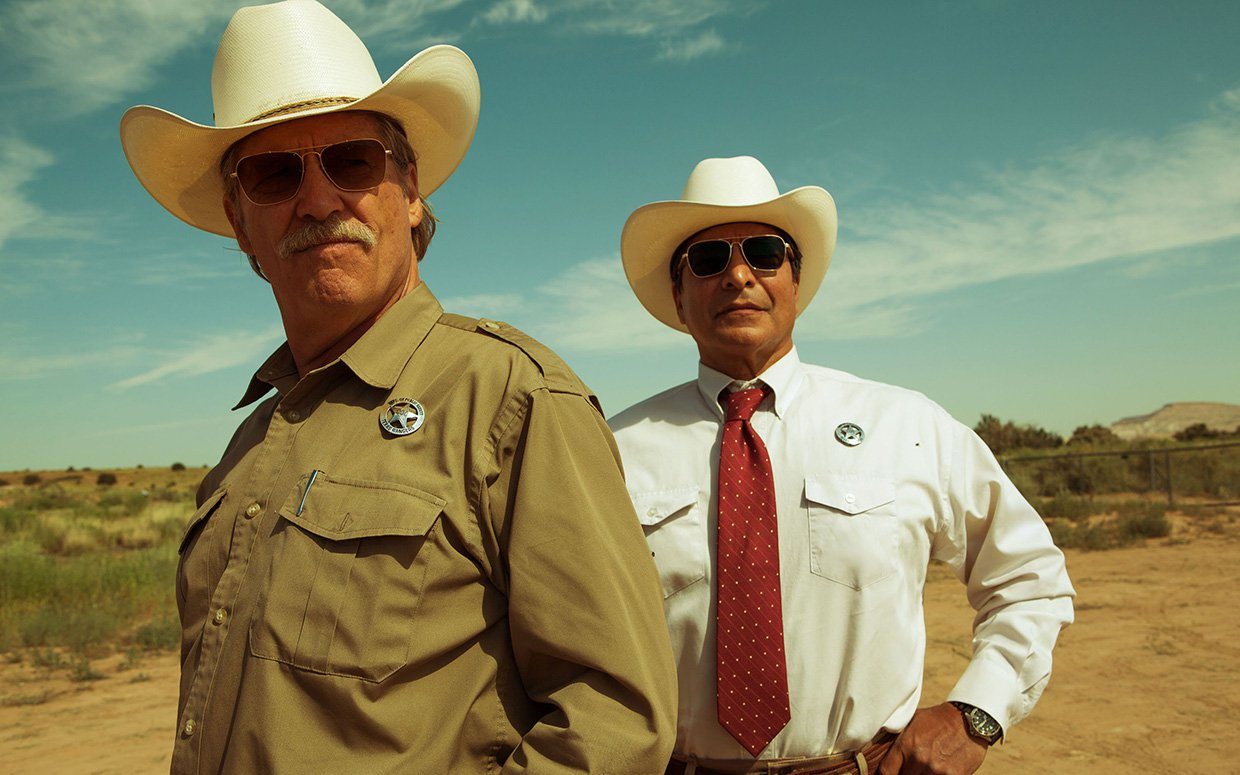
Bridges plays a Texas Ranger in search of the crafty bandits, joined by his half-Native American partner Alberto, played by Gil Birmingham. They’re after the Howard brothers, played by Chris Pine and Ben Foster, who’ve been robbing small banks belonging to the same Texas branch in towns all over the state. This might sound like a dour crime movie set within a western backdrop, but it’s a actually a more lively affair than its close cousin, No Country for Old Men, yet as somber and beautifully shot as last year’s Sicario, which writer Taylor Sheridan also produced the script for.

The combinations and comparisons don’t end there. Hell or High Water is also a talkative film that brazenly explores the painful consequences of the Great Recession, paralleled with how the 21st Century has both changed and been passed over in these small towns across west Texas. In other words, this is a western that actually has a lot to say when the bullets aren’t flying.

hell or high water review

Despite all of its obvious inspirations, Hell or High Water manages to be an unpredictable experience, never resorting to obvious plot contrivances that would manufacture tension between Foster and Pine, who have one of the more unique brotherhood dynamics in recent cinema. Pine is very much the straight man, while his brother is essentially the Joker without face paint — an agent of chaos with a surprisingly sober backstory to lend credibility to his madness. Watching these two actors play off each other is a high point of the film, enhanced by how similarly compelling the relationship is between the rangers, Bridges and Birmingham, who are constantly after them.

Hell or High Water is slow in parts and often methodical in how it wants you to absorb its scenery and frequent allusions to “Debt Relief” signs and shots of working-class Texans who are either packing heat or know someone nearby who is. This could be wrongly perceived as preachy storytelling or an obvious “Robin Hood” spin on the west, if it weren’t for the complex and animated Bridges, who lives by a code of justice that is as sympathetic as the supposed protagonists. Yet just as horrifying.

In short, it’s no 99 Homes. The world of west Texas is easy to disappear into once the first shot is established, as you’re forced to wonder if this is some sort of post-apocalyptic version of the U.S., despite the setting being quite true-to-life and accurate in terms of how massive sprawls of the country have become lawless, apathetic wastelands due to financial greed. It’s probably one of the most interesting “fantasy” worlds created for the big screen this year, and it’s not even fabricated or dolled up with CGI.

hell or high water review

There are a lot of words that describe Hell or High Water in a satisfying way. It’s cynical, yet humorous.  Brainy, yet simple. Mischievous, yet noble. Depressing, yet beautiful. Touching, yet tragic. Straightforward, yet ironic. It’s the masterful combination of these juxtapositions, complemented by well-rounded performances across the cast, that elevate what should have been a B-list movie into one of the best (and most relevant) westerns in years.

Grade: A

Extra Credits:

  • David Mackenzie, who is Scottish, shoots Texas like a true European. Mostly flat shots of the land and wide landscapes to impress upon the magnitude of the state. This is something a lot of American filmmakers tend to take for granted. Though to be fair, this film was mostly shot in New Mexico.
  • “What don’t you want?”
  • This might seem obvious, but a lot of the extras in this movie are “real” people they filmed on location.
  • Seriously, if the idea of Jeff Bridges playing a Texas Ranger on the verge of retirement doesn’t draw you in to see a movie, we need have a discussion in the comments below.
  • The tracking shots are a lot better than the more gimmicky “one-shots” you’ll see in standard films. Each one is simple and elegant, getting the moment of the scene across, rather than bragging about the lack of cuts.

    Thanks for reading this. Seriously. You can subscribe to my posts by clicking “Follow” in the right sidebar. Or just say hello on Twitter: @JonNegroni