The True Identity of Andy’s Mom In ‘Toy Story’ May Blow Your Mind

Andy's Mom

It all started with a hat.

Several months ago, one of my anonymous Pixar Theory Interns (that’s a thing on a resume) came to me with a crazy proposition: Andy’s mom is Emily, Jessie’s previous owner.

I laughed. I then agreed.

For some time, I compiled all of the evidence and found some incredible support for this theory. For one thing, take a close look at Andy’s cowboy hat he frequently wears in the movies:

Andy's Hat

Here’s another close look:

Andy's Hat

As you can see, Andy’s hat is noticeably different from Woody’s. Why is this? Why wouldn’t Andy want to wear a hat that closely resembles the one worn by his favorite toy?

It’s no secret that Andy has a close connection with Woody. In Toy Story 2, his mom (who we only know as Ms. Davis) mentions that Woody is an old family toy.

Remember that Woody doesn’t even recall that he is a collector’s item – a toy made in the 1950s. This is a deviation from other toys who know full well where they come from. It’s possible that Woody doesn’t know because he’s been in Andy’s family for a long time, possibly belonging to his father.

But we need more evidence. Take a close look at Jessie’s hat:
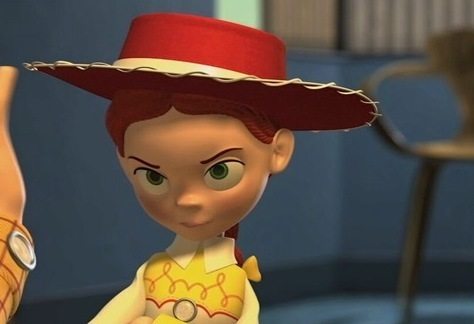
Andy's Hat

Ah, this hat looks familiar. It’s the same red hat with white lace that Andy wears. The only difference is that Jessie’s hat has a white lace around the center. But look at Andy’s hat again.

Andy's Hat

There’s a faded mark where the white lace should be. Why do you think that is? And what does Jessie have to do with this?

(Bob Saget’s voice) Kids, you remember the story of Jessie. Her owner Emily grew up with her, much the same way as Andy. She was incredibly loved, but Emily eventually gave her away when she grew older. Jessie ended up in storage for a long time, as confirmed by her in the movie when she has a literal panic attack over having to go back.

Now, take a close look at what’s on this bed in Emily’s room:

Andy's Hat

That is a hat that looks extremely similar to, you guessed it, Andy’s. The room is also pretty old-fashioned, leaving room for this to take place years before Andy was born.

In fact, you can clearly tell that this isn’t modern day with shots like these:

Andy's Hat

The only difference between the hat that Emily wears throughout this sequence and Andy’s hat is an extra white lace around the center, which is visibly missing from Andy’s hat. Otherwise, the hats are identical.

Also, in the donation box that Emily puts Jessie in, we don’t see the hat. We do see other remnants of her connection with Jessie, but the hat is noticeably absent. The box isn’t even big enough to hold it. So Emily held onto that hat…and maybe passed it on to her child, who would grow to also love a cowboy doll.

We never get a closeup of Emily’s face, but we do see that she has light, auburn hair as a teenager. Also, it is very short.

Compared to:

500full

The middle picture is closest to the strawberry blonde color we see when Emily is young. It’s perfectly reasonable to assume that her hair lightened as she aged, which is clearly the case in these photos (or she could have dyed it).

Here’s what we know for sure:

We don’t know the first name of Andy’s mom. We don’t know Emily’s last name. We know that Andy’s hat and Emily’s hat are the same. We know that Emily is old enough to be Andy’s mom. We definitely know that Pixar is perfectly capable of sneaking this in without being overt about it.

You may be wondering how the two characters could be the same if Emily was willing to give Jessie up so easily, while Andy was far more hesitant.

Actually, the scenarios are quite similar. Andy forgot about Woody as he grew up too, despite their strong connection. Andy even gave Woody away, albeit in a different manner than Emily.

In the end, it makes perfect sense that these two concurrent stories are so similar because they’re related by blood. It’s also a freak of destiny that Jessie would one day belong to her owner’s son, though we never get to see the mom’s reaction to seeing Jessie again.

She was probably indifferent and believed it to be a different version of the same toy. How would you respond if you saw your child with a toy that looked like one that you had as a kid? Your first assumption probably wouldn’t be that they’re the exact same toy.

What do you think? Do you believe that the two characters are the same and that Andy’s mom/Emily found redemption through the love her son had for the toy she left behind? Or, do you hate fun, love, and destiny? Let me know.


Thanks for reading this. To get updates on my theories, books, and giveaways, join my Mailing List.

Or just say hey on Twitter: @JonNegroni

All images courtesy of Disney/Pixar

Does The New Monsters University Short Disprove The Pixar Theory?

As excited as I was about the last Muppets movie, I can’t say I care much about Muppets Most Wanted, a movie with more celebrities than jokes, apparently.

One thing I am excited about, however, is the release of a Monsters University short that premiered at the 2013 D23 Expo and will be shown before Muppets Most Wanted. I’ve been told by some that it includes possible hints at the Pixar Theory (mainly with door technology), so I’m excited to see it all play out for myself.

Here is a quick preview:

It’s not much to go on, but as you can see, the door connects to points within the Monsters’ universe (the fraternity house and the party).

In the theory, I stress how the doors manipulate time, not necessarily dimensions. This is the first time in any of the Monsters Inc. properties that we’ve seen two doors linking within the same time period.

My hypothesis has been that the monsters are actually animals that have mutated and replaced humans thousands of years after the events of Wall-E. The monsters need energy – i.e. humans – to power their world, so they use the magical properties of wood and their advanced technology to travel back in time and harvest energy from past humans.

Monsters University Party CentralThe monsters don’t know they’re traveling back in time in order to preserve the delicate timeline. They’re taught that humans and their belongings are toxic, which is really a precaution against them messing with anything that would change history.

But in this short, we see that the doors are being used for spacial travel, rather than time travel.

Will this disprove the Pixar Theory? We’re going to have to wait and find out. Discuss!

Thanks for Reading! You can subscribe to this blog by email via the prompt on the sidebar. Otherwise, be sure to stay connected with me on Twitter (@JonNegroni). I’ll follow you back if you say something witty and awesome.

Is This What Pixar Movies Will Look Like One Day?

We’ve gotten pretty used to CGI animation. So much so, the idea of animation evolving even further doesn’t always get brought up, at least not in my mind.

But the truth is that innovation is always happening. It’s always…innovating (unlike my vocabulary.) When I was doing research for the Pixar Theory, I couldn’t help but notice just how far we’ve come since Toy Story, though the technological advancements have only been incremental.

Well, that may change in the not-so-distant future. Pixar recently published a video showing off a completely different animation style for our viewing pleasure. You can view the full video below:

Stylizing Animation By Example from Pierre Bénard on Vimeo.

What gets me excited about this type of style is how close it sticks to the original Disney movies. It feels more drawn.

One major complaint about CGI, at least from me, has always been that it has a knack for lacking expression. It just takes way too much time and effort to make computer animated films be as fluid as the animated movies from just 15 years ago. Wow I feel old.

This fusion of art and pixels, however, provides a new twist on how onscreen characters can be rendered. The crisp frame-rate combined with other big words I’m not going to pretend I know could promise to deliver movies we’ve never imagined before.

Of course, these are just white paper innovations, and Pixar probably isn’t close to incorporating them in upcoming movies. In the meantime, we still have the fortune to enjoy the already masterful animation Pixar (and other great studios) have privileged us with.

Thanks for reading! Don’t forget to subscribe to this blog via the right sidebar. You can also connect with me on Twitter (@JonNegroni). I’ll follow you back if you say something witty and awesome.

What ‘The Incredibles’ Teaches Us About Inequality

If I make the statement that “Inequality” is one of the most pervasive issues of our time, then most of you will probably agree.

It seems like everyone is always talking about inequality politics, especially when it comes to race, gender and income.

Now, if you’re like me, then talking about politics is really boring and superfluous unless you make sense of it with movies and philosophy, two of the greatest things in the world.

Fortunately for us, The Incredibles is a movie that exists, and it even provides us with some basic philosophy that sheds some insight into how we should honestly make sense of inequality in the real world.

Go on…What ‘The Incredibles’ Teaches Us About Inequality

Review: ‘Frozen’

Disney is a strange company, but in the best way possible. They’re bold enough to buy the Marvel franchise, hire Pixar’s mastermind as their creative director of pretty much everything at this point, and continue crafting movies that stay true to the Disney tradition, at least by most loose definitions of the term.

By this tradition, I mean the continuation of the Disney princess phenomenon, including its most recent renaissance (as they say) of the classic Disney Princess movies reinvented to capture the cutting edge animation that reached new heights in the late 80s with The Little Mermaid, only to reach full form thanks to breakout 90s hits like Beauty and the BeastAladdin, and Mulan.

frozen
The rise of Pixar brought on a new age, however, with the onslaught of yet another renaissance in animation — one that rendered any other offering by Disney (ironically) obsolete.

Pixar was their critical and family-driven darling, and the mouse studio didn’t really have the creative direction to answer this problem for quite a while, even when DreamWorks came into its own with the introduction of Shrek and those frankly despicable minions.

This is all to say that Disney plays the long game when necessary. After the tempered success of Princess and the Frog in 2009 and Tangled a year later, it became more than clear to me and others that Lassetter’s Disney was on a true comeback, beginning with Bolt and carrying on today to Frozen.

You see, Disney has been experimenting over the past few years with what I call the “Disney-Pixar-Dreamworks” trilogy. They’ve taken the strongest elements of each animation studio and developed full-fledged Disney movies with them.

One might argue that this all started with Meet The Robinsons or the aforementioned Bolt, but these movies were mere precursors to what Disney would ultimately settle on creatively. No, this all started with Tangled, a new take on a classic Disney character named Rapunzel.

The checklist is simple:

1. Does the movie have a Disney Princess and/or fantasy setting?

2. Are the animation and storytelling in sync, as it is with Pixar?

3. Does it contain lovable side characters that shape the marketing campaign akin to Dreamworks?

This list is a complete yes to the “trilogy” that is Tangled, Wreck It Ralph, and Frozen. And it shows in how Frozen in its most basic components is a mixture of several movies and concepts: It has the character relationships of Shrek, the plucky female from Tangled, and the Broadway musical effort of Wicked (complete with the plot of two sisters at odds with each other).

This is no complaint, as Frozen manages to also maintain its own originality and charm between the pages, mostly thanks to the ambitious retelling of The Snow Queen (though the similarities between stories is slim at best), a story that isn’t told often enough complicated by Disney’s best soundtrack in years, perhaps since Mulan or Lilo and Stitch if you’re an Elvis fan.


frozen

The Snow Queen is an old Danish fairytale most audiences have never heard of, centering around two sisters who happen to be princesses living in a kingdom Disney has deemed Arendelle. The oldest sister, Elsa, has magic powers of no explanation: she can turn anything into snow or ice for reasons the audience is never clued in on, thankfully. As she grows older, her powers become harder to control, and for reasons I won’t spoil, she shuns her doting sister, Anna, for the majority of their childhood.

The opening sequence to Frozen is clearly gunning for the same emotional beats of Up and its first eight minutes, offering a lively, albeit sad look at the broken relationship between these two girls. You don’t have to be a sister or have one to feel the cloying sentiment in this number, aptly called Do You Want to Build a Snowman?

frozen

After an unfortunate incident, Elsa unintentionally curses the kingdom with an eternal winter (even though it’s summer), covering the land in snow and paranormal snow creatures. She runs away in order to isolate herself and is pursued by Anna and some of her new friends, a group of misfit characters to put it kindly.

Plot-wise, the story is strong and well-written, focusing more on its comedic timing than anything all that dramatic, but the music seems to be the tool that delivers the film’s most poignant moments, including some key lessons meant to empower young girls, including a twist on the romantic love story that is sure to delight parents.

The characters, for the most part, are likable and effortless in their inclusion as this is Anna and Elsa’s story.  When we are introduced to Kristoff and his reindeer Sven, who have a friendship reminiscent of Han Solo and Chewbacca, the movie succeeds at making them a worthwhile addition without distracting from the main plot. Even Olaf, who should have been annoying in hindsight, provided the levity and fun required of him in a film that could otherwise be deemed dark and heavy-handed.

frozen

The only complaint worth lodging at Frozen in my view is the ending, as it goes with many animated movies of recent years. It’s not terrible in any sense, but it is a slight let down in how the film builds and executes, aside from a minor twist on the material involving the impact of the two sisters and their relationship. For every other character, there’s little for them to do by the final minutes.

Other than that, Frozen is a fantastic installment in the Disney archives, providing a new and fun adventure that children and nostalgic young adults like myself will enjoy thoroughly.

Does ‘Planes’ Fit Into the Pixar Theory?

planes pixar theory

It’s time to talk about what none of us wants to talk about.

Go on…Does ‘Planes’ Fit Into the Pixar Theory?

Review: ‘Disney Infinity’

disney-infinityThe possibilities with Disney Infinity are, well, infinite. But is it worth your hard-earned money?

Go on…Review: ‘Disney Infinity’