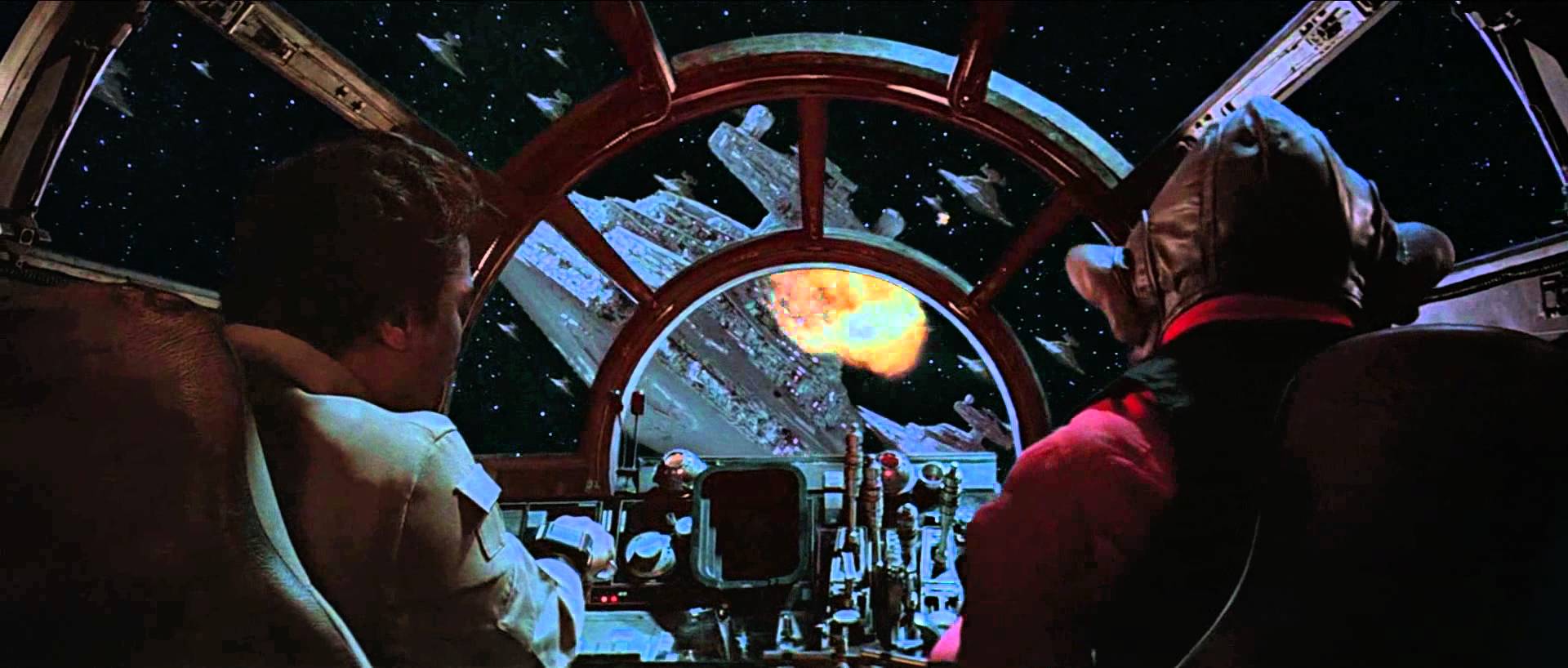
Star Wars: The Force Awakens Isn’t Really A Remake Of A New Hope

force awakens

Every so often, a fan theory comes along to remind us how good fan theories can actually be when the work and time is put into them. Less than a year ago, EC Henry composed what I believe to be a masterful breakdown of The Force Awakens that (dare I say it) makes the movie just a little bit better.

Is Star Wars: The Force Awakens a remake of the original Star Wars (A New Hope)? I’ve always considered the movie to borrow voraciously from that original film, while also lifting plenty from the other two parts of the trilogy. But many reviewers like myself have talked ourselves breathless about how TFA features yet another “droid on the run” story with Death Stars, cantinas, and a modest chosen one.

But in EC Henry’s video essay below, the case is made that TFA is really a “creative remix” of the original trilogy, and there’s a strikingly good reason for this that might shed light on the future of the entire franchise. I’ll unpack the theory below (with some of my own observations), but here’s the quick 3-minute breakdown.

As EC Henry points out, nearly all of the similarities between TFA and A New Hope occur in the first act of both movies. BB-8’s story is parallel to R2D2’s, and we’re on a barren planet that slowly reveals our hero, Rey, who is reminiscent of Luke in some ways.

The Millennium Falcon departing Jakku, followed by meeting Han Solo and Chewbacca, is where the first act in TFA ends (roughly), which mirrors the end of the first act in A New Hope, when Luke meets Han and departs Tatooine aboard the same ship. Henry also implies that Greedo and Han’s antagonism is mirrored with Han’s confrontation with the mercenaries aboard the freighter.

At this point, TFA’s second act starts to mirror the second half of The Empire Strikes Back. There’s a monster-in-space encounter (Rathtars in place of the asteroid worm) followed by Han deciding to visit an old friend (Maz Kanata as a fill-in for Lando Calrissian). We also see Kylo contacting Snoke in the same way Vader contacts Palpatine.

To save for time, TFA converges the Luke/Dagobah subplot with the Cloud City subplot. Rey goes to a mysterious planet and learns more about her origins and destiny with Maz pulling double duty as a fill-in for Yoda. And just like in Empire, the villains show up to wreck things. Rey is defeated by Kylo Ren (a la Luke and Vader’s first fight) and is captured, similar to how Han is taken away by Boba Fett.

force awakens

From here, TFA mirrors the third act of Return of the Jedi. The Rebels/Resistance meet to discuss their rescue plan and discover “another Deathstar.” The story breaks in two with ground forces on Starkiller Base trying to break down the shields and Rogue Squadron attacking from space, just as the Battle of Endor had two fronts. There’s an epic lightsaber battle happening as the space assault reaches its climax, with the Jedi using fury to overwhelm the Sith (Rey slicing Kylo is quite similar to Luke taking down Vader).

As Henry also points out, there are exceptions to this where small elements of the original trilogy are mirrored throughout (the catwalk scene, for example), but there certainly seems to be a primary structure in place that combines all of the movies in a coherent way. But what’s the point? Why would Lucasfilm do a creative remix like this at all?

The expectations for TFA were always going to be astronomically high, so the strategy here makes some sense. Add all of the nostalgic fan service to TFA as a tribute in order to gain credibility for this new trilogy, so the next two movies can unfold in more creatively bold ways that aren’t enslaved to the source material. Put more simply: they started with a look at the past and ended with a strong look toward the future.

And in one strange way, TFA is basically the movie George Lucas intended to make in the 1970s. Rather than a trilogy, he envisioned the entire arc of Star Wars to be told in a single movie. TFA essentially fulfills that vision and authorial intent, so as someone who had a lot of problems with the film, I’m finding myself appreciating it more for what it manages to accomplish in light of what couldn’t have been done 40 years ago.

Did I miss anything? Add some of your own observations below. And if you like this essay, be sure to subscribe to EC Henry’s channel, and consider supporting him on Patreon for more great videos.


Thanks for reading this. Seriously. You can subscribe to my posts by clicking “Follow” in the right sidebar. 

Or just say hello on Twitter: @@jonnegroni

Kong: Skull Island and Samurai Jack Review – Cinemaholics

On an all-new Cinemaholics, Will Ashton and I review Kong: Skull Island, the second entry in Legendary’s “MonsterVerse” after 2014’s Godzilla, and Samurai Jack Season 5, the Adult Swim short series that will finally wrap up one of the greatest animated shows in a lifetime. We also take a look at some other shows and a comedy special later in the episode.

YOU TELL US: Does Kong: Skull Island deserve to be #1 at the box office over Logan? Comment below or email us, cinemaholicspodcast [at] gmail.com. You might just hear your email read next week…

Go on…Kong: Skull Island and Samurai Jack Review – Cinemaholics

Snarcasm: Carl From ‘Up’ Is Insane And So Are You

up

Snark + Sarcasm = what you’re about to read

Word of warning: if you tag me in a tweet promoting a fan theory you “wrote,” then expect the Snarcasm treatment in the most lighthearted way possible .

So here’s the background. Two years ago, SuperCarlinBros did a fan theory video about Pixar’s Up that proposed Carl Fredricksen is “insane” for reasons that sound anything but. It’s an amusing video from a couple of good friends of mine, which is why it’s strange to see the theory popping up again…from someone else.

Jonathan Sim, a different writer, tagged me in his own write-up for a theory he didn’t write, but instead rewrote with credit to the SuperCarlinBros. Now that this is in written form and it’s coming out while this column is a thing, we get to dive into why the “Insane Carl Theory” is…well, to say it’s insane is giving it at least a little credit.

What if I told you that Carl Fredericksen was actually insane and this movie was a figment of his imagination?

I’d tell you that it’s spelled “Fredricksen.” Then I’d tell you that at least 20 million “fan theorists” have been speculating that any given piece of fiction is “in someone’s head” since Descarte.

So, we start off this theory with that scene in Up where Carl assaults a man with his cane.

It’s a walker with tennis balls, but alright.

This is assault and battery as the man is later seen with blood on his forehead. And we later see Carl in a courtroom. And they sentence him to…a nursing home?

We’re not about to have a discussion about legal precedent are we—

Doesn’t it seem strange that this old man has committed what can be considered third degree assault and battery and his sentence is a nursing home?

Well, no, if we use our thinking caps. As you state, this is third degree battery, which is a misdemeanor. As in, not a felony. Most states will either put you in jail for 30 days and/or make you pay a $500 fine. Depends on the judge, though.

Now, let’s look at the situation Carl is in. This is, by all reasonable accounts, his first offense ever. In addition, a huge corporation has a clear stake in getting him out of his house. So we can surmise from the wordless court scene that BnL’s lawyers have arranged to make a deal that forces Carl to stay at a retirement home so that they can bulldoze his house. We even hear from the police officer in the next scene say that Carl doesn’t seem like a “public menace,” likely referencing the arguments made to kick him out.

You could also consider that Carl doesn’t have the money to pay the fine (he’s a balloon salesman, after all), but the state would rather put him in a retirement home than jail because of his age and the fact that he lives alone. This seems like a pretty logical ruling from a judge who has to sentence an old man without a criminal record.

I mean, he should honestly just receive a jail sentence or something like that. But a nursing home is not legitimate.

Let’s not pretend nursing homes don’t exist as punishments.

So, Carl actually was sentenced to a prison.

Wait, what? No he wasn’t?

And when this happened, he had lost everything. He lost his wife, his freedom, and now, he loses his mental health.

Um…no? The police officer told him that the retirement folks would pick him up in the morning. Where exactly does his mental health collapse for you? And why are you convinced he’s gone insane in the first place, just because he’s sad? Is that your only criteria?

What Carl then does next is absolutely impossible: he lifts up his house with balloons.

At this point, that seems way more plausible than what you’re suggesting.

Well, first off, that would mean he was a really bad balloon salesman.

Oh, I get it. Jonathan is just joking with us. Right?

Right?

Second, according to production notes from the film,

No, no, no, hold up and don’t you dare switch the topic. Carl is a bad balloon salesman? How does that…what? Because…he has a bunch of balloons? That means he’s bad…at selling them..but he’s retired…

WHO ARE YOU?

So, in one night, we’re expected to believe Carl had the stamina and physical ability to fill that many balloons with helium?

No, we’re expected to believe he already had those balloons ready to inflate and finish tying up, secretly. Remember, he and Ellie were planning on taking the house to Paradise Falls, hence the drawing of the house…on Paradise Falls. But they never did because she got sick, and the point of this next scene is to show that Carl’s willing to embark on the adventure they always dreamed of, but he’s not really alone because Ellie is the house and—

Oh sorry, you were saying?

He can’t even walk down the stairs without his machine.

Right. That means all the other times he’s running around and attacking construction workers were all a hoax. Which part of the movie is “in his head” again?

And not only that, but lifting a house with 10,297 balloons is not possible.

Neither is having a head shaped like a perfect rectangle, but you don’t question that for some reason.

Up co-director Pete Docter recently told Ballooning magazine

Recently? You mean in 2009?

that technician Pixar estimated

Who is technician Pixar?

it would take 23.5 million party balloons to lift a 1,800-square-foot house like Carl’s.

The funny thing is that in this same article, they point out that if the house did have enough balloons to lift the house, it would shoot off like a rocket rather than leisurely float away. So Pete Docter’s idea here never would have worked in the real world, but they went with it anyway because they like to dream big. Which doesn’t mean Carl’s dreaming big, an argument that Jonathan (both of them) haven’t even gotten to defending yet.

And then, when he is on his way there, he finds a child on his doorstep.

Thank goodness for babiesovernight.com.

He and Ellie never got to have children in their lives, and this crazy dream sequence (or you can call it heaven if you want) is giving him everything that he didn’t have before.

Let’s break this down. First, Jonathan just sneaks in yet another fan theory about Up that suggests Carl is dead the whole time. Which has been debunked by almost everybody because it’s such an overused fan theory that no one cares anymore.

Second, why would Carl be dreaming of a kid he’s already met? And that he hates? And if the kid represents what he wants in life, why does he try to get rid of the kid throughout the entire movie?

Carl and Ellie grew up loving adventurers and exploring and this kid shows up at the door, who loves adventuring and exploring and would be an ideal, perfect child for Carl and Ellie. 

Thanks, IMDB.

But that’s not the main reason why I don’t buy this.

Don’t buy what? You don’t believe what you just said?

See, Russell said that he saw a snipe (a type of bird) and chased it under his porch. However, that was when Carl lifted up his house and he remained on the house.

You don’t see Russell either, but you know he’s still there. Also, you know, birds fly.

I don’t see how it would be possible to get under that porch, and when he noticed the house lifting up, why would his immediate response be to grab on? It doesn’t make sense, and therefore, Carl’s mind is simply creating this vision for him.

Russell didn’t “grab on,” he clearly was hiding in fright. We don’t see him because the filmmakers wanted to keep his presence a surprise. We would have been distracted if Russell had been shown. This is a plot hole in the movie, not a definitive piece of evidence that Carl is imagining the whole movie.

The only kid that gets into Carl’s house is the kid that somehow knows how to get from the United States to South America, navigating with a house he’s not familiar with steering.

He uses his GPS to navigate. And he’s steering a floating house, not a B52. Movie logic aside, the nonsensical premise of Up is deliberate. To suggest that it’s all a fabrication is pointless,  because the movie is already a fabrication.

There is a scene in which Carl tries to drop Russell into the street by suspending him with a rope while about six stories off the ground. Carl then drops Russell into the street by accident, but in the next scene, he shows up in Carl’s house again, completely unharmed without a single scratch.

Jonathan…did you watch the movie? Because…Jonathan, if you watched the movie you’d know that this happened IN AN ACTUAL DREAM SEQUENCE CARL WAS HAVING.

See, Carl was considering dropping off Russell, but he DREAMED the scenario and realized it would harm Russell.

And we also have the character of Kevin.

Oh, don’t you even dare bring Kevin into this.

when we first meet Ellie as a child, we can’t really tell whether or not she is a male or female.

Yes you can? True, she’s a tomboy and it might not be immediately clear to everyone, but it doesn’t take long.

Russell names the bird Kevin (a male name), but we find out at the end of the movie that she is a female, as she gives birth.

You’re not about to say Ellie is the bird, are you? She’s already the house, mate.

To add on, Kevin can have kids, but Ellie had a miscarriage.

(Voice of Buzz Lightyear) Themes! Themes everywhere!

And right when Carl lands in Paradise Falls, he meets his childhood hero: Charles Muntz.

…who is the inspiration for why Carl wants to go to Paradise Falls in the first place.

Muntz is 92 years old during the main events of the film and though there are people who live up to 92 years old, he cannot be this impressive.

Why not? We see him struggle in his fight with Carl later on, so it’s not like he’s the pinnacle of health. Wouldn’t a life of living off the land make him hardier?

Anyway, it doesn’t matter because a dropped plot point of the movie is that Muntz’s age was slowed down by Kevin’s eggs, explaining how he’s still alive at such an old age.

He is living in the jungle with no healthcare, no way to treat any possible diseases, and not a lot of food.

OK, this is actually offensive. You do realize that people in other countries who have no modern medicine are still able to live a long time, right? And he lives on a zeppelin with tons of food shown onscreen, because his dogs take care of him.

And there is also the fact that when Carl points out a skeleton of a giant Somalian leopard tortoise, Muntz says, “I found it on safari with Roosevelt.

Here we go.

There are two likely Roosevelts that he was talking about: Franklin D. Roosevelt and Theodore Roosevelt.

To even suggest it was FDR is laughable, but go on.

Now, Theodore Roosevelt wouldn’t really make sense because Muntz was born in 1911 and Roosevelt died in 1919. That would mean that the oldest he could have been while hanging out with Roosevelt is eight years old and apparently, Roosevelt was going on safari and cheating at gin rummy games with eight year old kids.

Technically, Charles could have been a child on safari exaggerating his role. And kids are certainly capable of playing card games. But the more likely explanation is that Charles went on safari with Roosevelt’s son, Kermit Roosevelt, who was also an adventurer who actually went on African safaris.

OK, now hopefully Jonathan will reveal all of the evidence pertaining to Carl’s mental health by—

This means Carl was either insane, or, as other theories have said, he could have died and this may simply be his ascend to heaven. Russell, Kevin, and Dug are all just in his imagination.

That’s it? That’s the whole thing? This entire fan theory is just one argument over and over again: the movie is a bit silly, so that means it’s a dream.

This isn’t a fan theory, it’s a fan guess. And not a good one at that. There’s nothing about how Carl does actually have some clear psychological problems with thinking his wife is a house and how his attachments clearly blind him to reality over the course of the film. But rather than address anything like that, Jonathan just tells us it’s all a dream because movies aren’t real. Or something.

So in a way, doesn’t this mean we’re all insane for believing them?


Thanks for reading this. Seriously. You can subscribe to my posts by clicking “Follow” in the right sidebar. 

Or just say hello on Twitter: @JonNegroni


Get Out, Rock Dog, & A United Kingdom Review – Cinemaholics

In my new weekly podcast, Cinemaholics, co-host Will Ashton and I finally reviewed Get Out, along with I Don’t Feel At Home In This World AnymoreRock DogFences and A United Kingdom.

We also talked about the Razzies, some news coming out of the DCEU’s Batman and Nightwing movies, and our own version of the Oscars, where we picked our own winners in our own ceremony. Obviously.

Go on…Get Out, Rock Dog, & A United Kingdom Review – Cinemaholics

The Top 5 ‘Best Picture’ Winners Of All Time – Now Conspiring

best picture

In honor of the Oscars, Now Conspiring shares their favorite movies that have taken home the golden statue for Best Picture. Before we mention our top five picks, we find out where Adonis has been hiding and why Sam has beef with Bridget. We switched this week from playing Would You Rather to chatting quickly about some foreign films we have recently watched.

Question of the Week: What is your favorite Academy Awards Best Picture winner? Also, if you have any foreign film recommendations, let us know!

Go on…The Top 5 ‘Best Picture’ Winners Of All Time – Now Conspiring

Logan, The Great Wall, Fist Fight Review – Cinemaholics

This week on Cinemaholics, Will and I review Logan, the latest “X-Man” movie starring Hugh Jackman. Don’t worry, no spoilers here. We also reviewed The Great Wall and Fist Fight, along with some new TV shows like Crashing on HBO and The Good Fight on CBS. Finally, we covered some of the latest movie news this week, and this episode features special guest Matt Donato.

Be sure to email cinemaholicspodcast [at] gmail.com to submit any and all feedback. You might hear your email read on next week’s show!

Go on…Logan, The Great Wall, Fist Fight Review – Cinemaholics

‘Batman v Superman’ Is Better Than ‘Civil War’ Because Whatever – Snarcasm

batman v superman

Snark + sarcasm = what you’re about to read

Hey superhero fans and all-time purveyors of basic logic! I’ve got a twister for you. Did you know that  with just a few baseless assertions and false equivalency arguments, you can decide for everyone else that a truly terrible movie is better than a pretty good one?

Welcome the internet! And also the inner workings of this summer’s ultimate contrarian, Donnia, who wrote this little number on Fansided:

Batman v Superman Is Actually A Better Movie Than Civil War

You heard it here first. And for good reason.

Now, I’m all for taking a close, critical look at Captain America: Civil War, an entertaining film that doesn’t fully succeed at being anything extraordinary beyond what we’ve already seen of the MCU. It’s pretty good and an easy recommend, but it can be picked apart just as easily as any other Marvel film.

Batman v Superman, on the other hand, is a glorious misfire as one of recent film history’s most obvious examples of style over substance. Still, the movie has its fans who declare it to be an underrated masterpiece, in some part (I suspect) because they’re displacing the earned love they have for DC onto this neat-looking, but thematically hollow, fan film by Zack Snyder. It’s not without its high points (a great Batman aside from sociopathic tendencies and pretty much everything Gal Gadot does aside from opening emails). But to say it’s better than Civil War is a such a non-starter piece of hot-take nonsense, I can’t wait to share it with you.

Despite what many think, Captain America: Civil War really isn’t a good movie,

“Sorry legions of people who have the exact opposite opinion, including film critics, fans, and experts in this industry. I’m smarter than you!”

but Batman v Superman: Dawn of Justice is.

I’ll give Donnia some credit here for at least eliminating the pretense that she considers film analysis subjective.

That’s right, folks: you read the title correctly.

Yup, so sit back and breathe in the “pretty much clickbait.”

If you dare to have this unpopular opinion, you’re sure to be bombarded with reasons as to why Captain America: Civil War is apparently the better film

Right, it’s almost as if people use reasons to articulate their observations. Next you’re going to get mad at them using examples and evidence.

But the truth is that both of these movies hit the same beats to the same effect but for some reason, Civil War is praised for it while Batman v Superman is criticized. And the question is: why?

False premise alert! Donnia is putting opinions into our heads, claiming that the reason people disliked Batman v Superman as a set up, not an execution. Which means if I liked Mission Impossible: Rogue Nation but disliked Spy Kids 3D, then obviously it was because I have a double standard for the genre. Obviously.

I enjoyed Batman v Superman.

You don’t say.

When critics panned the movie for being poorly edited, poorly paced and basically a massive failure of a superhero film, I was discouraged to say the least.

You shouldn’t be, and for one simple reason: Liking a bad movie is fine. People do it all the time. That’s why they’re called guilty pleasures.

I couldn’t put my finger on it, but I knew there was something strange about the film when I first saw it. It wasn’t a bad feeling, but I knew that the film didn’t feel like what a superhero film usually feels like.

Was this before or after Jesse Eisenberg shoved a Jolly Rancher into an old dude’s mouth?

It didn’t look like it either, and that’s when it hit me—Batman v Superman didn’t follow the formulaic superhero narrative that we’re used to seeing.

False premise alert! Donnia is slipping into a quick, no-big-deal conclusion that we’re apparently used to seeing formulaic superhero narratives in our movies. This is important because instead of establishing this as a problem, she jumps ahead to the part where Batman v Superman solves it. Tell us more!

we all know that the MCU has and will continue to release a million movies and we flock to see all of them.

Everyone is terrible, yeah.

The MCU follows a very specific blueprint, as if it’s not obvious by this point.

“So obvious, I don’t need to spell it out. I’m just right.”

Yeah, so, all movies follow blueprints, especially franchises. If you’re criticizing Marvel movies for having some common ambiguous…thing…then you have to say the same for Star Wars always involving Skywalkers or Indiana Jones always being about historical adventures (yawn!)

 the problem occurs when a movie like Batman v Superman comes along and is very different than what we’re used to seeing.

Being different isn’t always better, and Civil War is actually a great example of that. Despite what you may think, Donnia, that movie isn’t a lot like any of the other Marvel movies. In fact, plenty of Marvel movies have been completely different from each other. Iron Man was an action comedy, Thor was a fantasy adventure, Captain America was a pulpy period action piece followed by a 70s-esque spy thriller in its sequel, Guardians of the Galaxy was a space opera comedy, and Ant-Man was a superhero heist movie.

And then there’s Civil War, which was a superhero teamup fight movie where the bad guy (spoiler alert) actually wins in the end. So how is Civil War formulaic again?

We’ve unknowingly set expectations for what we think a superhero movie should be that we reject when one tries to be different.

Nope. We just reject bad movies. Simply being different isn’t enough merit to warrant getting a pass, for the same reason a lot of people wanted to write off Ant-Man long before it was released because it was being heralded as something different.

And how exactly is Batman v Superman all that different from typical superhero movies, aside from having Snyder’s particular visual flair we’ve seen many times since 300?

Batman v Superman isn’t poorly edited or paced, it intentionally edited to be like a comic book.

Pack it up, everyone, the medium has officially stopped being the message.

Look, there’s nothing wrong with trying to make a movie match the experience of a comic book story. It’s been done successfully in the past with movies like Scott Pilgrim vs. The World, and done quite poorly with movies like Batman and Robin.

Pointing out that what they were going for was interesting in and of itself doesn’t negate the problem, which is that editing a movie too much like a scatterbrained paperback is a bad idea, mostly because comics usually have built in context continuity and are able to be digested in short bursts that rely on dramatized set pieces.

Movies are different, especially if they’re aiming to be over 3 hours long. They require cohesive visual editing that allow viewers to soak in the narrative and appreciate the characters, because unlike a comic, everything moves. And there’s sound. When you remove that cohesive visual editing, the “spectacles” onscreen that would look great on a comic ring hollow on the big screen.

 It was a radically experimental decision, and it did feel strange at first but once I realized what the film was doing, I loved it. How can I put a movie down for trying something different in an industry that always does the same thing?

Easily! For doing it poorly. Remember when I said style over substance? Yeah, I wasn’t just throwing around a cliche aimlessly for once. That directly applies here.

A common complaint about Batman v Superman is the “Martha” scene. That scene is just so horrible and laughable to many people and I don’t understand how they can mock that scene when the exact same thing happens ten minutes into Civil War. 

False…everything alert!

Bruce loses focus because Clark says his mother’s name and Steve loses focus because Crossbones says Bucky’s name.

And then Steve and Crossbones become best friends for life! Right?

Obviously the context of their names being said are different—

“But that huge difference in the scenes is not important or anything unless it makes my point stronger. Obviously.”

Look, the whole “Martha” thing has been talked to death in length elsewhere and on this very site, and honestly, I’m quite done with it. The main issue at this point is that this scene is so badly executed, everyone mocks it and willingly ignores the author’s intent. That’s a sign something went wrong here.

Another complaint towards Batman v Superman is the Doomsday fight…By taking the fight to an uninhabited island they’re preventing mass death.

That’s not the complaint at all. The complaint is more an aside (and not even one of the movie’s most annoying flaws) regarding how ham-fisted the line is when they say, “Oh, and that island is inhabited! WINK WINK.” We point it out because it’s moments like these that take the viewer out of the movie, because you consistently have to be told by the filmmakers that this isn’t Man of Steel. Oh, how I wish this movie had been Man of Steel.

Civil War does the same thing when Cap’s team and Iron Man’s team fight in an empty airport and destroy it in the process. So why does Batman v Superman get criticized for the line that a government official makes when he says that he island is uninhabited but no one says a word when it’s stated that Tony evacuated the airport so that they could have their showdown?

Is this a real question? Because they evacuated the airport. It was a decision that made sense because they don’t want people to get hurt. With Doomsday, they practically flashed this on the screen as, “Oh, what a coincidence that Doomsday wants to duke it out on an abandoned island that’s abandoned because whatever. Now you can’t complain! Wait, I’m not supposed to say that part of the line that’s scribbled on the script in red ink?”

I don’t have a problem with how either movie handled these scenes but I can’t help but to feel some animosity towards Civil War because audiences and critics are so willing to give the film a pass for doing same thing that they criticized Batman v Superman for.